Opinion
Where are women in the post–mass uprising election?
The political structure and processes in Bangladesh remain predominantly patriarchal and under male control. The patriarchal society of Bangladesh does not favour women's participation in the country's political framework, resulting in low female representation at all levels of political parties. Selim Jahan explores where women stand in the upcoming elections.
After the July 2024 uprising, a question that emerged was, "Where are the women warriors of July?"
This question had context. During the July uprising, women were at the forefront of the struggle—leading, demanding, and visible. There is no doubt that women's participation was a significant catalyst in the success of the July movement.
Historically, this is not new in our country. In the 1971 Liberation War of Bangladesh, women fought shoulder to shoulder with men—directly on the battlefield and indirectly across the nation.
However, post-independence, neither their heroism nor their role in the liberation war was duly acknowledged.
Often, those women have only been portrayed as victims of the liberation war, not as warriors deserving of proper valuation. Consequently, post-independence, women were largely overlooked in various nation-rebuilding activities. No one considered them, nor thought of utilising their capabilities.
The primary reason is that the political structure and processes in Bangladesh are still predominantly male-dominated and controlled by men. The patriarchal society does not wish for women to participate in the political structure of the country, resulting in lower female representation across all levels of political parties.
Eighteen months after the July uprising, Bangladesh is now preparing for a fair and participatory national election as part of its democratic journey.
The foundation of the July movement was the establishment of a non-discriminatory Bangladesh and the creation of an equal society. With this aim, Bangladesh is moving towards a participatory and fair election to form a democratic government.
In this context, again the question arises, "Where are the women in the elections today?"
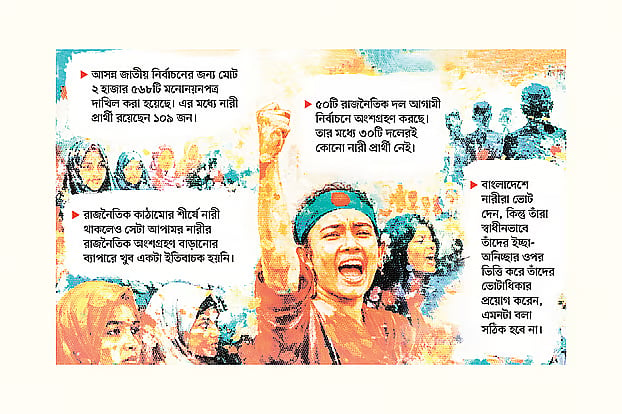
There is a justifiable reason for raising this question. According to media reports, a total of 2,568 nomination papers have been filed for the upcoming national elections. Among these, there are 109 female candidates, which is only 4.2 per cent of the total candidates.
Among these female candidates, 72 are party-nominated and 37 are independent. This means, out of every three female candidates, one does not have any party backing.
Politically, 50 political parties in Bangladesh are participating in the upcoming elections. Thirty of these parties have no female candidates, meaning three-fifths of the political parties in the country have not fielded a single female candidate.
More than half of Bangladesh's total population is female. In this situation, it is unfortunate that these 30 parties did not find even one qualified woman to nominate as a candidate.
Naturally, questions arise: Has an implicit hostility towards women and discrimination against them played a role here?
Among the parties that have fielded female candidates, Bangladesh Nationalist Party (BNP) and the Marxist Bangladesh Socialist Party (BSP) top the list with only 10 female candidates each.
It is highly regrettable that a major grassroots-embedded political party like BNP could not or did not include more than 10 female candidates (merely 3 per cent) out of its 328 candidates.
Nine political parties in the country have nominated only one female candidate each. The National Citizen Party (NCP), which emerged from the July 2024 uprising, selected only three female candidates out of its 44 nominees, despite being born in the context of an anti-discrimination movement.
Notably, among the 279 candidates of Jamaat-e-Islami, one of the major political parties in the country, there is not a single female candidate. What message is this party trying to convey?
Recently, several female leaders of the NCP have resigned, citing their discomfort with Jamaat's policies and stance towards women, following the party's alliance with Jamaat.
Moreover, political parties had reached a consensus regarding the elections, pledging that a minimum of 5 per cent of their candidates would be women. It now seems that most political parties have broken this commitment.
Secondly, according to the Representation of the People Order of the country, political parties were supposed to ensure at least 33 per cent female representation in their councils at all levels by 2020. Failing to meet this requirement, the deadline was extended to 2030. Although exact data is unavailable, it seems unlikely that this target has been achieved.
What are the reasons behind this unfortunate picture?
The primary reason is that the political structure and processes in Bangladesh are still predominantly male-dominated and controlled by men. The patriarchal society does not wish for women to participate in the political structure of the country, resulting in lower female representation across all levels of political parties.
In essence, women's presence in the political arena is minimal, and the number of women actively engaged in politics in Bangladesh is limited.
Consequently, fewer women run as candidates, participate in rallies, or campaign during elections. Society is not accustomed to seeing women in these roles. Furthermore, the traditional use of muscle power in elections in Bangladesh does not encourage women to run as candidates.
For women, it is challenging to fund their campaigns, mobilise manpower, or even gather financial support if they are party candidates. Additionally, the spread of "mobocracy" in recent times has discouraged women from running for office. Many women prefer to contest in reserved seats instead.
This is a reserved system and goes against women's competitive political capabilities.
Despite this backdrop, it remains true that for three decades, women have been at the helm of the two most prominent political parties in Bangladesh, and during this period, they took turns serving as the country's head of government.
However, this remained confined to the top level of the political framework and did not significantly impact the reality of women's participation or representation at the grassroots or mid-levels.
Moreover, during their leadership or tenure as prime ministers, they did not take any extensive direct incentivising measures in this regard.
Therefore, even though women are at the top of the collective political structure, it seems their presence has not contributed positively to increasing the overall political participation of women.
Historically, there has not been a significant presence of women participating in rallies or campaigns in support of any candidate during elections in Bangladesh.
The male-dominated society also does not look favourably upon women's participation in election activities. Although women vote, many do not exercise their voting rights based on their preferences.
Household males dictate whom or which symbol they should vote for, giving women little opportunity to use their judgment and discretion in casting their votes.
Consequently, the best answer to the question of where women stand in Bangladesh's elections is that they remain in the position where the patriarchal society wants them to be.
If this circle cannot be broken, elections will come and go, but the women of this country will remain in their male-designated places. Breaking this circle is not just the responsibility of women, but of all of us.
#Selim Jahan is former Director, Human Development Report Office and Poverty Eradication Division, United Nations Development Programme.
*The opinions expressed are the author's own.
#This article, originally published in print and online editions, has been rewritten in English by Rabiul Islam