The Welfare Mandate: How bread-and-butter politics delivered BNP's historic 2026 victory
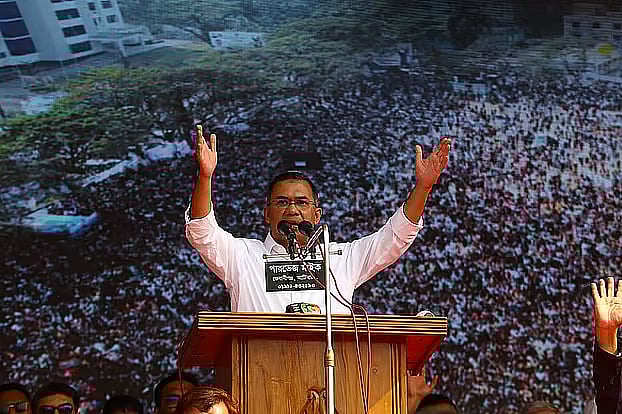
The dust settled on the watershed of the 2026 Bangladesh national election, and the figures paint a narrative that many traditional analysts would not have dreamed of. Bangladesh Nationalist Party (BNP) has secured a nationwide mandate with a supermajority of 212 seats in the Jatiya Sangsad and is poised to form a new government. The short-term temptation of the political intelligentsia is to interpret this election as an ideological victory of the purest sort, a physical repudiation of the legacy of Awami League and an all-out, all-up embrace of the centre-right nationalism of the BNP.
But a more detailed examination of the mechanics of this triumph and the 59 per cent turnout reported by the Election Commission is an indication of a different, more utilitarian fact. BNP did not merely win the ideological war; they did a masterpiece of new welfarism. The politics of the kitchen table were successfully transformed by BNP into a post-uprising political environment that was still tainted by inflation and economic nervousness.
To understand the sheer scale of the BNP’s landslide, one must look beyond the campaign rallies and examine the party’s manifesto. The cornerstone of their campaign was not a lofty constitutional promise but a highly targeted socioeconomic safety net. The pledge of a "family card" for low-income households, subsidised rations, unemployment benefits for youth, and specific financial support for disabled citizens fundamentally altered the electoral arithmetic.
By weaponising welfare, BNP successfully built a direct, transactional connection with the most vulnerable layers of the electorate, circumventing the more traditional political elites and establishing this connection with the most vulnerable segments of the electorate. It is not an entirely new strategy; it is borrowed directly from the playbooks of contemporary and powerful political machineries around the world.
One only needs to look at its neighbour, India. Although the ruling Bharatiya Janata Party (BJP) has earned the international observers' accolades for attributing the electoral hegemony of such a party to its ideological nationalism, it is actually strategic welfarism that has been the powerful anchor of the party. BJP has achieved a huge, loyal base of labharthis (beneficiaries) by the direct provision of benefits such as subsidised cooking gas and sanitation facilities, as well as direct cash transfers. The BNP has seemingly come to the realisation that in South Asia today, a nationalistic storyline, coupled with violent and left-wing economic attacks, is the final recipe for a winner.
This welfare-orientated mindset is also the reason for the strategic failure of the opposition bloc. Bangladesh Jamaat-e-Islami, the main opposition, misinterpreted the immediate hierarchy of the electorate's needs. Jamaat conducted a highly anti-fascist, structural reformist, and ideologically pure campaign. Although these themes were undeniably moving during the July 2024 uprising, in 2026, when voters were exhausted by a weak transition economy, they demanded economic confidence more than systemic transformation. Jamaat never came up with a serious counteroffer to the BNP family cards and unemployment schemes, effectively giving the economic point away. However, ideology does not guarantee success.
Additionally, the welfare agenda of BNP included a significant gendered aspect that played a decisive role. Welfare programmes that allocate resources directly to women in developing democracies (who are often presented as the economic breadwinners of the house) are likely to produce enormous electoral payoffs. Focusing on women's development and guaranteeing improvements to the household economy helped BNP gain a silent but important group of female voters. This strategy of deliberately avoiding the patriarchal patronage networks that typically influence rural voting blocs allowed BNP to directly reach voters as a provider.
This transition is of a deep scholarly tone. In 2026, the electorate in Bangladesh will witness the shift of a completely emotive voting block to a highly rational interest-based electorate. A turnout of 59 percent indicates a calculating electorate that considered its choice and voted for the party that would bring the most solid payoff on their ballot. This indicates that the electorate is no longer willing to cast their votes based solely on historical sentiment; they now expect a tangible return on their democratic investment.
However, winning an election through welfare populism is not the same as governing successfully. The BNP has fundamentally redefined the social contract in Bangladesh, elevating the people's expectations to unprecedented levels. Fiscal reality is the challenge that the incoming administration is facing now. To meet the important financial needs of family cards, disability supports, and unemployment programs in a recovering economy, careful economic changes and a tough stance on corruption will be necessary.
So far, BNP has demonstrated that economic security is the strongest political ideology in the contemporary democratic sphere. The BNP has led the debate on welfare issues. The real test of whether their rule was good or detrimental will be whether the state's coffers can pay the bill.
* Arman Ahmed is founder & president, DhakaThinks; Research Analyst, Nicholas Spykman International Center; Research Fellow, ICHRPP
* The views expressed here are the writer's own