Opinion
July Charter, much ado about nothing?
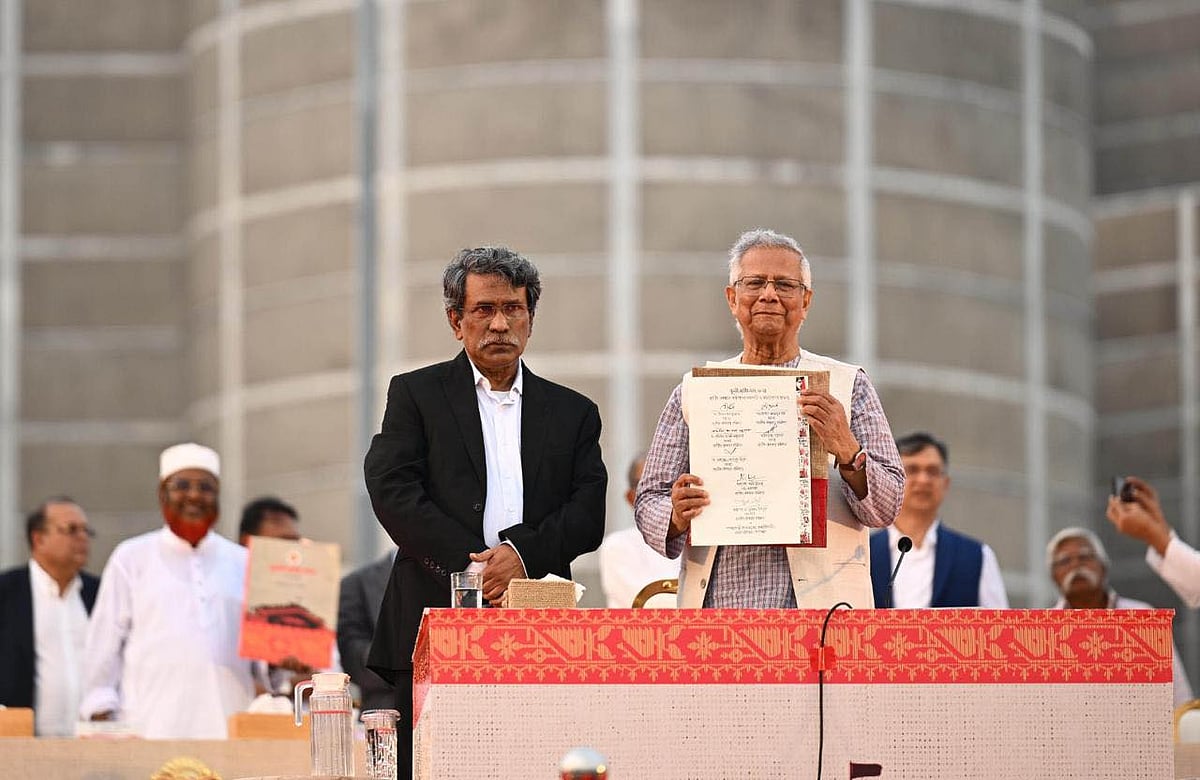
Almost all parties have signed the July Charter. Only those young people whom the Yunus government had sought to pacify by initiating reforms and the charter did not sign. They have remained restive so far. Still, after the signing ceremony, there is a general sense of relief for almost everyone. There is now no obstacle to going to elections.
Over the past year, a lot of effort has gone into the July Charter. It felt as if, without creating this “Magna Carta,” our elections, government, and politics would all grind to a halt.
For us common people, keeping track of all nitty-gritty details in the provisions and sub-provisions of the charter, had become difficult. However, from the summaries presented by the media, three key phases of the charter’s process have come to everyone’s attention:
1. Arguments and dissent over what would be written in the charter.
2. Debates over how the charter would be adopted.
3. Haggling over who would sign the charter and who would not.
All three phases were quite entertaining. One day someone would be in favour; the next day they would switch sides; and then they would be persuaded and brought into line again.
BNP leaders said, “The charter will be made by the people’s parliament. Who in this government will make the charter?” They added some “dissent” points in red ink and signed in black ink.
The Islamic parties had resisted all this time. No charter without PR, they declared. But they too have now signed. The only problem remaining is with the NCP. They have completely sealed their pens. Space has been left in the charter for their signatures, and they can sign at any time.
Politicians, in trying to control the charter for themselves, have made it quite cumbersome. The commission has proposed 84 reforms, but it is hard to understand which ones will bring real benefit.
For example, it seems unlikely that the Upper House will serve any purpose other than burdening the parliament. Political scientist Rounaq Jahan expressed the same view at a CPD meeting. Here one may ask a question—why didn’t the Reform Commission consult experts before drafting the charter?
Of course, there are some good things in the charter. At the very least, their headings sound promising. For example, national elections under a neutral government. But how “neutral” will the charter’s recipe for a “neutral” government actually be? As the English saying goes, “The devil is in the details.”
In 1984, Walter Mondale was the Democratic Party’s presidential candidate in the United States. He mocked his rival’s electoral promises by borrowing from a hamburger company advertisement and asked, “Where’s the beef?” meaning, it’s just the bun, where’s the meat?
Since then, the phrase has surfaced in one form or another in every election. In our country, we now have a charter within a charter, but what’s actually inside it? Is there really any “meat”? “Where’s the beef?”
Let us try to understand to what extent the charter will ensure a neutral government during the election period!
The 16th clause of the charter deals with the caretaker government system. To understand this in a bit more detail, one day I called a member of the National Consensus Commission. He is an extremely courteous person. I had only wanted to ask about the neutral government. He patiently explained what the Consensus Commission intends to finalise regarding the neutral government and also clearly stated the limits of their authority.
I asked him, how neutral will this system really be? He did not answer directly. He only said that there is a review petition in the Appellate Division of the Supreme Court against the annulment of the 13th Amendment.
If the Appellate Court reinstates the 13th Amendment, then, as before, the Chief Advisor of the election-time government will be the most recently retired judge of the Supreme Court. I felt somewhat reassured.
During Sheikh Hasina’s tenure, the Appellate Division had annulled the 13th Amendment and ordered the caretaker government system to be abolished. On June 30, 2011, the Awami League government passed the 15th Amendment in the National Parliament, thereby abolishing the caretaker government system.
In December 2024, a High Court bench partially annulled the 15th Amendment. The portion that was annulled has paved the way for the caretaker government system during elections (13th Amendment) to be reinstated in the country’s constitution; however, the review petition against the annulment of the 13th Amendment must also be resolved.
The review petition is awaiting hearing in the Appellate Division. The petition was filed by the secretary general SUJAN, Badiul Alam Majumdar, who is now a member of the Consensus Commission. If the Appellate Division rules in favour of the petitioner, the caretaker government system will be reinstated.
It may be noted that before its annulment, under the Caretaker Government Act, the Chief Advisor of the election-time government was the most recently retired judge of the Supreme Court.
The Charter’s neutral government
Regarding a neutral government during elections, Clause 14 of the charter states that new elections will be held within 90 days of the current parliament’s term ending. Before the government’s term expires, a selection committee will be formed to choose the “Chief Advisor of the Caretaker Government during elections.” This committee will include: 1. the Prime Minister, 2. the Leader of the Opposition, 3. the Speaker, 4. the Deputy Speaker (from the opposition), and 5. a representative of the second-largest opposition party in parliament.
If the committee fails to select the Chief Advisor, the charter provides several alternative arrangements. These alternatives are even more complex than one another
The way the Constitutional Reform Commission has designed the neutral government appointment process, it can be said that politicians themselves will determine who will enter the caretaker government.
The charter further states that the committee will invite proposals for names of individuals qualified to serve as advisors to the caretaker government, as described in Article 58G of the constitution, from registered political parties, parliamentary political parties, and independent members of the National Parliament. The committee will select one person as the Chief Advisor of the caretaker government, who will then be appointed by the President.
There is also much drama around the shortlist of nominees. The ruling party will nominate five individuals; the opposition party will select one from them for the shortlist. Likewise, from five nominees of the opposition, the ruling party will select one. Ultimately, at least four of the five committee members will vote to elect the final Chief Advisor from the shortlist.
Even with this complex process, can a truly neutral head of government be found? The nominated person will be chosen by elected representatives who are politicians, selected by a committee of politicians, so perhaps one of them will become the head of our “neutral” government.
If the committee fails to select the Chief Advisor, the charter provides several alternative arrangements. These alternatives are even more complex than one another. But the objective is the same, to keep all powers to select the Chief Advisor of the caretaker government in the hands of elected political representatives.
Questions will remain about how neutral the nominated head of the caretaker government will be. Many will hope that the 13th Amendment be reinstated by a court ruling and that a retired judge will serve as the Chief Adviser during elections.
For 90 days during the election period, the administration should remain free from political influence, as it was during the tenure of Justice Shahabuddin.
Former Prime Minister Sheikh Hasina, when abolishing the caretaker government system, argued that “the country will not be run by an unelected government even for a single day, and even during elections the country will be governed by elected representatives.”
Now, the drafters and signatories of our charter can proudly say that during elections, the country will be governed by a Chief Advisor appointed by elected representatives. Many will see little difference between these two situations. Using the charter, politicians themselves will determine who will oversee the elections, they will nominate their own people, and one among them will become the “neutral” Chief Advisor. For this reason, the entire charter seems be much ado about nothing.
* Saleh Uddin Ahmed is a writer and political analyst. He may be reached at salehpublic711@gmail.com
* The views expressed here are the writer's own.