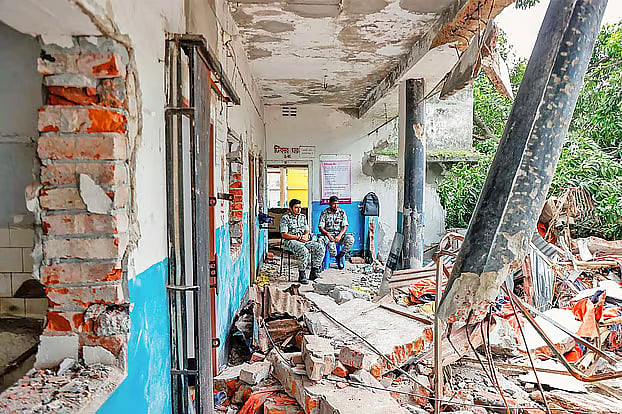
Should we consider the demolition of the health centre in Mirpur a “red line” when viewed through two considerations, the deterioration of law and order and the extent of people’s sense of insecurity?
People feel safe when they believe that the state will stand by them in times of danger. And that trust develops when they actually find the state standing by them. How does the state do this? If someone tries to forcibly occupy another person’s land, house or property, the state’s law-enforcement agencies intervene to stop them. Or if someone attempts to vandalise an institution, the police arrive, prevent the attack and take action against those responsible. But in Bangladesh, it seems that this system is no longer working. As a result, people are unable to feel safe in any meaningful sense.
There is ample reason to regard the late-night attack, looting and subsequent demolition of the entire facility with heavy machinery at the Mirpur healthcare centre (Radda MCH-FP Centre) as a red line. The incident has not only shaken the public’s sense of security but has also raised serious questions about the state’s capacity to enforce the law.
The organisation said that the police were informed when the attack took place. Although the police went to the scene, they were neither able to stop the attackers, nor could they protect the facility. Most significantly, strong allegations have emerged that people affiliated with the ruling party and a member of parliament, Ferdousi Ahmed Misty, were involved in the incident.
A series of other incidents followed. The media has reported attempts to seize a building, along with attacks, vandalism and looting, in the capital’s Adabor area, as well as an attempt to take over land in the Mohammadpur area involving more than a hundred people. Around the same time, the studio of content creator Salman Muqtadir in the ECB Square area was attacked and vandalised.
The police, who appeared inactive and ineffective during the attack on the Mirpur health centre, were seen playing a different role at the JSD office. After BNP and Jubo Dal leaders and activists raised allegations about the political identities and intentions of those gathered there, the police conducted a raid, detained hundreds of people to verify their identities, and arrested some of them.
In the incident at the JSD office, the police effectively acted as an auxiliary force for BNP and Jubo Dal activists. It appears that, rather than carrying out their duties or taking action in accordance with the rules governing the police force, the police have chosen to follow political considerations and directives as the safer course.
The government believes that the country’s law-and-order situation has improved. On 10 September, Home Minister Salahuddin Ahmed told the parliament that there had been a visible improvement in the country’s law-and-order situation since the current government took office. He believes that the morale of the police, which had collapsed after the July mass uprising, has been restored and that the police are now operating at full strength.
But the government’s statements do not seem to match citizens’ experiences. At an event marking Police Week on 27 September, however, the Home Minister said that some members of the police were assisting fascist forces. We know that during Sheikh Hasina’s authoritarian rule, the government made extensive use of the police force to remain in power unlawfully.
It is not unusual for there to be people loyal to that regime within the police force. But more than two years have passed since the mass uprising of 2024. During this period, an interim government governed the country for a year and a half.
The current elected government has also been in office for nearly seven and a half months. The government should now understand that the scope for invoking the authoritarian era as an explanation for every failure is becoming increasingly limited.
Rebuilding the police force after the damage it suffered in the aftermath of the 2024 mass uprising is undoubtedly a difficult task. The government has pursued transfers, postings, promotions and disciplinary measures as part of this effort. But these measures alone cannot rebuild the force or restore its shattered morale. What matters most is ensuring political guarantees and commitments that allow the police to perform their duties properly and in accordance with the rules.
A police officer becomes inactive when he believes that someone influential is involved and that he could put himself in danger by taking action. Conversely, if the police believe that taking swift action in the government’s political interests is safe and could benefit their future careers, that is what they will do. Would it be wrong to interpret the police’s seemingly contradictory roles, as inactive in the case of the Mirpur healthcare centre and active in the case of the JSD office, in this way
People in the country have been under economic pressure for a long time. Many did not expect fuel prices to rise so sharply and so suddenly. But many ordinary people are aware of the realities. It is not that explanations involving the Iran war, the international political situation or the global fuel market are entirely unacceptable to them. People often learn to adapt to or make compromises with economic pressures. But can people compromise with the uncertainty of being unable to keep their own homes, land, businesses, workplaces, or their families and children safe?
In particular, because allegations of involvement have been raised against a member of parliament in connection with the Mirpur incident, many people are doubtful about how far the government will be able to go in addressing the matter.
The government has an opportunity to make its position clear by ensuring a credible investigation into the incident and taking firm action, thereby setting an example of political will. This could also mark the beginning of an effort to address the sense of insecurity that has taken hold across the country.
The question now is whether the government itself considers what we regard as a “red line” in terms of law and order and public safety to be a red line at all. Does the government regard these incidents as warning signs? Does it see them as a wake-up call?
* AKM Zakaria is an associate editor of Prothom Alo.(akmzakaria@gmail.com)
* The views expressed here are the author’s own.
* This article appeared in Prothom Alo print and online and has been translated by Ayesha Kabir for Prothom Alo English Online