Ali Riaz's column
Mecca Pact: What Bangladesh should do
The discussions regarding whether or not to join the Mecca Agreement remain unclear as to whether the participants and the government policymakers are considering these challenges for the long term. Ali Riaz writes about what Bangladesh should do regarding the Mecca Agreement.
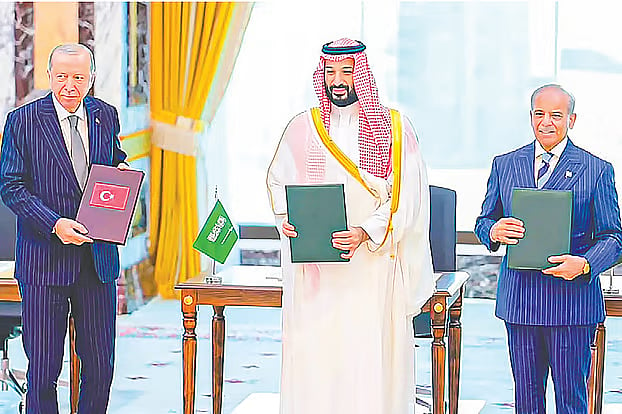
Although Bangladesh has not yet received a formal invitation to join the tripartite defence agreement signed among Saudi Arabia, Turkey, and Pakistan, known as the ''Mecca Joint Defence Agreement'' or simply the ''Mecca Agreement,'' there has been extensive discussion on this in the country. The government's statements indicate that it is interested in joining.
The positive aspect of this debate is that experts in the country's politics and security, who stay informed, feel the need to present the pros and cons of the agreement to the citizens before the government makes a decision on it.
Since Bangladesh has never participated in such a military agreement in the past, it is essential to examine various aspects of this agreement thoroughly due to its significance. Such agreements are not solely a governmental issue, and once a government joins, the succeeding government cannot easily withdraw from it.
When following these discussions on the Mecca Agreement, it appears that many are considering this matter in isolation, bypassing the other existing challenges to the country's foreign and defence policies.
In light of Bangladesh's increasing geopolitical importance for over a decade and a half, the nation's foreign policy has revolved mainly around one question: Should Bangladesh tilt towards India or China?
A US-controlled system has persisted in the Middle East for more than five decades. Recent joint US-Israeli attacks in Iran have elevated Iran into a direct threat for US allies in the region, and failing to protect these nations from potential Iranian attacks has led some to believe this infrastructure could form as an alternative to the US-sponsored security framework. Some even describe it as a Muslim NATO.
After the US adopted the Indo-Pacific Strategy in 2016, the question arose as to whether Bangladesh should join it. At the time, Bangladesh's position seemed to be amidst a triangular tug-of-war involving the US , China, and India.
A cornerstone of Sheikh Hasina's autocratic governance has been dependence on India, leading to attempts to legitimise an unequal relationship through historical ties, while reliance on China is portrayed as an economic necessity. The source of the tension between the Hasina government and the US has been the latter's stance on democracy and human rights.
The situation changed after the fall of the Hasina government because India was not practically willing to abandon its previous policy towards Bangladesh; instead, it seemed to shelter Hasina and use her as leverage.
Regarding relations with India, a large segment of the Bangladeshi population has grievances arising from India's behaviour and its denial of Bangladesh's legitimate claims, and it seems that India has not truly understood this even two years after the mass uprising in July 2024.
The visits of Interim Government's Chief Advisor Professor Muhammad Yunus and the current Prime Minister Tarique Rahman to China suggest a foreign policy that is evidently not India-centric. However, China's ideological stance and the experiences of other countries in their dependence on China should also be considered.
Although the Trump administration in the US emphasised transactional diplomacy and trade, it does not mean that they are entirely dismissive of China's influence in the region, nor should we forget the possibility of future administrations adopting different foreign policies. For Bangladesh, these are issues of defence and strategy beyond mere diplomatic concerns.
It is not yet clear whether participants and policymakers are considering these long-term challenges in the ongoing discussions about whether or not to join the Mecca Agreement. We can hope they will take them into account.
What is the agreement actually about?
Although detailed information about the Mecca Agreement has not been fully disclosed, it is clear that it is a defence agreement with joint security clauses modeled after NATO's Article 5. This clause states that an armed attack against any of the three states will be considered an attack against all three.
Generally, it is understood that Saudi Arabia will provide financial support and funding for defence projects; Turkey will supply advanced military technology, drones, and deep-tech defence equipment, while Pakistan will assist with frontline military personnel and their current defence capabilities. Twenty-four days after the agreement's signing, a strategic political and defence committee was formed under it on 31 August.
The committee has now begun working on transforming political commitments within the agreement into a suitable implementation framework. However, questions linger about whether a joint command structure like NATO's will be developed, or if there will be regular joint exercises, crisis planning, intelligence sharing, logistics agreements, and integrated air and missile defence systems.
Many are claiming this new defence agreement to be a security architecture, but the question remains how new it really is. A strategic bilateral defence agreement already exists between Pakistan and Saudi Arabia from September 2025, and military training, electronic warfare, and defence industry cooperation between Turkey and Pakistan have expanded. The rise of defence relations has also reduced historic tensions between Saudi Arabia and Turkey.
But a bigger question looms over whether the involved countries share a threat perception and if they will come to each other's aid even if their immediate interests don't align.
End of US dominance
A US-controlled system has persisted in the Middle East for more than five decades. Recent joint US-Israeli attacks in Iran have elevated Iran into a direct threat for US allies in the region, and failing to protect these nations from potential Iranian attacks has led some to believe this infrastructure could form as an alternative to the US-sponsored security framework. Some even describe it as a Muslim NATO.
However, in reality, none of these countries are outside the US sphere of influence. Turkey is a NATO member, and Saudi Arabia and Pakistan maintain very close security relations with the US. Furthermore, the US and Saudi Arabia recently signed a nuclear agreement allowing American companies to build nuclear plants there for civilian use. Despite discomfort from Trump's administration's behaviour, there is no reason to believe these countries are stepping out of the American orbit. That's why Trump has welcomed this agreement.
This agreement follows a long-term US policy to form an alliance with Middle Eastern countries that will pose no threat to Israel. CENTO, signed in 1955 and known as the Baghdad Pact, was the initial attempt at this, and the latest iteration was the Abraham Accords of 2022.
An analyst highlighted the religious identity, commenting, "Since the country is an 'island of Muslims surrounded by non-Muslims,' such an agreement would bring benefits." Others argue that it will strengthen economic cooperation with member states and diversify Bangladesh's arms import sources. For the general populace, joining the alliance serves as a counterbalance to strained relations with India, which many see as a preventive measure.
Countries signing the Abraham Accords not only established normal relations with Israel but also accepted US-Israeli dominance. In a sense, those left out of the Abraham agreement are now being brought under the Mecca Agreement's umbrella. Although it has been repeatedly stated that the agreement is not against any nation, the effort is to clarify that it is not against Iran. But since 1979, US policy has aimed to create an anti-Iranian force led by Saudi Arabia regionally and globally, if possible.
What should Bangladesh do?
Those advocating for joining this alliance emphasise potential benefits, including gaining significant strategic advantages and enhancing national security. The strongest argument made is that Bangladesh has not established a strategic relationship with any country, leaving it vulnerable and friendless.
An analyst highlighted the religious identity, commenting, "Since the country is an 'island of Muslims surrounded by non-Muslims,' such an agreement would bring benefits."
Others argue that it will strengthen economic cooperation with member states and diversify Bangladesh's arms import sources. For the general populace, joining the alliance serves as a counterbalance to strained relations with India, which many see as a preventive measure.
On the contrary, there are serious negative aspects to joining this alliance. Given the various ongoing conflicts and long-standing tensions in the Middle East, joining this alliance would mean bringing distant conflicts home.
Regional confrontations between different countries and powers—such as the conflict in Yemen between Saudi Arabia and the Iran-backed Houthi rebels—are of minimal strategic interest to Bangladesh. Yet, this agreement would make Bangladesh a participant in them.
If a member of the Mecca Agreement is attacked, Bangladesh might be obliged to send troops to war due to mutual defence commitments. Hence, a natural question arises: is this the best use of Bangladesh's military resources? There is no logical reason for Bangladesh to adopt or be swayed by threat perceptions from other countries, either geographically or strategically.
The argument that Bangladesh is an island among non-Muslim countries is severely flawed, as Bangladesh's foreign policy should not be driven by religious identities but rather by national interests—military, strategic, economic, and political. The argument that joining the alliance would diversify arms import sources is also flawed because Bangladesh is already purchasing weapons from Turkey, and defence cooperation with Saudi Arabia started in 2025.
India's concern over Bangladesh's positive reaction to the agreement points to viewing this as an opportunity for Pakistan's silent presence and a security threat along its eastern borders. This could allow Bangladesh to shift away from an India-centric foreign policy. Bangladesh should be mindful of India's concerns but not let it solely influence the decision to join or refrain from joining the alliance.
Bangladesh's decision should be solely driven by its national interests. Under the current circumstances, the arguments made in favour of joining the alliance do not negate its risks, challenges, and potential harms.
Instead of quickly adopting any measures based on existing circumstances or emotions, the government should consult everyone. The parliament exists for this purpose. Instead of brief statements by foreign ministers or deputy ministers responding to queries, a detailed discussion is necessary—what the government is thinking and why it holds such views.
#Ali Riaz is a former Vice-chair of the National Consensus Committee of the Interim Government and a Distinguished Professor in the Department of Politics and Government at Illinois State University, USA.
*The opinions expressed here are the author's own.
#This article, originally published in Prothom Alo print and online editions, has been rewritten in English by Rabiul Islam