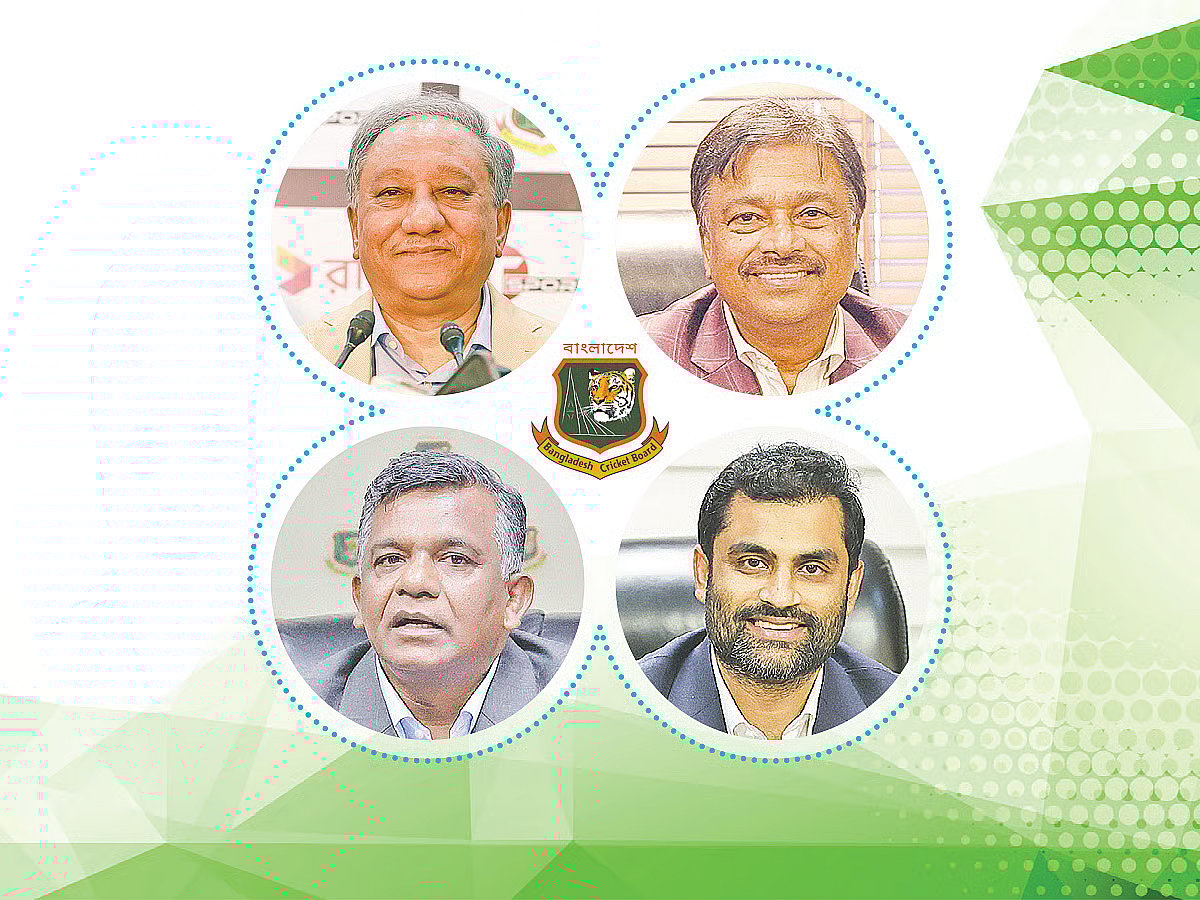
Bangladesh cricket
4 presidents in 20 months: ‘A circus' at BCB
To get into the Guinness Book of Records, one must apply with proper documentation. Bangladesh could perhaps give it a try. A record has certainly been set—whether it qualifies for Guinness recognition is for the authorities to decide. But that a record exists is beyond doubt.
So, what is the record? Here it is: even on the afternoon of the day before yesterday, Aminul Islam was sitting in the BCB president’s chair. Before evening fell, that very same chair was occupied by Tamim Iqbal.
The post of board president is not permanent—changes do happen, and have happened before. But for two individuals to occupy the position within a matter of hours on the same day—there is no precedent for that, not just in Bangladesh cricket but in world cricket. If that is not a record, what is!
Bangladesh cricket seems to produce such “records” regularly. No other country has seen three former national captains become board president in succession. That, too, must be counted as a record.
Cricketers often say they want to give something back to the game out of gratitude for what it has given them. It appears no one matches Bangladeshi cricketers in this regard. Their eagerness to serve the game is enough to make anyone emotional.
The latest example is fresh: after the National Sports Council (NSC) announced the dissolution of the elected BCB board and the formation of an ad hoc committee, Tamim Iqbal did not even wait for the official government gazette. He went straight to the BCB office and took his seat as president.
Soon after, other members of the ad hoc committee arrived, and they even held a brief meeting. In such a critical moment for the country’s cricket, could a single moment be wasted!
The level of circus going on in the cricket board—if you buy a ticket for Tk 2,000, it won’t go to waste. The biggest circus in Bangladesh right now is the cricket board.Former Bangladesh cricketer Aftab Ahmed
Take Aminul Islam, who still claims to be the legitimate president. He himself had once said he would step aside after playing a “T20 innings” in response to cricket’s call. In the end, his tenure as president indeed turned out to be a T20 innings. Though he seemed keen to extend it into a “Test innings”, that ambition remained unfulfilled.
Or consider Faruque Ahmed. Even for him, becoming BCB president in the aftermath of the July uprising was an unexpected surprise. When he was removed through the same process that brought him in, he challenged the decision in court.
Not long after, he returned to the BCB as vice-president through a controversial election. However one sees it, such determination to serve the nation’s cricket deserves applause, does it not?
Is this turning into satire? What can one do—writing about the BCB inevitably takes this tone. Former Bangladesh cricketer Aftab Ahmed, now based in the United States, recently posted a video on Facebook saying, “The level of circus going on in the cricket board—if you buy a ticket for Tk 2,000, it won’t go to waste. The biggest circus in Bangladesh right now is the cricket board.”
Aftab was always known for speaking bluntly yet simply during his playing days. It seems life abroad has not changed that quality. What is happening at the BCB—what else can it be called but a circus?
Since August 2024, in less than two years, the BCB has already seen four presidents. Following the inevitable fallout of the July uprising and the departure of Nazmul Hassan, who had almost turned the position into a personal domain, came Faruque Ahmed. Then, almost overnight, Faruque was replaced by Aminul Islam.
There is no doubt that the government exerted considerable influence over the BCB elections in October. However, it would be erroneous to assume that Tamim Iqbal withdrew from the election, along with his team, solely out of principled objection.
In the latest development, Aminul’s removal and Tamim’s appointment happened within a single day—the very “record” mentioned at the beginning. The meaning is clear: it doesn’t matter whatever happens to the game on the field; occupying the BCB chair is what truly matters.
Even by the standards of Bangladesh cricket, long influenced by politics, recent events are unprecedented. The dissolution of an elected board has happened before, coincidentally, also during a BNP government. The difference is that previously the matter went to court; this time, it went through an investigation committee.
Ironically, the same National Sports Council that oversaw the October election has now raised serious questions about it—so serious that it dissolved the board and immediately announced an ad hoc committee.
The sequence could well have been reversed—the ad hoc committee perhaps decided first, the investigation report merely formalising it. The explanation is simple: the NSC during the election was under Asif Mahmud Shojib Bhuyain; the current NSC is under Aminul Haque. The sports minister, after all, is the ex-officio chairman of the NSC.
A reminder from history: in 2001, after the BNP came to power, the elected committee of the Bangladesh Football Federation (BFF) was dissolved and replaced by an ad hoc committee. FIFA, unlike the ICC, acted firmly and suspended Bangladesh from international football until the elected committee was restored.
The current ad hoc committee has gone even further, with the inclusion of sons of three ministers and the wife of a minister. In Parliament yesterday, Wednesday, Cumilla-4 MP Hasnat Abdullah described it as a “Baaper doa committee (committee of inherited privilege).”
That experience likely explains why a more cautious approach was taken this time with the BCB. After Bangladesh gained Test status, structural reforms were introduced, replacing the executive committee with a board of directors and renaming the Bangladesh Cricket Control Board to the Bangladesh Cricket Board. These changes were unanimously adopted at a special general meeting in Cox’s Bazar in 2000.
Interestingly, Indira Road Krira Chakra official Rafiqul Islam, who had supported those reforms, later filed a writ challenging them after a political change in power. The court ruled in his favour too, leading to the dissolution of the board.
At that time, the government directly appointed the president of the cricket board. Ali Asgar Lobby, MP, was the nominated president then. After the board of directors was dissolved, he remained the sole authority in the board for some time. Later, an ad hoc committee was formed, which, unsurprisingly, was dominated by individuals aligned with the ruling party, much like now.
However, the current ad hoc committee has gone even further, with the inclusion of sons of three ministers and the wife of a minister. In Parliament yesterday, Wednesday, Cumilla-4 MP Hasnat Abdullah described it as a “Baaper doa committee (committee of inherited privilege).”
Let’s rewind a bit to 2002. After the elected BCB committee was dissolved, BCB reverted to being BCCB, replacing the Board of Directors with an Executive Committee. The logo was also changed. A short while later, the reinstatement of BCB and its Board of Directors made clear the real intent behind the court petition.
In the cricket arena, Rafiqul Islam Babu became known as “Writ Babu.” This same “Writ Babu” is also part of the current ad hoc committee. During Aminul Islam’s tenure as board president, he played a major role in many clubs’ boycotting the Dhaka league.
He received an initial reward for that, and perhaps an even bigger one is still waiting. Since the new election is scheduled within three months, and ad hoc committee members face no barriers to contest that, you can imagine what that “reward” might be.
Meanwhile, curiosity remains over how much the investigation committee’s observations and recommendations regarding irregularities in the last election will actually be implemented.
Like all sports federations in Bangladesh, BCB elections have never been free from either direct or indirect government influence. During the last three BCB elections under the Awami League government, the winners’ names were practically known even before voting. There was never any uncertainty over whether Nazmul Hassan could become president.
Even though the rhetoric was about reform, the interim government followed the same pattern. Ideally, the president should have been someone who would not contest the election personally but would ensure a free and fair election process.
The term “appointed” may raise objections. The government is not supposed to appoint anyone. We thought the government interference in BCB is entirely prohibited.
It’s a classic example where formal rules exist, but political realities completely override them. The presence of two NSC-nominated directors on the BCB effectively opens the door for governmental interference. It was precisely through this avenue that Faruque Ahmed and Aminul Islam were appointed as BCB presidents.
The subtleties of the manoeuvre are even more apparent: to secure Aminul Islam’s position, he was appointed as a councillor of the Dhaka Division Sports Association, and to create that vacancy, Mohammad Ashraful, who resigned from the role, was appointed as the national team’s batting coach. One doesn’t need to be a genius to assess this.
There is no doubt that the government exerted considerable influence over the BCB elections in October. However, it would be erroneous to assume that Tamim Iqbal withdrew from the election, along with his team, solely out of principled objection.
The primary reason was the failure to reach a consensus during discussions over the distribution of posts. The opposing side had already consolidated their arrangements so effectively that the prospect of defeat was unmistakable. Moreover, the certainty that an elected committee would not endure should the BNP assume power in a national election also played a part—a prediction that has now been borne out.
More than 25 years after gaining Test status, Bangladesh cricket still struggles. It remains Dhaka-centric, and efforts to spread infrastructure nationwide remain largely rhetorical. All this evokes deep frustration—made even greater by the relentless battle to occupy the BCB chair.