Education statistics
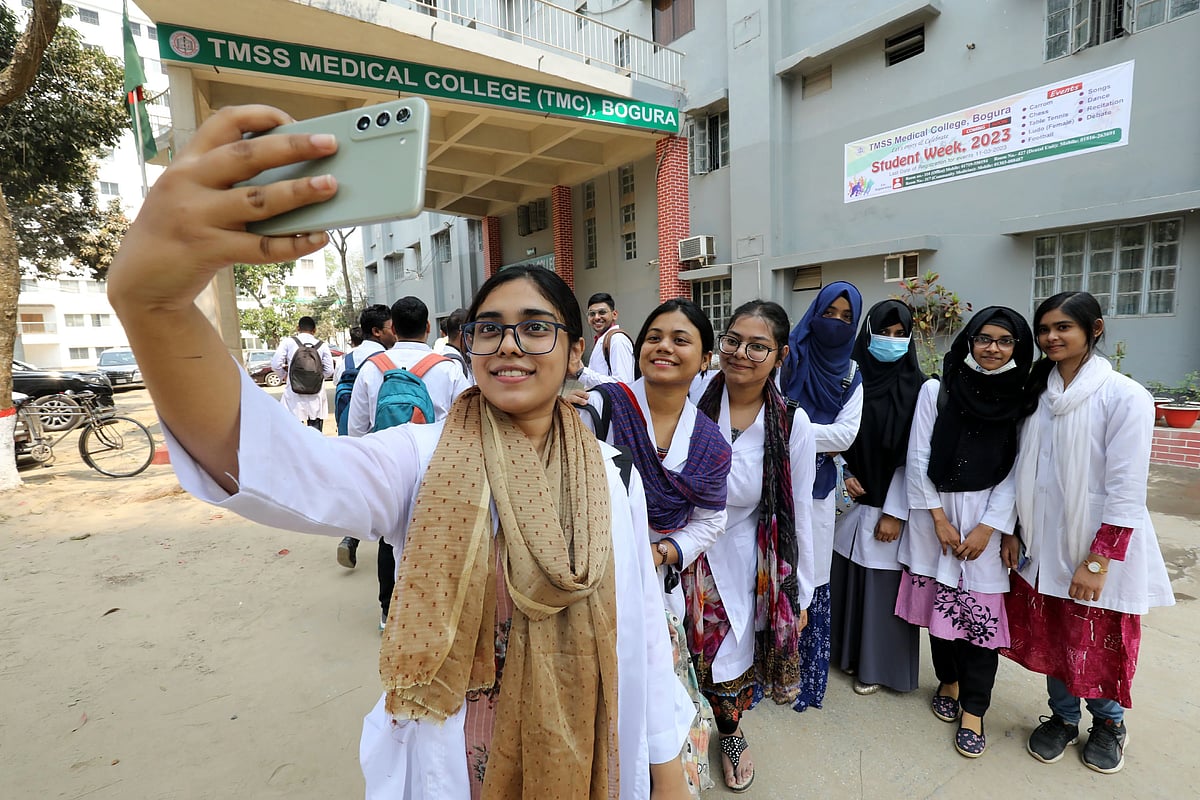
Women constitute 63pc of medical students
Female enrolment in medical education has risen significantly across Bangladesh. Women currently account for nearly 63 per cent of all students pursuing degrees in public and private medical colleges.
Female students also outnumber their male counterparts in dental education, while in nursing and midwifery programmes, women represent approximately 90 per cent of total enrolments.
However, the proportion of female physicians in the professional sphere, particularly in government jobs, remains comparatively lower.
The trend of advancement of women observed at the primary, secondary, and higher secondary levels is visibly mirrored in medical education.
Nevertheless, this continuity is not uniformly maintained across the university sector. Outside the affiliated colleges of the National University, the proportion of female students in public and private universities remains below 40 per cent.
The predominance of female students in medical colleges has been evident for the past eight to 10 years. The number of female graduates passing the MBBS examinations also exceeds that of males.
Consequently, female participation among newly qualifying physicians entering the workforce is expanding at a higher rate than previously recorded.
The report titled Bangladesh Education Statistics 2025, published by the Bangladesh Bureau of Educational Information and Statistics (BANBEIS), outlines the trajectory of women's progress in medical education alongside general education metrics.
In the 39th (Special) BCS examination, the Public Service Commission (PSC) recommended 6,792 physicians for appointment. Among those recommended, 53 per cent were male and 47 per cent female, despite women comprising over 56 per cent of the total applicant pool.
According to the report, in 2025, a total of 51,313 students were enrolled across 109 public and private medical colleges nationwide (with two additional colleges receiving approval subsequently). Of these students, 62.79 per cent were female. In the 37 public medical colleges, women comprised 61.57 per cent of the total student body. Meanwhile, in the 72 private medical colleges, the proportion of female students stood at 63.60 per cent.
Medical colleges impart training through the MBBS degree programme. The clear female majority in this course indicates that women now constitute a substantial proportion of those on the path to becoming medical professionals. The leading position of female students is evident across both public and private institutions.
However, in the professional workforce, specifically in the government jobs, female physicians continue to lag behind slightly. In the 39th (Special) BCS examination, the Public Service Commission (PSC) recommended 6,792 physicians for appointment. Among those recommended, 53 per cent were male and 47 per cent female, despite women comprising over 56 per cent of the total applicant pool.
A similar pattern emerged in the 42nd (Special) BCS examination, where 4,000 physicians were recommended for recruitment. Of these, approximately 51 per cent were male and 49 per cent female, while women accounted for nearly 56 per cent of the applicants.
Women lead in dentistry and nursing as well
Female representation is dominant not only in MBBS programmes but also across other health-related academic disciplines. According to Education Statistics 2025, nearly 7,500 students are currently enrolled across the country's 35 dental colleges and dental units, of whom 60.85 per cent are female.
Female representation remains relatively low in several critical medical specialities as interest often remains concentrated in specific fields such as Obstetrics and Gynaecology.Syed Abdul Hamid, Professor of the Institute of Health Economics at Dhaka University
Female participation is even higher in nursing and midwifery education. Bangladesh houses 475 nursing and midwifery colleges and institutes, with a combined student body of approximately 40,000. Nearly 90 per cent of them are female.
Physicians, dental surgeons, nurses, and midwives all play vital roles in forming a skilled healthcare workforce across various tiers of service delivery. However, sector experts note that alongside female numerical superiority in education, it is equally crucial to assess the extent to which their workforce participation, professional career progression, and leadership opportunities are advancing.
The trend of female predominance in medical education is not entirely new. Statistics from the Directorate General of Health Education (DGHE) on medical admissions and MBBS pass rates between 2009 and 2018 corroborate this pattern.
According to the data, a total of 48,777 domestic students cleared the MBBS examinations over that decade, of whom 26,901 were female, representing roughly 55 per cent of all successful graduates.
Academic merit, family encouragement, and educational progress
Education professionals attribute the growing representation of women in medical education to several major factors. Female participation has expanded at the primary, secondary, and higher secondary levels, where the proportion of female students currently exceeds 50 per cent.
Girls also outperform boys in achieving GPA-5, the highest performance benchmark in public examinations. As a result, female participation in the competitive admission exams for higher education continues to grow.
He stressed the importance of strategically encouraging broader female participation across diverse medical specialities to establish a balanced distribution, suggesting that the issue requires deliberation at the policy-making level.
At the same time, according to them, the strong interest of high-achieving female students in pursuing a medical career, alongside encouraging family support, plays a pivotal role. Socioeconomic background, access to education, career preferences, and success in admission examinations further contribute to this trend.
Another significant facet of female participation in medical education is their professional field of choice.
Researchers from the BRAC James P Grant School of Public Health and icddr,b (International Centre for Diarrhoeal Disease Research, Bangladesh) analysed data from 34,697 physicians registered with the Bangladesh Medical and Dental Council (BMDC) between 2006 and 2015.
The analysis revealed that among registered physicians, 48 per cent were male and 52 per cent female. Notably, 87 per cent of male physicians with specialised qualifications were concentrated in Medicine and Surgery, whereas 96 per cent of female physicians with specialised qualifications held expertise in Obstetrics and Gynaecology.
This research paper was published in the online medical journal PLOS ONE in January 2019.
Speaking to Prothom Alo, Professor Syed Abdul Hamid of the Institute of Health Economics at Dhaka University noted that the academic excellence and advancement of female students represent a positive development.
According to him, they secure admission to medical colleges on the basis of merit through highly competitive entrance examinations. However, certain barriers persist in the professional workplace.
Owing to working environments and logistical realities in rural and district-level areas, female physicians frequently encounter distinct challenges in performing their duties, he stated.
Professor Abdul Hamid pointed out that female representation remains relatively low in several critical medical specialities as interest often remains concentrated in specific fields such as Obstetrics and Gynaecology.
He stressed the importance of strategically encouraging broader female participation across diverse medical specialities to establish a balanced distribution, suggesting that the issue requires deliberation at the policy-making level.