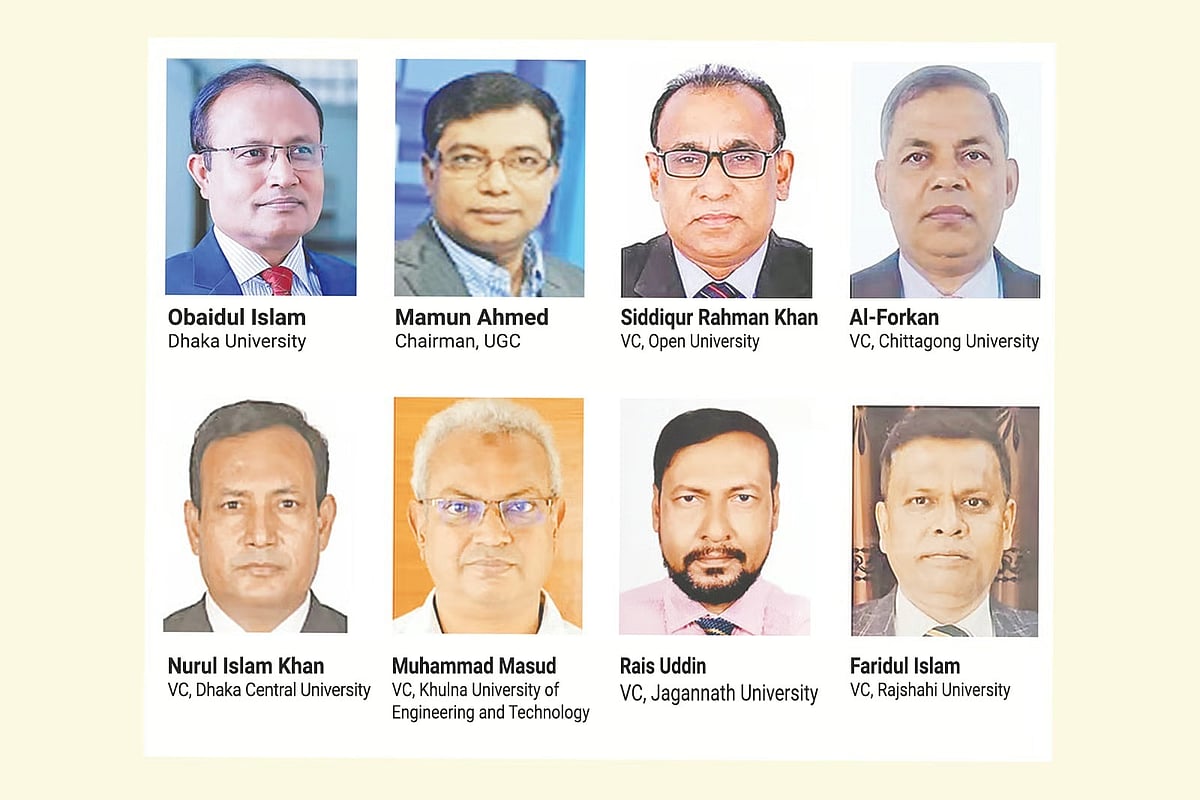
The government has decided to appoint new vice-chancellors to seven public universities in the country, including Dhaka University, Chittagong University, and Rajshahi University.
In addition, changes are being made to the position of chairman of the University Grants Commission (UGC), the body responsible for overseeing higher education.
At a press conference held at the Secretariat on Monday afternoon, the Minister of Education, ANM Ehsanul Hoque, announced the names of those selected for appointment as VCs and as chairman of the UGC.
Mahdi Amin, adviser to the prime minister on Education and Primary and Mass Education, was also present at the press conference.
The authorities will complete the necessary formalities and issue official notifications shortly.
Among the seven vice-chancellors appointed by the BNP government, one individual currently holds a position within the party, while the remaining six are former or current leaders of pro-BNP teachers’ organisations.
In the past, governments followed a similar practice of appointing leaders of party-affiliated teachers’ organisations as VCs.
As a result, university teachers often became inclined towards academic politics in pursuit of such positions.
There had been expectations that the July mass uprising would bring changes in this regard; however, such changes have not materialised.
The BNP’s election manifesto states its commitment to establishing a “non-discriminatory, merit-based and accountable state” and to building “a merit-based, transparent, efficient and pro-people administration in all state institutions.”
The BNP’s election manifesto states its commitment to establishing a “non-discriminatory, merit-based and accountable state” and to building “a merit-based, transparent, efficient and people-friendly administration in all state institutions.”
Appointments of VCs by university
Professor ABM Obaidul Islam, the current vice-chancellor of Bangladesh Open University (BOU), will become the new vice-chancellor of the Dhaka University.
He is a professor in the Department of Physics at the university and serves as the education affairs secretary of the BNP. Following the July mass uprising in 2024, the interim government appointed him as vice-chancellor of the Open University.
After the mass uprising, Professor Niaz Ahmed Khan was appointed as vice-chancellor of the Dhaka University. Following the formation of the new government, he submitted his resignation to the president on 22 February.
According to the relevant statutes, the vice-chancellors of the Universities of Dhaka, Rajshahi, Chittagong, and Jahangirnagar are to be appointed from a panel of three candidates elected by the Senate.
In practice, however, this process is not properly followed. The most recent vice-chancellor, Niaz Ahmed Khan, did not arrange Senate elections during his nearly 1.5 year tenure. Consequently, the new vice-chancellor is also being appointed without a Senate-elected panel.
Professor Md Faridul Islam of the department of marketing will become the vice-chancellor of the University of Rajshahi. He serves as the general secretary of the university’s Jiya Parishad.
Professor Mohammad Al-Forkan will be appointed as the new vice-chancellor of the University of Chittagong.
He is a faculty member of the Department of Genetic Engineering and Biotechnology and also serves as the senior vice-president of the Jatiyotabadi Shikkhok Forum.
Earlier, on 18 September 2024, Professor Mohammad Yahya Akhtar was appointed as the 20th vice-chancellor of the university.
In May 2025, the authorities formed a ‘search committee’ to recommend candidates for vice-chancellor positions across all public universities in the country.
The government appointed a vice-chancellor at Khulna University of Engineering and Technology (KUET) based on the committee’s recommendation. However, the authorities did not follow that process for subsequent appointments.
Professor Rais Uddin, chairman of the Department of Islamic Studies, will become the vice-chancellor of Jagannath University.
Is it a crime for a person to engage in politics?ANM Ehsanul Hoque, Minister of Education
He currently serves as president of the Teachers’ Association and general secretary of the White Panel, a pro-BNP teachers' platform. During the tenure of the interim government, Professor Rezaul Karim was appointed as vice-chancellor of the university.
Professor Mohammad Siddiqur Rahman Khan, dean of the Faculty of Arts at the University of Dhaka, will become the vice-chancellor of Bangladesh Open University.
He is a professor in the Department of Islamic History and Culture and previously served as joint convener of the White Panel.
Professor Muhammad Masud will assume the role of vice-chancellor of KUET.
Following the fall of the Awami League government, authorities appointed him as vice-chancellor of KUET in September 2024; however, they later removed him amid protests. He will now return to the position.
The authorities have decided to appoint Professor Nurul Islam Khan, currently pro-vice-chancellor of the National University, as vice-chancellor of Dhaka Central University, which was formed by combining seven colleges.
Two days before the new government assumed office, the interim government had appointed ASM Abdul Hasib, a faculty member of Bangladesh University of Engineering and Technology (BUET), as VC of the Dhaka Central University. He will have to step down before formally assuming office.
In response to journalists’ questions on whether political considerations influenced the appointments of vice-chancellors, the Minister of Education, ANM Ehsanul Hoque stated, “Is it a crime for a person to engage in politics?”
He emphasised that the authorities gave the highest priority to academic qualifications and said that they made appointments based on the highest level of “performance”, considering the needs of each university.
Current government is an elected one, and people can reasonably expect it to learn from the past, exercise caution in appointments, and establish institutional processes. However, the manner in which the authorities are making appointments indicates a greater inclination to continue past practices.Professor Anu Muhammad
New chairman of the UGC
After the interim government assumed office, it appointed Professor SMA Faiz as chairman of the University Grants Commission (UGC). Yesterday, Monday, he submitted his resignation citing physical illness.
On the same day, the authorities decided to appoint Professor Mamun Ahmed, pro-vice-chancellor (education) of Dhaka University, as the new chairman of the UGC.
He is a professor in the Department of Biochemistry and Molecular Biology and previously served as an adviser to the BNP chairperson.
Professor Anu Muhammad, former professor at Jahangirnagar University, told Prothom Alo that during the tenure of the Awami League government, party loyalty had been the principal criterion for appointing VCs.
He noted that such appointments tend to prioritise party dominance in university administration, relegating education to a secondary position.
He added that a similar pattern was also evident during the interim government’s tenure.
Professor Anu Muhammad further stated that the current government is an elected one, and people can reasonably expect it to learn from the past, exercise caution in appointments, and establish institutional processes.
However, he observed that the manner in which the authorities are making appointments indicates a greater inclination to continue past practices.
He warned that if this trend persists, it will be difficult to reverse the ongoing decline in the quality of education at universities, adding that this is a bad sign.