In the party-nomination-based reserved seat system, women Members of Parliament (MPs) do not have their own constituencies. As a result, there is no direct connection between the MPs in reserved seats and the voters. In such a situation, women’s rights activists have long been demanding direct elections in reserved seats to ensure the political empowerment and accountability of these MPs.
Following the fall of the Awami League government on 5 August last year in a mass uprising, discussions on various reforms in the state have brought the issue of direct elections for women’s reserved seats into sharp focus. However, the political parties have not reached an agreement on the matter. Several parties have also raised objections to direct elections for women’s seats.
The Constitutional Reform Commission and the Electoral Reform Commission had separate proposals on the issue of women’s reserved seats. Both commissions proposed increasing the number of reserved women’s seats to 100 and holding direct elections. The Constitutional Reform Commission suggested that MPs for these 100 designated constituencies would be directly elected through contests among women candidates only.
Meanwhile, the Electoral Reform Commission proposed a “rotating system” for direct voting in the 100 reserved seats. According to their proposal, there would be 400 single-member regional constituencies in Parliament, of which 100 would be reserved for women.
In the first term, the 100 reserved constituencies would be selected randomly or through another method. In the next parliamentary election, a different set of 100 constituencies—excluding the previously reserved ones—would be reserved for women. In this way, the reserved seats for women would rotate.
However, as political parties failed to agree on the election process for women’s reserved seats, the National Consensus Commission put forward a new proposal for the abolition of reserved women’s seats in Parliament.
Under this proposal, political parties contesting at least 25 constituencies would be required to ensure that at least one-third of their total candidates are women. This would require an amendment to the Constitution. However, the political parties could not agree on this proposal either.
Later, the Consensus Commission proposed increasing the number of reserved women’s seats from 50 to 100 and introducing direct voting for them. Again, parties could not reach an agreement. After that, the commission suggested retaining the 50 reserved seats and requiring parties to nominate women candidates for 5–7 per cent of the 300 general seats. This proposal, too, failed to secure consensus among the parties.
There was no female representative in the National Consensus Commission. The discussions did not reflect women’s voices or demands. They have not only disappointed us, but also made us deeply angry.Rasheda K Choudhury, former adviser to the Caretaker Government
‘Women’s voices must be heard’
As political parties failed to reach a consensus on direct elections for women’s reserved seats, the National Consensus Commission has finally announced a decision.
According to the decision, almost all parties have agreed to gradually increase women’s representation in Parliament to 100 seats, though a few parties have expressed dissent. Some parties support increasing the number to 100 through direct elections, while others favour a proportional representation system for the reserved women’s seats.
As per the National Consensus Commission’s latest decision, the existing 50 reserved seats will be retained by making the necessary amendments to the Constitution. In the next general election following the signing of the July Charter, the Commission will call on every political party to nominate a minimum of 5 per cent women candidates for the existing 300 parliamentary constituencies.
In the election after the next one, political parties will have to nominate at least 10 per cent women candidates, which will also be added to the Constitution. Until the target of nominating a minimum of 33 per cent women candidates is achieved, the percentage will continue to increase by at least five per cent in each subsequent general election, and this requirement will be incorporated into the Constitution. Meanwhile, the reserved women’s seats will remain in place until the year 2043.
Former adviser to the Caretaker Government, Rasheda K Choudhury, told Prothom Alo, “There was no female representative in the National Consensus Commission. The discussions did not reflect women’s voices or demands. They have not only disappointed us, but also made us deeply angry.”
Rasheda K Choudhury added that the Women’s Affairs Reform Commission had recommended increasing the number of women’s seats and holding direct elections for them. These recommendations were also excluded from the National Consensus Commission’s discussions. She said, “Women make up 51 per cent of the country’s total population. Women’s voices must be heard.”
Women’s representation in parliament
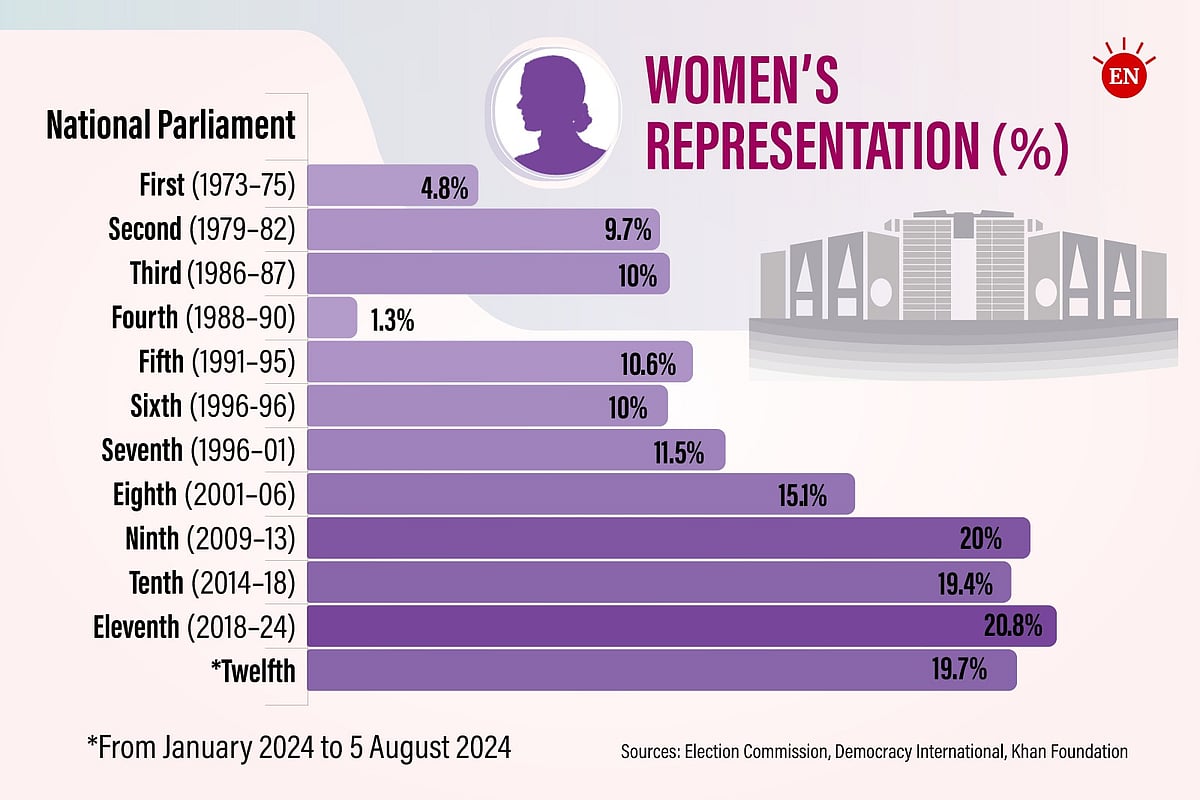
According to the Election Commission, the Khan Foundation’s research report “Empowering Women Through Reserved Seats in Parliament: Fight or Flight Response?”, various newsletters from Democracy International, and Prothom Alo’s own reports, women’s representation in Parliament began with the 15 reserved seat holders in the first National Parliament (1973–1975).
In the second Parliament (1979–1982), there were two directly elected women MPs along with 30 in reserved seats, making a total of 32 women MPs. In the fourth Parliament (1988–1990), there were no reserved seats for women with only four women MPs elected directly. And, in the fifth Parliament (1991–1995), there were five directly elected women along with 30 in reserved seats, totalling 35 women MPs.
In February 1996, during the BNP’s one-sided sixth National Parliament election, only three women MPs were directly elected and there were 30 reserved seats for women. However, this election was annulled, and a new election was held in June 1996 for the seventh Parliament (1996–2001), in which there were eight directly elected women MPs, bringing the total number of women representatives to 38.
In the eighth National Parliament (2001–2006), seven women were directly elected and there were 45 reserved seats, making a total of 52 women MPs. In the ninth National Parliament (2009–2013), 21 women MPs were directly elected. However, after the death of Momtaz Iqbal, MP for Sunamganj-4, a man won the by-election for that seat. During this term, the number of reserved seats was increased to 50, bringing the total number of women MPs to 70.
During the Awami League regime, the tenth, eleventh, and twelfth general elections in 2014, 2018, and 2024 were one-sided and controversial. In the tenth Parliament, there were 18 directly elected women MPs with a total of 68 women MPs. In 2018, there were 23 directly elected women MPs and a total of 73 women MPs. Then in 2024, there were 19 directly elected women MPs, with the total number of women representatives being 69.
Parties’ stance
In the National Consensus Commission’s discussions on women’s seats, BNP representatives said that the number of reserved seats for women should be increased to 100 and, as before, these should be allocated to parties based on the proportion of parliamentary seats they win in the general election.
Representatives of Jamaat-e-Islami said they agreed with having 400 parliamentary seats under a proportional representation (PR) system, with 100 of them reserved for women.
This time, in the discussions of the National Consensus Commission, men took decisions on women’s seats. I was deeply disappointed that not even a single woman could be gathered to take to the discussion! I cannot decide whether to call this the party’s failure or the leadership’s,Rumin Farhana, former MP from BNP
Representatives of the National Citizens’ Party (NCP) supported direct elections for 100 women’s seats. However, they later put forward a new proposal saying each political party should nominate 10–15 per cent women candidates.
This would result in 350–400 women contesting the election. Those who win would become MPs, and from among those who lose, the 100 with the highest number of votes would be given the reserved women’s seats.
Meanwhile, the Women’s Affairs Reform Commission proposed increasing the number of seats in Parliament to 600, with 300 reserved for women, and direct elections to be held for those seats among women candidates.
However, as the Women’s Affairs Reform Commission’s report was submitted later, its recommendations were not included in the Terms of Reference of the Consensus Commission, according to the Commission’s vice-chairman, Professor Ali Riaz.
As a result, there was no discussion with the political parties about the Women’s Reform Commission’s proposals. Leaders of various parties also felt that increasing Parliament to 600 seats, with 300 reserved for women, was not compatible with the country’s realities.
NCP’s senior joint convenor Samantha Sharmin, told Prothom Alo that it was unfortunate no honourable solution was reached regarding women’s seats. She said one major reason for parties’ reluctance to adopt a direct election system for women’s reserved seats was long-standing political habits.
The country’s political culture does not support direct elections for reserved seats or nominating large numbers of women for direct contests. The prevailing political culture often involves winning elections through displays of force, corruption, and spending a lot of money.
Samantha Sharmin added that another practice is granting reserved seats to women with family backing. She stressed that the existing political culture must be changed to increase women’s participation in politics.
Limited to ‘yes’ or ‘no’ votes
The reserved seats in the National Parliament are officially called Reserved Women’s Seats. In the 1972 Constitution, 15 seats were reserved for women in the National Parliament. This facility for reserved seats was initially kept for 10 years.
Later, in 1978, the number of reserved seats was increased to 30, and the term was extended from 10 years to 15 years. The term for the reserved seats ended in 1987, and in 1988, during the fourth National Parliament, there were no reserved seats at all.
Later, in 1990, the reserved seat system was reinstated for 10 years. After the term expired, there were no reserved seats at the start of the eighth parliament in 2001. Then in 2004 during the term of this same Parliament, the number of women’s seats was increased to 45 for a 10-year term through the 14th amendment to the Constitution.
Although political parties were asked on the issue of increasing the number of seats for women in parliament and to hold direct elections for those seats, they did not listen. The commission cannot impose any decision on political parties.Professor Ali Riaz, vice-chairman of the National Consensus Commission
At that time, changes were made to the election procedure for these seats. The number of reserved seats allocated to each party was determined based on the proportion of representation of each political party in the parliament.
The directly elected MPs of each party then voted to elect the women MPs for the party’s reserved seats. In 2011 during the ninth parliament, the number of women’s seats was then increased to 50 with the 15th amendment of the Constitution.
According to the law, women MPs in reserved seats receive the same monthly salary, allowances, and other benefits including duty-free car purchase facilities as directly elected MPs.
Over the years, with a few exceptions, the role of most women MPs in reserved seats has been limited to casting ‘yes’ or ‘no’ votes in the parliament. In order to remain loyal to their party, avoid offending anyone, and keep the scope for future nominations open, most women MPs have considered it ‘safer’ to remain silent. Even in high-profile incidents of violence against women, they have rarely been vocal in parliament.
In the 11th parliament (2018-2024), BNP’s only nominated woman MP for a reserved seat was Rumin Farhana. She told Prothom Alo, “For 53 years, the number of women’s seats has been increased from time to time. But in no way have the reserved seats smoothed or widened the path for women.”
“Many leaders have placed female members of their families in those seats to benefit them. This time, in the discussions of the National Consensus Commission, men took decisions on women’s seats. I was deeply disappointed that not even a single woman could be gathered to take to the discussion! I cannot decide whether to call this the party’s failure or the leadership’s,” she added.
Organisations working on women’s rights have been urging political parties to prioritise women’s interests over group interests when it comes to women’s issues. They say that in July, women were at the forefront. These women must not be allowed to disappear again. Women must be kept in decision-making positions, and pressure must be applied on political parties to hold direct elections for women’s seats.
When asked about the angry reactions of women regarding women’s seats, Professor Ali Riaz, vice-chairman of the National Consensus Commission, told Prothom Alo that although political parties were asked on the issue of increasing the number of seats for women in parliament and to hold direct elections for those seats, they did not listen. The commission cannot impose any decision on political parties.
When asked if there was still any possibility of fulfilling women’s demands regarding women’s seats, he said that the civil society must become active now in order to achieve this demand.