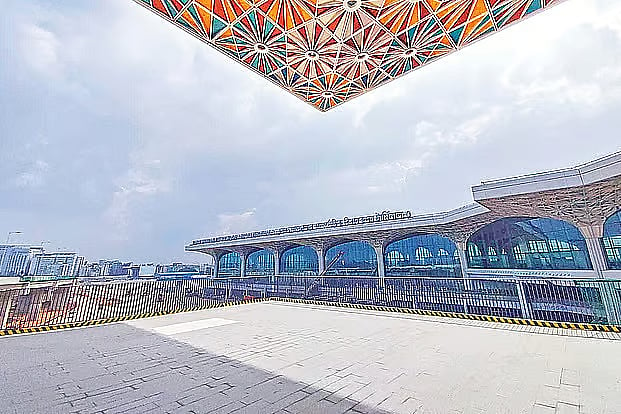
Dhaka airport’s 3rd Terminal to be run by Japanese consortium for 15 years
A Japanese consortium is set to take responsibility for operating and maintaining the Third Terminal at Hazrat Shahjalal International Airport in the capital. The Civil Aviation Authority of Bangladesh (CAAB) will sign a 15-year concession agreement with the consortium tomorrow, Monday.
Under the agreement, CAAB will receive 13.5 per cent of the total revenue generated from passenger and cargo services at the Third Terminal after it opens. Once the terminal reaches full capacity, CAAB’s share of the revenue will increase to 27 per cent.
Preparations are under way to begin partial operations at the Third Terminal on 16 December, Victory Day, with four flights. The target is to transfer passenger and cargo operations for all regular international flights to the new terminal within 14 months of its handover. Accordingly, the terminal is expected to become fully operational around February–March 2028.
Air Vice Marshal Mostafa Mahmood Siddiq, chairman of CAAB, disclosed this at a press conference held at CAAB headquarters in Kurmitola, in the capital, today, Sunday.
He said that, following lengthy discussions, reviews, and technical and financial analyses, the two parties have reached a final agreement on the concession contract. The necessary legal scrutiny has also been completed.
The CAAB chairman said the areas covered by the concession at the Third Terminal would be handed over to the operating company within 15 days of the agreement being signed.
The target is to transfer services for at least 25 per cent of regular international flights to the new terminal within eight months of the handover. The number of flights will then be increased in phases, with all regular international passenger and cargo handling operations expected to be transferred there within 14 months, he added.
However, the 15-year term of the agreement will begin on the date when all regular international flights at Hazrat Shahjalal Airport have been transferred to the Third Terminal. In other words, the 15-year period will not start from the date the agreement is signed.
Under the agreement, the Japanese consortium will operate, repair and maintain the Third Terminal, the multi-storey car park and the new import and export cargo terminals at its own expense.
It will also be responsible for purchasing, installing and commissioning additional equipment needed to increase passenger service capacity. In addition, the company will have to carry out necessary expansions to related infrastructure, including mechanical, electrical and water supply systems.
Once the terminal becomes fully operational, passenger services for all regular international flights at the airport will be handled there. International cargo operations will also be conducted through the new cargo terminal. As a result, CAAB will be able to use Terminals 1 and 2 for domestic flights, Hajj flights and other non-scheduled flights.
To ensure the quality of passenger services, the agreement sets out minimum service standards and key performance indicators (KPIs). These include terminal cleanliness, adequate lighting, the operational availability of lifts and escalators, check-in, baggage delivery, cargo handling and car parking services.
Specific targets have also been set to reduce the time passengers have to wait for their luggage after landing. The first bag must be delivered to the conveyor belt within 15 minutes of the aircraft coming to a stop. The deadline for delivering the last bag has been set at 42.5 minutes for narrow-body aircraft and 47.5 minutes for wide-body aircraft.
Waiting times at check-in counters have also been specified. The standards require average waiting times to be limited to five or 10 minutes for business-class passengers and 20 or 30 minutes for economy-class passengers.
The operating company will also have to ensure that the terminal’s key technical systems remain operational for specified periods.
These include the baggage handling system (BHS), the common-use passenger processing system (QUT), the automated self-service check-in system (QSS) and the flight information display system (FIDS). The standard has been set to keep these systems operational 95 to 98 per cent of the time.
If the operator repeatedly fails to meet the prescribed service standards and performance indicators, it will have to pay financial compensation. Depending on the nature and recurrence of the failure, the agreement provides for compensation ranging from USD 5,000 to a maximum of USD 35,000 for each instance of non-compliance.
According to CAAB, the Third Terminal covers an area of approximately 230,000 square metres and has the capacity to serve 24 million passengers a year.
When asked why it took so long to reach an agreement with the Japanese consortium on operating the Third Terminal, the CAAB chairman said both parties had made every effort to protect their respective interests. The process had involved assistance from the International Finance Corporation (IFC), various government bodies and experts.
In response to a journalist’s question, he said the initial proposal had been for CAAB to receive a 15 per cent share of the revenue, but this had been increased to 27 per cent following lengthy negotiations.
He claimed that every clause of the agreement had been reviewed in an effort to safeguard national and financial interests. Overall, he said, CAAB was satisfied with the terms of the agreement.
Those present at the press conference included CAAB Member (Operations and Planning) Air Commodore Abu Sayeed Mehbub Khan, Member (Administration) SM Lablur Rahman, Member (Security) Air Commodore Md Asif Iqbal, Member (ATM) Air Commodore Md Nur-e-Alam, Member (Flight Standards and Regulations) Air Commodore Md Monirul Islam, Member (Finance) Mohammad Nazmul Haque, and Chief Engineer (in charge) Md Zakaria Hossain, along with other officials of the authority.