BRAC study
Battery-rickshaw drivers earn Tk 29,000 a month, pay Tk 10,323 in rent
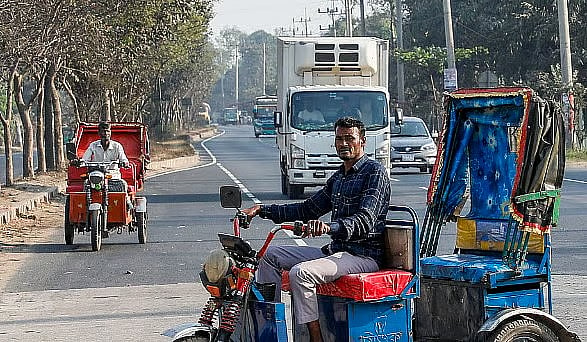
A battery-powered rickshaw driver in Dhaka earns an average of Tk 29,000 a month. From this income, the driver has to pay the rickshaw owner an average of Tk 10,323 a month in rent. This means that, on average, 38.6 per cent of their monthly earnings go towards paying the owner.
This information emerged from a joint study by BRAC and the BRAC Institute of Governance and Development (BIGD).
Mehnaz Rabbani, BIGD’s director of operations, presented the findings at a policy dialogue titled ‘Battery-powered rickshaws: Livelihoods and an inclusive, sustainable transition’ at the CIRDAP auditorium in the capital today, Tuesday.
The study, titled ‘The political and socio-economic realities of battery-powered rickshaws in Bangladesh’, collected data from 450 rickshaw drivers in Dhaka and Barishal. Of the drivers surveyed, 78.2 per cent rented their rickshaws, while 18 per cent owned their vehicles. Data for the study were collected in June and July.
The study found that 78.3 per cent of the drivers surveyed in Dhaka had come from other districts. Of them, 84.2 per cent had moved to the capital because of limited job opportunities and limited scope of income in their localities.
Some 42.2 per cent of the drivers surveyed had faced a major livelihood crisis in the previous year. Of these, 87.9 per cent said their income had fallen by more than half or their work had come to a complete halt during the crisis.
They had to take out loans to cope with the situation. If their income stopped, nearly 62.9 per cent of the drivers would be unable to support their families for more than a week.
The study also highlighted the significant number of accidents involving rickshaw drivers. In the month before the survey (May), 26.7 per cent of the drivers had been involved in at least one road accident.
Of the drivers surveyed, 96 per cent did not have a licence. The remaining 4 per cent reportedly drove rickshaws with permits issued by city corporations and organisations for people with disabilities.
The study said that a sudden ban on or restrictions on the operation of battery-powered rickshaws could reduce drivers’ incomes and place considerable pressure on their families. Their livelihoods therefore need to be taken into account when formulating a regulatory framework.
The study examined the ‘Three-Wheeled Low-Speed Battery-Operated Rickshaw (E-Rickshaw) Movement Rules, 2026’ prepared by the Local Government Division. It described the guidelines as an important step towards recognising the sector and bringing it under orderly management.
However, effective implementation would be the main challenge. Alongside road safety, environmental risks and the regulatory framework, the lives and livelihoods of people working in the sector would also have to be considered.
Dhaka South City Corporation Administrator Abdus Salam spoke at the event. He said city residents had the right to move around without hindrance, while rickshaw drivers also had the right to live and work.
However, if everyone continued to head towards Dhaka, ensuring civic amenities would become impossible. The issues therefore needed to be considered together, and an integrated plan drawn up with the involvement of all stakeholders and taking into account the overall capacity of Dhaka city.
Dhaka North City Corporation Administrator Shafiqul Islam Khan said, “We are not against auto-rickshaws or rickshaw drivers. Their right to a livelihood must also be protected. However, if they operate within a set of rules, there will be scope for accountability, and we will be able to support them more effectively.”
Professor Shamsul Hoque of Bangladesh University of Engineering and Technology (BUET) blamed weaknesses in the public transport system for the growing number of battery-powered rickshaws in the country.
He said Bangladesh had failed to make buses an attractive mode of transport. The metro rail, however, had proved attractive. Even people who owned cars left them at home and travelled by metro rail. This was not because of its speed, but its reliability. No other mode of transport had been able to offer that.
During the panel discussion, Prothom Alo Executive Editor Sajjad Sharif spoke about rising inequality in Bangladesh, the lack of good governance and the excessive centralisation of everything in Dhaka.
He said battery-powered rickshaws were, in fact, a reflection of these problems — a very ugly reflection. He did not believe the issue could be resolved with a few quick fixes.
The study made several recommendations for regulating battery-powered rickshaws. It said safety standards for the vehicles and designated operating areas must be established. It must be clearly specified which roads they can use, how fast they can travel, and where they can park and pick up or drop off passengers.
The study also recommended ensuring the safety of electricity connections and charging systems at garages. It said arrangements should be introduced to upgrade garages and bring them under a formal accreditation system where necessary.
A safe system must be developed for collecting, transporting and recycling old batteries. It also recommended considering the potential for using environmentally friendly battery technology and solar power for charging.
BRAC Executive Director Asif Saleh said the voices of people working in the informal sector did not reach policymakers. The challenges surrounding the safety, road management and regulation of battery-powered rickshaws needed to be addressed by taking drivers’ realities into account and ensuring a just transition.
Professor Akhtar Mahmud of the Department of Urban and Regional Planning at Jahangirnagar University, Dhaka Metropolitan Police Joint Commissioner (Traffic-South) Mohammad Asfiqur Rahman Akhtar, and BRAC Director Ahmed Nazmul Hossain, among others, took part in the panel discussion.
BRAC Director Nafiul Hasan moderated a panel discussion during the second session of the event.