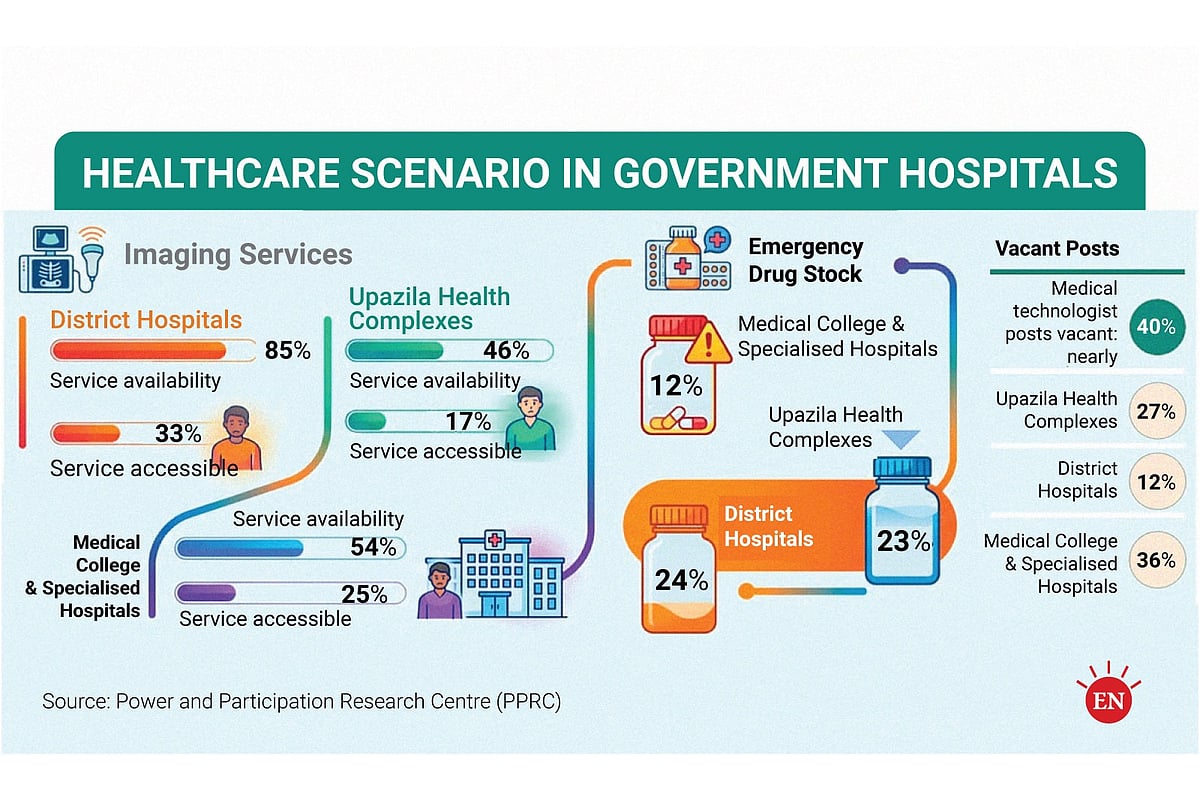
Government hospitals have diagnostic imaging equipment such as X-ray and ultrasound machines, but many of these are not being use to provide regular services. Although the availability of such services at district hospitals stands at 85 per cent, a recent study found that over the past year, regular diagnostic services were available only 33 per cent of the time.
The study, covering 22 government health facilities including district hospitals, upazila health complexes and medical college hospitals found that 52 per cent of the diagnostic equipment had not been used at all during the previous year. It also found that stocks of essential and emergency medicines remain inadequate in these hospitals.
The research was conducted by the private think tank Power and Participation Research Centre (PPRC). The findings were presented yesterday, Wednesday, at the International Mother Language Institute in the capital under the title ‘Bridging Gaps in Bangladesh's Public Health System: A Rapid Facility-Level Assessment of Expenditure Efficiency towards Ensuring UHC-Compliant Health Service Delivery’.
The seven-member research team was led by PPRC Executive Chairman Hossain Zillur Rahman. The study was funded by the Health Economics Unit of the Ministry of Health.
Bangladesh aims to achieve universal health coverage by 2030. Against this backdrop, the study was carried out to assess how effectively health sector allocations are being used and to identify the system’s key shortcomings.
The nine-month study involved surveys, interviews and document reviews at 22 government health facilities across the country’s eight divisions.
Upazila and union-level health centres were categorised as primary-level facilities, district hospitals as secondary-level facilities, and medical college hospitals as tertiary-level facilities. One specialised hospital was also included in the tertiary category. The researchers noted that the relatively small sample size was a limitation of the study.
One of the major areas of irregularities and corruption in the health sector involves the procurement and use of medical equipment. In many cases, equipment is purchased without actual need. Even when machines become faulty, they are often not repaired promptly, with various excuses cited for the delay.
Previous government surveys of public health facilities have also revealed widespread problems with broken and unusable equipment across hospitals nationwide. The PPRC study reflects a similar picture.
According to the study, the performance of the health sector should not be judged solely by the size of budget allocations. Instead, the key measure should be whether institutions are able to spend those funds according to actual needs and whether the spending translates into medicines, diagnostic services, functional equipment, skilled personnel and reliable healthcare for citizens.
Health and Family Welfare Minister Sardar Md Sakhawat Husain attended the event as chief guest. He said that many expensive medical devices had remained unused for years due to poor planning. In many hospitals, X-ray and other equipment are available, but there are no trained technologists to operate them.
Referring to procurement during the Awami League government's tenure, the minister said that unplanned purchases and weak implementation had resulted in a waste of public money.
The health minister also said that policy reforms and research recommendations are not enough to solve the problems in the health sector.
If physicians neglect their duties in public hospitals while performing surgeries in private clinics, refer patients there for diagnostic tests and receive commissions, then no amount of research or policy advice will be enough to ensure quality healthcare for the public, he added.
The biggest challenge in the health sector is not simply increasing budget allocations, but building the capacity to translate those allocations into effective healthcare services.Hossain Zillur Rahman, executive chairman, PPRC
Equipment in place, services missing
The study found that the availability of diagnostic imaging services across hospitals at all levels was 65 per cent during the survey period. In reality, however, regular diagnostic services had been available only 25 per cent of the time over the previous year.
On paper, district hospitals had the highest availability of such services, at 85 per cent. But over the past year, people received regular services only 33 per cent of the time.
During the study period, diagnostic services were available in 46 per cent of upazila health complexes, yet regular services had been available only 17 per cent of the time over the previous year.
During the same period, the availability of such services stood at 54 per cent in medical college and specialised hospitals. Over the past year, however, regular services were available only 25 per cent of the time.
The study identified malfunctioning equipment as the main reason for the lack of services. In 79 per cent of cases across the hospitals surveyed, equipment was out of order. A further 14 per cent of service disruptions were attributed to shortages of other essential supplies, while 7 per cent resulted from the absence of trained medical technologists.
Under the Ministry of Health and Family Welfare, 3,892 medical technologists are currently employed against 6,406 approved posts. In other words, nearly 40 per cent of the positions remain vacant.
The vacancy rate stands at 27 per cent in upazila health complexes, 12 per cent in district hospitals, and 36 per cent in medical college and specialised hospitals. As a result, many hospitals possess modern equipment but lack the skilled personnel needed to operate it.
The issue of broken or out-of-order medical equipment has often been highlighted in the media.
On 22 February 2023, Prothom Alo published a report on faulty equipment at three major hospitals in Dhaka. It revealed that 238 machines at Dhaka Medical College Hospital, Shaheed Suhrawardy Hospital, and Sir Salimullah Medical College and Mitford Hospital were out of order, with an estimated combined value of nearly Tk 1 billion.
Another Prothom Alo report, published on 14 September 2023, stated that 537 pieces of equipment, both large and small, were out of order at Rangpur Medical College Hospital. When equipment in public hospitals remains out of service, patients are deprived of essential healthcare, with the burden falling most heavily on poorer people.
The study further noted that most medicines supplied to public hospitals come from the state-owned Essential Drugs Company Limited (EDCL). However, to meet demand, hospitals have had to procure 33 per cent of their medicines from sources outside EDCL, while another five per cent come from other suppliers.
Shortage of essential medicines
The study also found a severe shortage of essential medicines in public health facilities. The situation was worst in medical college and specialised hospitals, where medicine stocks met only 12 per cent of requirements. The corresponding figures were 23 per cent in upazila health complexes and 24 per cent in district hospitals.
The picture remained almost unchanged when assessed over the previous year. Overall, the availability of essential medicines across public health facilities averaged just 22 per cent.
The study further noted that most medicines supplied to public hospitals come from the state-owned Essential Drugs Company Limited (EDCL).
However, to meet demand, hospitals have had to procure 33 per cent of their medicines from sources outside EDCL, while another five per cent come from other suppliers. This indicates that shortcomings in the central supply system are forcing hospitals to rely regularly on alternative sources.
On the other hand, most hospitals had adequate stocks of routinely used supplies such as gauze, cotton wool, syringes and gloves. However, many lacked essential items required for emergency treatment.
Nearly 64 per cent of the facilities did not have tourniquets, 55 per cent lacked bag-valve masks (resuscitators), and 41 per cent did not have neonatal umbilical cord clamps. The researchers said these items are vital for emergency care and the treatment of newborns.
Although training opportunities are available for health sector officials, the knowledge gained is not being effectively applied. Over the past two years, 84.2 per cent of officials received training, yet only 40 per cent reported using the knowledge they had acquired.
Disparities in laboratory testing services
The study found that laboratory testing services are comparatively better at upazila health complexes and district hospitals. Upazila health complexes provide 83 per cent of the essential laboratory tests, while the figure stands at 91 per cent in district hospitals. Over the past year, these facilities maintained regular laboratory services 81 to 89 per cent of the time.
The picture however is different at medical college and specialised hospitals. There, both the availability of laboratory tests and the regularity of services throughout the year have fallen between 43 and 45 per cent.
According to the study, shortages of reagents, malfunctioning equipment and a lack of trained medical technologists have resulted prevented many tests from being run. In 43 per cent of cases, services were disrupted because of reagent shortages. Faulty equipment accounted for 34 per cent of disruptions, while 19 per cent resulted from a shortage of skilled personnel.
Unable to spend the full budget
The study found that in the 2024–25 fiscal year, the surveyed public health institutions spent 85 per cent of their total allocated budget. District hospitals recorded the lowest utilisation rate, spending only 78 per cent of their allocation.
By the end of the fiscal year, 94 per cent of the institutions still had a portion of their budget unspent. However, only 11 per cent of the institutions considered this to be a problem of financial mismanagement.
The study also found that only 27 per cent of the funds allocated for purchasing general supplies were actually spent. Expenditure reached 68 per cent of the allocation for travel and transfers, with 59 per cent for professional services and allowances.
The research further revealed that although training opportunities are available for health sector officials, the knowledge gained is not being effectively applied. Over the past two years, 84.2 per cent of officials received training, yet only 40 per cent reported using the knowledge they had acquired in their workplace.
Recommendations
Presenting the study findings, PPRC Executive Chairman Hossain Zillur Rahman said the biggest challenge in the health sector is not simply increasing budget allocations, but building the capacity to translate those allocations into effective healthcare services.
He recommended several short-term measures, including the rapid recruitment of medical technologists to fill vacant posts, making sector-wise analysis of budget expenditure mandatory, introducing an integrated digital information system for budget and resource management, and simplifying and making public procurement procedures more flexible.
For the medium term, Hossain Zillur Rahman recommended establishing a professional health management structure for hospital administration and further decentralising financial authority.
In the long term, he advised modernising Essential Drugs Company Limited (EDCL), ensuring an uninterrupted supply of raw materials, and making the distribution system of the Central Medical Stores Depot (CMSD) more efficient.
The event opened with a welcome address by Md Enamul Haque, director general of the Health Economics Unit. Other speakers included Professor Prabhat Chandra Biswas, director general of the Directorate General of Health Services, Mohammad Kabir Uddin, director of the Health Economics Unit, among others.