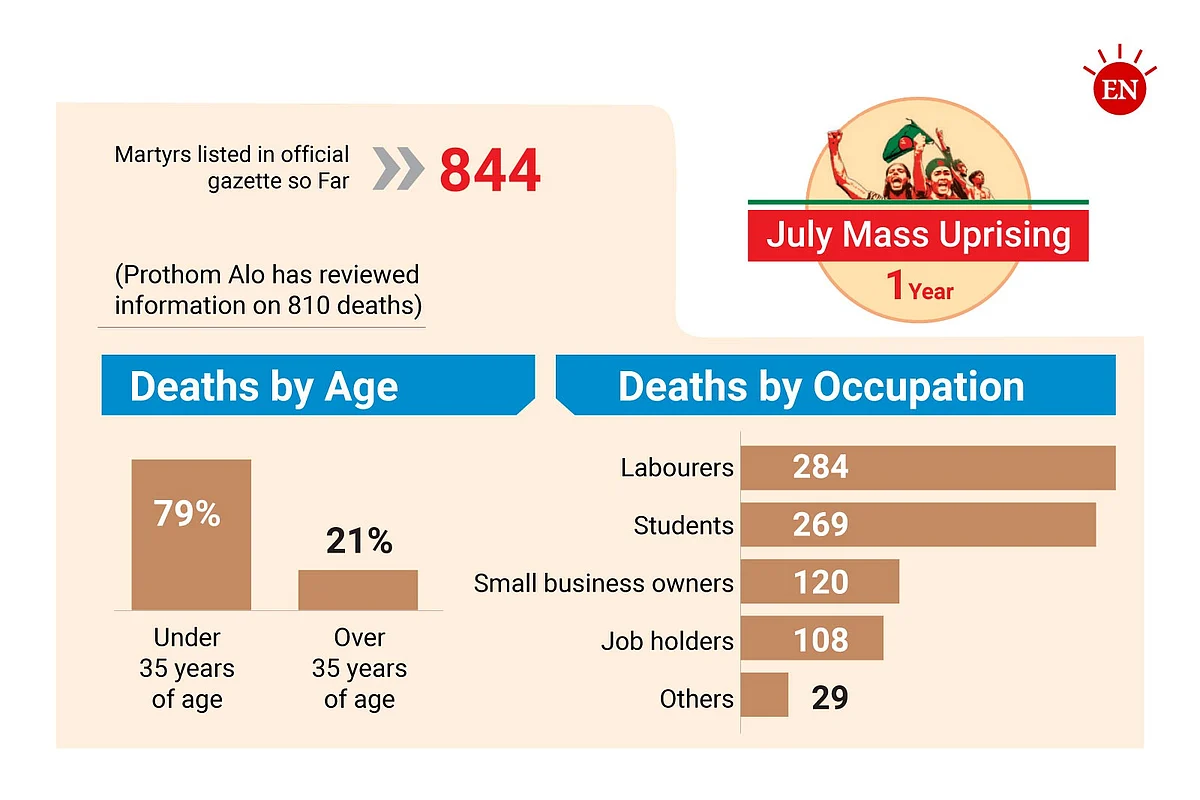
The majority of the deceased killed in July uprising were working-class people. At least 284 individuals from the labouring classes were martyred in the uprising.
Day labourers, rickshaw pullers, rickshaw-van drivers, CNG auto-rickshaw drivers, truck drivers and their helpers, shop workers, restaurant employees, and garment factory workers — both from formal and informal sectors — lost their lives during the uprising.
Out of the 844 names listed in the government’s official gazette of martyrs, Prothom Alo gathered specific information on 810 individuals. The newspaper interviewed the families of every one of them.
Based on family accounts and a breakdown by profession and age, the analysis shows that after labourers, students comprised the second-largest group of victims — 269 in total.
A significant number of these students were under the age of 18. School, college, and madrasah students, many of them minors, were at the forefront of the movement. According to Prothom Alo’s investigation, at least 133 children were killed during the uprising.
After labourers and students, the next highest number of deaths occurred among small and medium business owners — at least 120 lost their lives. They were followed by private sector employees, numbering 108.
Students led the uprising. But as the movement for equity and justice spread, people from nearly every class and profession joined in. This trend is also reflected in the government’s list of martyrs.
Prothom Alo’s analysis shows that 35 per cent of those martyred were working-class people. Besides, 33 per cent were students while 15 per cent were small or medium business owners, and 13 per cent were private sector employees.
Most of the killed were under 35
Among those killed during the July uprising, 79 per cent were under the age of 35 — that is 638 individuals. Notably, 17 per cent of the victims were children under 18. The majority died from live ammunition, though some were hacked, beaten, or burned to death.
Ages ranged from a 4-year-old child to a 70-year-old adult. In demographic terms, people between 15 and 64 years of age are typically considered “economically active.” Among the 810 martyrs Prothom Alo documented, 767 fell into this age group — meaning 95 per cent of the dead were working-age individuals.
The movement that sparked the July uprising was driven in part by demands for employment. Unemployment, inequality, and social injustice were core grievances. That so many working-age individuals joined spontaneously and lost their lives underscores the deep impact of these systemic issues. The scale of this loss is devastating for any country.
Large number of labourers joined the uprising
Many of the working-class people killed during the uprising were the sole breadwinners in their families. Their deaths have left their loved ones devastated.
Prothom Alo’s analysis indicates that Dhaka’s Jatrabari, Uttara, Mirpur, Mohammadpur, and Rampura areas witnessed the highest casualties — at least 324 people died in these five neighbourhoods. These areas are also home to large working-class populations. Particularly in Jatrabari, Mohammadpur, and parts of Mirpur, where fierce resistance took place, working-class people played a central role.
One such victim was Rajib Hossain, a CNG driver shot dead in Jatrabari on 19 July last year. His father, Tofazzal Hossain, told Prothom Alo on Wednesday that Rajib had lived in a rented flat with his wife and two children. Since his death, the family has been in crisis. They had to leave Dhaka and move to Damudya in Shariatpur, where his wife’s family lives.
Other areas like Savar, Gazipur, and Narayanganj — densely populated with formal and informal sector workers, including garment laborers — also saw high death tolls. According to the investigation, at least 65 people died in Savar, 36 in Gazipur, and 34 in Narayanganj. Many were working-class individuals.
Syed Sultan Uddin Ahmed, head of the Labour Reform Commission, told Prothom Alo that many labourers were killed while simply going to work. He said, “When a working-class person dies, the entire family falls into crisis.”
Labourers have long suffered systemic inequality, he added. Many could not accept the brutal killing of students, which pushed them to join the protests. The Labour Reform Commission has submitted several recommendations to the interim government for ensuring protection for the families of slain labourers, and for addressing structural inequality and improving workers’ living standards. These recommendations must now be implemented.
33pc of the victims were students
Among the dead were 269 students, including Abu Sayed and Mir Mahfuzur Rahman Mughda. The student deaths account for 33 per cent of all those martyred. The list includes students from public and private universities, schools, colleges, and madrasahs. One of them was 16-year-old Abdullah Al Mahin.
Mahin, a student of the National Institute of Engineering and Technology, was shot dead on 4 August in front of the Rajuk Commercial Complex in Azampur, Uttara. His mother, Samira Jahan, told Prothom Alo on Wednesday (16 July), “He told me, ‘What’s the point of studying if I don’t get a job because of discrimination?’ He said he would fight inequality even if it cost him his life. And he really did die.”
Another protester in Uttara was Sheikh Shihabuddin, a student of a polytechnic institute. Speaking to Prothom Alo, he said he joined the movement for two reasons: his belief in the demand to eliminate discrimination in employment and society, and the emotional trauma of seeing fellow students shot and injured. He recounted how indiscriminate gunfire tore through Uttara and how he helped carry wounded students to the hospital.
Youths faced the bullets
The July uprising was youth-led. Even in the face of police and military gunfire, they refused to abandon the streets.
A report published in February by the UN Office of the High Commissioner for Human Rights found that the Sheikh Hasina government employed systematic and increasingly brutal measures to crush the protests. Between 15 July and 5 August, more than 1,400 people may have been killed. The report stated that 66 per cent of the victims were shot by rifles, 12 per cent by shotguns, and 2 per cent by handguns.
Dhaka University professor of Population Sciences, Mohammad Mainul Islam, told Prothom Alo, “The youth who participated in the uprising became symbols of courage. One of the most striking aspects of this movement was the death of more than a hundred children and adolescents. Their sacrifice in the face of injustice and inequality will never be forgotten.”
[This report was prepared with assistance from Prothom Alo correspondents Md Mamun, Jannatul Naeem, Abriti Ahmed, and district correspondents.]