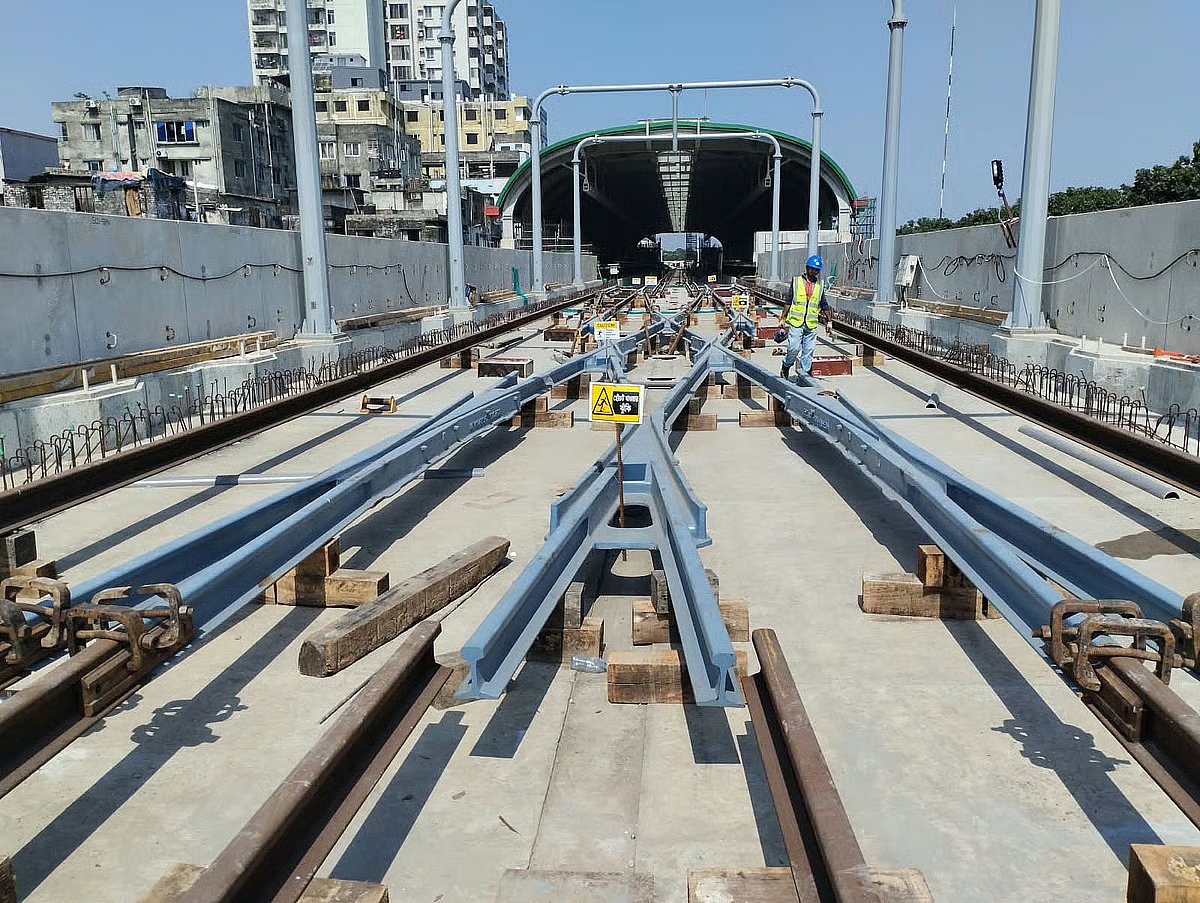
Metro rail extension to Kamalapur 85pc complete, service set to begin in July
Sohel Rana, an employee of a private company, lives in Farmgate of the capital city. During this year’s Durga Puja holiday, he was travelling by train to his village home in Mohanganj. He took the metro rail from Farmgate station to Motijheel and then took an auto-rickshaw to reach Kamalapur Railway Station.
The rickshaw journey from Motijheel to Kamalapur cost him Tk 40 whereas, the metro journey from Farmgate to Motijheel had cost him just Tk 28. Apart from the additional expense, it involved the hassle of getting on and off the stations, changing the mode of transportation and the extra delay.
While speaking to Prothom Alo at around 12:00 pm last Wednesday, Sohel Rana said he had reached Motijheel from Farmgate by metro rail in very little time. If the metro service had extended to Kamalapur, he said, both the time and cost of his journey would have been lower.
The metro rail as a mode of transportation is becoming increasingly popular in Dhaka. Around 100,000 passengers travel through Motijheel station alone every day. From there, they disperse to different destinations, including Kamalapur, the country’s main railway station.
Against this backdrop, those concerned believe that extending the metro rail to Kamalapur will attract even more passengers. Currently, work is under way to extend the line from Motijheel to Kamalapur.
The Dhaka Mass Transit Company Limited (DMTCL) is responsible for constructing and operating the metro rail in Dhaka. The company had earlier planned to begin trial runs on the extension to Kamalapur in January, with passenger services scheduled to start in April.
However, sources concerned with the project say some changes are being made to the plan. Under the revised schedule, trial runs from Motijheel to Kamalapur are expected to begin in February. Commercial services carrying passengers could start in early July.
Visiting the site it was found that track-laying work is under way on the Motijheel–Kamalapur section. Electrical work is also continuing. However, the delivery of some equipment from Japan, including the fare collection system for the station, may be delayed. This could push back the opening slightly. Some work at Kamalapur metro station, including the installation of lifts also remains unfinished.
Sources concerned with the project say some changes are being made to the plan. Under the revised schedule, trial runs from Motijheel to Kamalapur are expected to begin in February. Commercial services carrying passengers could start in early July.
According to DMTCL records, a total of 313.5 million (31.35 crore) passengers had travelled by metro rail by the end of August since the service began. Company officials say the daily passenger count now consistently exceeds 450,000.
When the project was planned, the estimated daily ridership between Uttara and Motijheel was 500,000. The current number of passengers is therefore close to the original projection. Once the extended section to Kamalapur opens, daily ridership is projected to reach 677,000.
Engineers involved in the project said around 30 per cent of the track-laying work had been completed so far. The authorities aim to finish it by December. About 40 per cent of the electrical work has also been completed.
Work yet to be completed
Visiting the Motijheel–Kamalapur metro rail section last week, workers were found using a temporary staircase to move up and down to the section in front of the Bangladesh Bank. The workers said construction of the elevated structure had been completed and that track-laying was now under way.
The metro rail runs entirely on electricity. Power poles have been installed along both sides of the track, and wires will be strung between them. The trains will operate through connections to these overhead wires.
Piles of sand and stones were lying beneath Kamalapur metro station. Monir Hossain, who works at the construction site, said the condition of the road below was dilapidated because of the ongoing station construction. Road repairs would therefore begin soon.
Engineers involved in the project said around 30 per cent of the track-laying work had been completed so far. The authorities aim to finish it by December. About 40 per cent of the electrical work has also been completed.
Other outstanding tasks include installing lifts at Kamalapur metro station, fitting the signalling system and automated fare collection equipment, laying tiles, preparing the toilets and installing water pumps, they said.
An engineer involved in the project, speaking to Prothom Alo on condition of anonymity, said senior officials had instructed that the metro rail should open in June or July. However, the service could begin operating in July even if some ancillary work remained unfinished, the engineer said, adding that this would not cause any problems.
Until recently, trains from Kamalapur Railway Station had served only the northern and eastern regions of the country. Since the opening of the Padma Bridge, train services to the southern and south-western regions have increased. In this context, the metro rail extension to Kamalapur would attract additional passengers and ease pressure on the roads, he said.Samsul Haque, transport expert
The metro rail line from Uttara to Kamalapur is known as MRT Line 6. Director of the project Brigadier General (retired) Md Abdul Wahab, told Prothom Alo that overall progress on infrastructure construction for the Motijheel–Kamalapur section stood at 85 per cent.
The project director hopes that the metro rail would reach Kamalapur by the end of June or the beginning of July. He added that the contract with the contractor ran until September, but efforts were being made to complete the work three months ahead of schedule.
How metro rail came to Dhaka
The metro rail project was launched in 2012 to ease traffic congestion in Dhaka with a construction cost of Tk 334.72 billion (33,472 crore). Around 59 per cent of the construction cost was financed through a loan from the Japan International Cooperation Agency (JICA).
The metro rail service from Uttara to Agargaon began on 28 December 2022. The section from Agargaon to Motijheel opened on 4 November the following year.
The Motijheel–Kamalapur section was originally scheduled to open in June 2025. A contractor was appointed in 2023 to construct the elevated structure and Kamalapur station along the 1.16-kilometre extension.
The physical construction work on the Motijheel–Kamalapur section is being carried out by Thailand-based Italian-Thai Development Public Company.
However, the appointment of a contractor for the electromechanical work was delayed. During the previous Awami League government, the contractor had submitted a bid of Tk 6.51 billion (651 crore) for the work. After the interim government took office, it pressed the contractor to reduce the cost.
Following negotiations, the amount was cut by Tk 1.86 billion (186 crore), and Indian company Larsen and Toubro was appointed to carry out the work for Tk 4.65 billion (465 crore). The company is currently undertaking the work.
Samsul Haque, a professor in the Department of Civil Engineering at Bangladesh University of Engineering and Technology (BUET) and a transport expert, told Prothom Alo that until recently, trains from Kamalapur Railway Station had served only the northern and eastern regions of the country. Since the opening of the Padma Bridge, train services to the southern and south-western regions have increased.
In this context, the metro rail extension to Kamalapur would attract additional passengers and ease pressure on the roads, he said. The investment in the metro rail had already been made, and to recover the costs quickly, the authorities needed to make the most of passenger demand, he added.