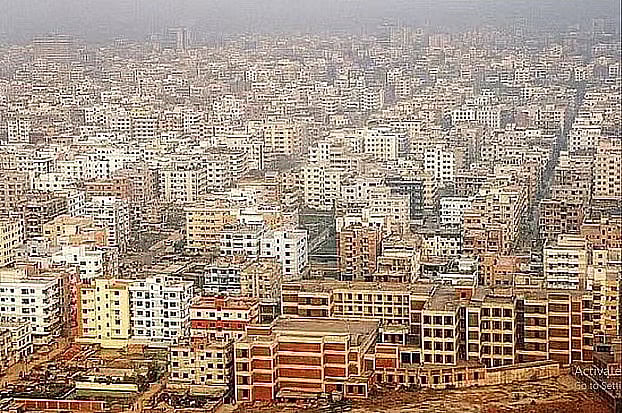
If a 6.9-magnitude earthquake strikes along the Madhupur Fault in Tangail, around 40 per cent of buildings in Dhaka could collapse and more than 200,000 people may lose their lives.
The Rajdhani Unnayan Kartripakkha (RAJUK) voiced this warning citing one of its own surveys. Ironically, RAJUK itself is responsible for ensuring that buildings in the capital comply with construction regulations and for overseeing planned urban development.
The findings were presented by RAJUK at a seminar and discussion titled ‘Preparedness and Actions to Reduce Earthquake Risks’, held Monday at the Institution of Engineers, Bangladesh (IEB) building in Ramna area of the capital. The seminar was organised by RAJUK following four tremors that shook Dhaka on Friday and Saturday.
Two of the advisers to the interim government, the RAJUK chairman, representatives of emergency services, representatives of professionals’ organisation, and experts in seismology and disaster management attended the event.
It is being said that 40 per cent of buildings would collapse in a major earthquake, and the primary responsibility for that lies with RAJUK. However, building owners and engineers cannot avoid responsibility either.Akter Mahmud, Urban planner and professor at BUET
Environment Adviser Syeda Rizwana Hasan urged the authorities to immediately begin assessing the vulnerability of buildings in the capital. Calling for the involvement of third parties in the assessment, she said there is no room for delay.
Mentioning that the RAJUK and the City Corporations must act strictly if needed, the environment adviser noted it’s really crucial that no leniency is shown where demolition is inevitable. She also suggested giving RAJUK special powers if required.
During the seminar, Industries Adviser Adilur Rahman Khan said amendments to the Town Improvement Act were being finalised to strengthen RAJUK’s authority.
How many buildings could collapse
The survey on how much damage will be there in case of an earthquake was conducted under RAJUK’s portion of the Urban Resilience Project (2015–2024), implemented at a cost of Tk 5.68 billion (Tk 568 crore).
Bangladesh last experienced a major earthquake of magnitude 7.5 in 1885 along the Madhupur Fault. Nearly 140 years have passed yet there has been no such major earthquake in that fault.
RAJUK’s executive engineer Khandaker Md Wahid Sadiq presented a paper in the seminar outlining potential damage. He said a 6.9-magnitude earthquake along the Madhupur Fault could cause 864,619 buildings to collapse in Dhaka, slightly more than 40 per cent of all structures.
The estimated financial loss in that would be USD 25 billion (USD 2500 crore) approximately Tk 3,000 billion (Tk 3 lakh crore). Repair or reconstruction of damaged buildings could cost USD 43.7 billion (USD 4,370 crore) approximately Tk 5,330 billion (Tk 5.33 lakh crore).
Despite long-standing warnings of earthquakes in the country, little action has been taken against old, risky, unauthorised, or illegally constructed buildings in Dhaka. Meanwhile, RAJUK is the authority responsible for ensuring compliance with building codes during construction itself.
Back in 1956, the Dhaka Improvement Trust (DIT) was established with special authority for planning and development in and around Dhaka. DIT became RAJUK in 1987.
RAJUK’s stated vision is “planned and sustainable urbanisation and livable housing in the area under its jurisdiction,” while its mission includes safe housing for all and building a disaster-resilient city. However, the agency faces widespread allegations of corruption and prioritising allocation of plots to the influential rather than enforcing planned development.
Urban planner and professor at the department of Urban and Regional Planning of Jahangirnagar University, Akter Mahmud told Prothom Alo that RAJUK has three tasks: planning, development, and development control. He said it has disappointingly failed in development control.
It is being said that 40 per cent of buildings would collapse in a major earthquake, and the primary responsibility for that lies with RAJUK. However, building owners and engineers cannot avoid responsibility either, he added.
A call for retrofitting buildings
Professor at the department of civil engineering in Bangladesh University of Engineering and Technology (BUET) Mehedi Ahmed Ansary emphasised the need for retrofitting buildings in Dhaka to reduce earthquake risks. He also presented a paper at the seminar.
Referring to a BBC report, Professor Mehedi Ahmed Ansary said rescuing a single person during the Turkey earthquake cost about Tk 3 million (Tk 30 lakh). In contrast, retrofitting a six-storey building on five kathas (approximately 3.125 decimal) of land in Dhaka would cost Tk 5 to 6 million (Tk 50-60 lakh).
The professor noted that the government wouldn’t have to bear the cost, five people who would buy apartments worth Tk 10 million (Tk 1 crore) could collectively fund retrofitting a building.
Professor Mehedi Ahmed Ansary said there will definitely be an earthquake here. Instead of debating when it might happen, he stressed the need to focus on how to prepare for it.
Bangladesh Institute of Planners (BIP) President Adil Mohammed Khan remarked that geological characteristics are almost entirely overlooked in the country’s urbanisation process. As a result, Dhaka has expanded through unplanned development into water bodies, wetlands and floodplains over the past 30 years. Constructing buildings in such areas is hazardous.
The BIP president further noted that RAJUK has prepared a seismic micro-zonation map for Dhaka, which outlines the earthquake risks and likely impacts for specific zones. However, the Detailed Area Plan (DAP) has been altered without aligning it to this map.
Under pressure from business groups, the Floor Area Ratio (FAR), which determines building height in relation to road width, has been increased in various areas, including high-risk zones. This will lead to far greater damage during an earthquake, he warned.
However, RAJUK chairman Md Riazul Islam told the seminar that the current DAP is not final. He said it has been approved only for a short period. After its gazette notification, a technical committee will be formed, and the plan will be implemented in line with the committee’s recommendations.
300 risky buildings identified in two days
In response to a question from journalists after the seminar, the RAJUK chairman said that following several recent earthquakes in the capital, a total of 300 small and large buildings had been identified as risky up to last Friday.
When a journalist asked whether RAJUK would publish a list of officials involved in approving the designs of these risky buildings, the RAJUK chairman replied that action had already begun against the officials involved.
He added that responsibility lies with both RAJUK and the building owners for unauthorised and non-compliant construction. The primary responsibility falls on the building owners and then the officials, he said.
Among others, Housing and Public Works Secretary Md Nazrul Islam, BUET Professor Md Jahangir Alam, Professor Tanvir Manzur, and president of the Institute of Architects Bangladesh (IAB) Abu Sayeed M Ahmed also spoke at the seminar.