Crime continues in Cumilla despite crackdown as teen gang names appear on walls
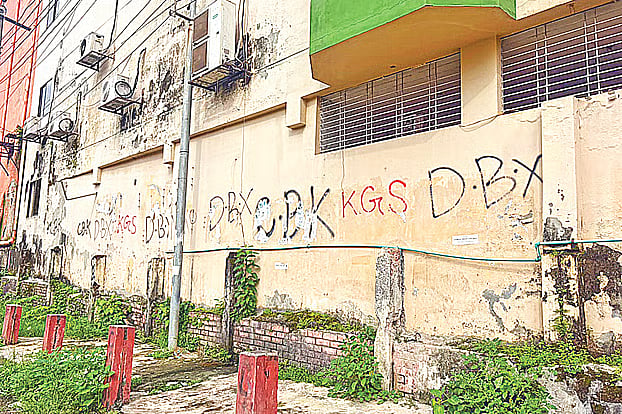
The Town Hall area of Kandirpar in Cumilla is always crowded, with a library, events at the auditorium, gatherings on the field and shops nearby. On several sections of the wall beside the Town Hall field, the names ‘CBK’, ‘DBX’ and ‘KGS’ have been written.
Abdul Motaleb sells clothes on the pavement in front of the Town Hall. Asked who had written those names, he said, “We don’t even look in that direction. Those boys are no good. In the evening, teenagers come to the field. They are the ones who wrote those names.”
People familiar with the matter said all three names belong to teen gangs in Cumilla. Writing their names on walls is an attempt to identify themselves.
Information has now emerged of groups being formed and displaying their strength not only on walls but also on social media.
An investigation by Prothom Alo found information indicating that at least 20 gangs are active in Cumilla city. Members of these groups have been named in at least 25 widely discussed criminal incidents in the first nine months of this year. However, the activities of such criminal groups have been continuing for more than a decade.
The district police, however, do not have an updated list showing how many such groups are currently active. From 2017 to 2025, members of teen gangs were named in at least 12 murder cases. Although they are referred to as “teen gangs,” not all their members are teenagers; many members, including gang leaders, are over 18.
The activities of teen gangs have come under renewed scrutiny following the killing of school student Ishayat Shahriar Apratim. In the meantime, 18 police stations conducted simultaneous raids across Cumilla from Wednesday evening until late at night and detained 624 people.
After verification, 451 were released on Thursday into the custody of their parents after their guardians signed undertakings. The remaining 173 were sent to court on various charges. However, police did not say whether all 173 had been found to have links to teen gangs.
Cumilla Superintendent of Police Md Anisuzzaman told Prothom Alo that since taking charge on 30 November last year, more than 250 members of teen gangs have been arrested. He said many were released quickly and became involved in similar crimes again. In many cases, their parents were also called in and made to sign undertakings.
However, District Public Prosecutor (PP) Kaimul Haque believes the police also bear some responsibility for the quick release of such suspects. He said that if a case statement does not contain specific details of the offence or information about an accused person’s previous allegations, even someone involved in a serious crime may benefit from the legal process.
Representatives of civil society said that, alongside major crackdowns, regular monitoring and proper investigation of crimes were essential.
Identity on walls, groups on social media
On the long wall beside the field behind the market next to Cumilla Town Hall, ‘CBK’ and ‘DBX’ have been written in black, while ‘KGS’ appears in red in between them. A little farther along, the same names appear again. The names are also written along the lower part of the wall. DBX has also been written on the wall in front of the Cumilla Ministerial Officers Club on the other side of the field.
Such coded names are commonly used by online or TikTok-based youth criminal groups to promote their groups in the criminal underworld and on social media.
Among them, CBK is known to police as “Cumilla Brothers Community.” In October 2024, police arrested a gang leader named Tanzim Abdullah. Police said at the time Tanzim led CBK and several subgroups operating under different names.
The groups were accused of snatching, extortion, drug sales and motorcycle displays. Police also said the groups had an estimated 750 members.
It has not been fully established who is behind DBX (Deadly Boys) and KGS (King Gangster Squad).
However, KGS bears some similarity to Cumilla’s well-known teen gang, King Squad. The words ‘Prince Nehal’ are also written in the same ink in front of the DBX inscription.
The practice of writing gang names on walls in Cumilla is not new. Local sources said gang names and logos were seen on walls in various parts of the city, including around Dharmasagar, in 2022. At the time, there was also information about the groups having Messenger groups and designated hangout spots.
Prothom Alo’s investigation has found that teenagers and young people are now being recruited through TikTok videos and social media groups as well as through wall markings. This has been followed by incidents of groups taking to the streets, staging motorcycle parades and brandishing weapons.
Old groups, new subgroups
Teen gang activity in Cumilla came under widespread discussion around 2015. At the time, three or four groups were particularly active. By around 2022, the number of prominent groups had risen to at least 20.
At present, King Squad, Squad or Ratan Group, Eagle, CBK and Crime Setup are among the groups most frequently discussed. Information has also emerged about two more groups named after Apu and Sabbir.
There are instances of the same members associating with multiple groups. Separate subgroups have also formed within larger gangs under different names. As police do not have an updated list, there is no complete picture of how many groups are currently active, who leads which group, or whether members are moving from one group to another.
Prothom Alo’s investigation found information about gang conflicts around Kandirpar, Dharmasagar, Ranir Dighi, Tal Pukurpar and Court Para. On 25 April last year, during the Cumilla University admission test, several groups staged a display with locally made weapons in Ranir Dighi, Tal Pukurpar and Court Para. The incidents caused panic among examinees, guardians and passers-by.
The names of CBK and Eagle emerged in connection with the display. Two days later, a joint force arrested nine people in Durgapur and Racecourse. Weapons and ammunition were recovered from them.
In May this year, there was information about another armed displays in Bhatar Pukur, Kaptan Bazar, Bow Bazar, Chanpur and Sangraish. Kotwali Model Police Station Officer-in-Charge (OC) Touhidul Anwar told Prothom Alo that the group was called “Crime Setup.”
New crackdown after Apratim’s killing
Ishayat Shahriar Apratim, a seventh-grade student at Cumilla Border Guard Public School, went missing after leaving his home in Gandhamati, Kotbari, at noon on 18 September. His body was recovered the following day from an isolated forest in Lalmai Hill. He was the only child of Nahida Begum, an associate professor in the Department of Bangla at Comilla University.
Police have arrested four people in the case, two of them minors. Police said three of them, including the principal accused, Saiful Islam Tuhin, have given confessional statements before a court. The investigation has brought to light both a plan to snatch Apratim’s iPhone and attempts to lure him into making TikTok videos and associating with older youths. After the murder, teachers and students at the university called for action against teen gangs.
Regarding the latest crackdown, Cumilla district police media officer and Additional Superintendent of Police Md Lutfur Rahman said Thursday afternoon that most of the 451 people detained the previous night who were released into their parents’ custody after signing undertakings were students. The remaining 173 were subjected to legal action on various allegations, including drug use, existing criminal cases, arrest warrants and involvement with a banned organisation.
Prothom Alo separately checked with several police stations. In the Kotwali Model Police Station area, 71 people were detained. Of them, 30 were released into their parents’ custody after signing undertakings. Police said the others were subject to legal procedures over allegations of drug use, existing cases, arrest warrants and other matters.
Kotwali police station OC Touhidul Anwar told Prothom Alo that among those facing legal action, four were known members of teen gangs. They are minors and work with various known criminal groups. Cases had previously been filed against them, and the matters were being investigated further.
In Sadar South Model Police Station area, which came under discussion following Apratim’s murder, 44 people were detained. Of them, 30 were released after signing undertakings.
Police said that of the remaining 14, nine were sent to court under Section 34—for specified offences causing public nuisance on roads and in open places—and five under Section 151, which allows arrest without a warrant to prevent a cognisable offence.
Additional Superintendent of Police Lutfur Rahman said several of those sent to court were directly involved with known gangs. He said their identities were not being disclosed yet in the interest of the investigation. However, he stressed that not everyone detained in the operation could be described as a member of a teen gang.
Disorder in Daudkandi, allegations of vandalism denied
During Wednesday night’s operation, police from Daudkandi Model Police Station and the Gouripur Investigation Centre detained 59 teenagers. At around 8:00 pm, disorder broke out at the police station. Amid allegations that parents attacked the station and damaged furniture, doors and windows, some of the detained teenagers reportedly escaped. However, the police station and district police denied the allegations of assault and vandalism.
An investigation found that more than 100 people—including men, women, children and teenagers—were inside the police station that night. At one point, tensions rose. Most of the 28 teenagers kept in one room broke down the door and came out. Some of them, along with parents who were outside, chanted “Bhua! Bhua!” (Useless) in front of the station.
A video circulated on social media shows furniture scattered inside the room, a plastic chair overturned and the door damaged. However, the video does not establish when or how the door was damaged.
At around 1:00 am on Thursday, OC Mohammad Sajedul Islam Palash told journalists that parents had come to the station after hearing that their children had been detained and had started creating a disturbance to get them released. At that point, part of an old door came loose.
Some chairs were overturned amid the chaos. However, he said the allegations of an attack and vandalism at the station were incorrect. After verifying the information, the teenagers were handed over to their parents after the guardians signed undertakings.
The OC told Prothom Alo on Thursday evening that no involvement in criminal activities had been found among the 59 detainees. All of them had been released into their families’ custody after signing undertakings by that night.
Additional Superintendent of Police Lutfur Rahman said misinformation had been spread about the incident. He told Prothom Alo on Thursday afternoon that because of the large number of detainees, 28 people had been kept in an abandoned room at the police station while their information was being verified.
Parents gathered there and created a disturbance, after which several teenagers came out. Some chanted “Bhua! Bhua!” (Useless). Police quickly brought the situation under control. The parents of the teenagers who left the room brought them back. Those who were students and were found not to be involved in crime were released after detailed verification and screening.
Calling the allegations of an attack and vandalism at the police station a “rumour,” Lutfur Rahman said the door to the room had already been damaged. He said no vandalism had taken place there.
Weaknesses in cases and questions over monitoring
PP Kaimul Haque told Prothom Alo that many of those detained in Wednesday night’s operation had been sent to court under Sections 34 and 151. In such cases, if there is no specific information indicating an offence beyond mere suspicion, the scope for keeping them detained is limited.
Kaimul Haque said case statements must be prepared on the basis of specific information and allegations. Detailed descriptions of the offences, as well as any previous cases or allegations against the accused, should also be included. He urged police to be more careful when filing cases.
District police said they plan to conduct such operations once or twice a week. Additional Superintendent of Police Lutfur Rahman also acknowledged that some shortcomings had been identified in the first round of operations. He said those shortcomings would be addressed before the next operations. Teenagers released into their parents’ custody after signing undertakings would also remain under surveillance.
The Special Response Battalion (SRB) also said it would continue conducting operations alongside the police. Major Sadman Ibn Alam, deputy director of CPC-2, SRB-11, Cumilla, told Prothom Alo that the former RAB and the current SRB had previously conducted operations against teen gangs in Cumilla. He said they arrest people involved on the basis of specific information.
Major Sadman claimed, “We have mainly arrested teenagers or young people who were leading the gang culture. At least 20 gang leaders have been arrested this year alone.” Saying that future operations would be made more effective, he added that efforts were underway to identify and arrest those leading the gangs.
People familiar with the situation said the names written on the walls beside the Town Hall remain. Both the old practice of publicly identifying gangs and new crackdowns following crimes are being seen in Cumilla.
Professor Md Abdul Latif, president of the Cumilla Citizen's Rights Forum, said such a simultaneous operation across all 18 police stations in the district had not been seen before. However, he stressed that continuity was essential. “If law enforcement agencies had maintained regular surveillance, teen gangs would not have had the opportunity to grow in this way,” he said.
Abdul Latif said teenagers must be identified and brought under the law at the earliest stage of their involvement in crime. Parents, too, need to keep track of where their children go, where they stay after evening and whom they associate with.