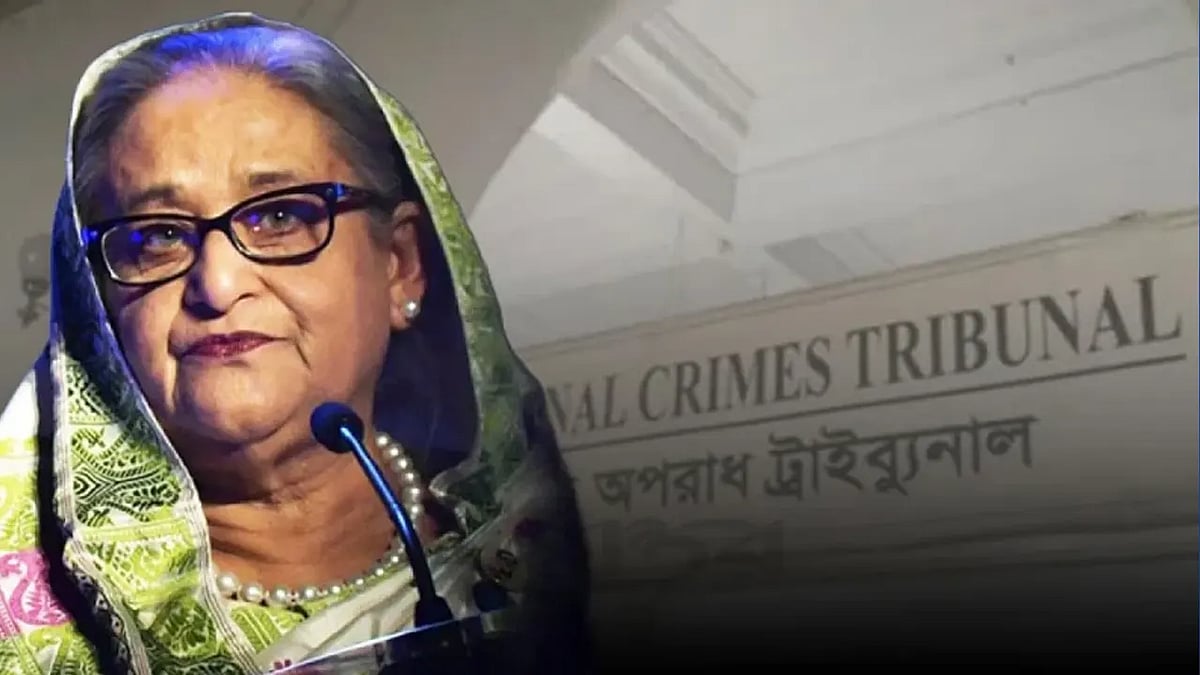
One of the offenses considered by the International Crimes Tribunal (ICT) against deposed prime minister Sheikh Hasina was her use of inflammatory statements.
The tribunal, in its verdict, stated clearly that even after being ousted in the July mass uprising, Sheikh Hasina continued to deliver hate-filled remarks. The verdict also noted that she has been making disparaging or contemptuous comments on social media.
According to the announced verdict, Sheikh Hasina has shown no remorse. She has not sought forgiveness; instead, she has continued issuing threats from time to time through ‘hate speech.’
The full copy of the verdict has not yet been released. However, while announcing the verdict last Monday, the tribunal highlighted several points, some of which related to Sheikh Hasina’s actions.
The tribunal mentioned during the verdict announcement that Sheikh Hasina had previously been instructed to refrain from making disparaging and hate-inciting statements. The verdict stated that in a phone conversation with party leader Shakil (from Gaibandha), Sheikh Hasina made hate-laden and derogatory remarks.
In that conversation, Sheikh Hasina reportedly said that since there were 226 cases filed against her, she had received the “license” to kill 226 people.
In a case concerning crimes against humanity committed during the July mass uprising, International Crimes Tribunal-1 sentenced Sheikh Hasina and former home minister Asaduzzaman Khan to death.
Another accused in the case, former inspector general of police (IGP) Chowdhury Abdullah Al-Mamun, was sentenced to five years in prison. The three-member Tribunal-1, headed by justice Golam Mortuza Mojumder, delivered the verdict. The announcement was broadcast live.
Provocative comments provoke others
The verdict also included the details of Sheikh Hasina’s conversation with then Dhaka University vice-chancellor Maksud Kamal on 14 July last year.
In that conversation, Sheikh Hasina spoke about the protesting students: “I have already hanged the Razakars; now I will do the same to you (the protestors). I will not spare a single one of you, I (Sheikh Hasina) am telling you.”
According to the tribunal, it is crystal clear that Sheikh Hasina’s instigating comments provoked her party activists, including Bangladesh Chhatra League and Jubo League. Her remarks incited the protestors as well. Through these statements, she effectively ordered the killing and elimination of the protestors.
After reviewing the events and surrounding circumstances, the tribunal observed in its verdict that instead of listening to the students or addressing their demands, then-prime minister Sheikh Hasina tried to “undermine the movement” and called the students “Razakars”—a term considered a grave insult in Bangla.
She had earlier remarked: “If the grandchildren of freedom fighters won’t get jobs, who will? Do the grandchildren of Razakars get them?”
Following such insulting comments, students became vocal. They demanded that Sheikh Hasina withdraw the remarks and apologise.
‘Order to use drones, helicopters and lethal weapons with intent to kill’
The tribunal noted in the verdict that Sheikh Hasina ordered law enforcement agencies to use drones to track the positions of the protestors. Subsequently, helicopters and lethal weapons were used with the intention of killing them.
The existence of such orders emerged from a phone conversation between Sheikh Hasina and then Dhaka South City Corporation mayor Sheikh Fazle Noor Taposh on 18 July last year.
Joint complicity in brutality
The tribunal stated that Sheikh Hasina, Asaduzzaman Khan Kamal and Chowdhury Abdullah Al-Mamun jointly committed brutalities with the intent to kill protesting students, acting in tacit understanding and collaboration.
Testimony from Mamun revealed that a “core committee” was formed consisting of the then home secretary Jahangir, an additional secretary, the SB chief, the DB chief, the RAB director general, the Dhaka Metropolitan Police commissioner, the directors general of BGB and Ansar, the head of NTMC, and the chiefs of DGFI and NSI.
After 19 July 2024, the core committee met every night at the residence of then home minister Asaduzzaman Khan Kamal. The committee received directives from Sheikh Hasina.
The tribunal stated in its verdict that Mamun’s testimony revealed decisions to use drones to identify protest gathering points. Decisions were also made to deploy helicopters and use lethal weapons.
Having no remorse
During closing arguments, ICT chief prosecutor Mohammad Tajul Islam said that none of the accused (Sheikh Hasina and Asaduzzaman) showed any remorse. Despite the gravity of the crimes, no sign of regret was visible. Instead, Sheikh Hasina continued issuing threats to those who filed cases or testified against her, warning that she would destroy their homes.
The tribunal referenced this point in the verdict, adding that Sheikh Hasina has continued delivering hate speech. Though instructed to refrain from spreading hatred, she did not comply.