Gas crisis
New gas connections for industries put on hold for now
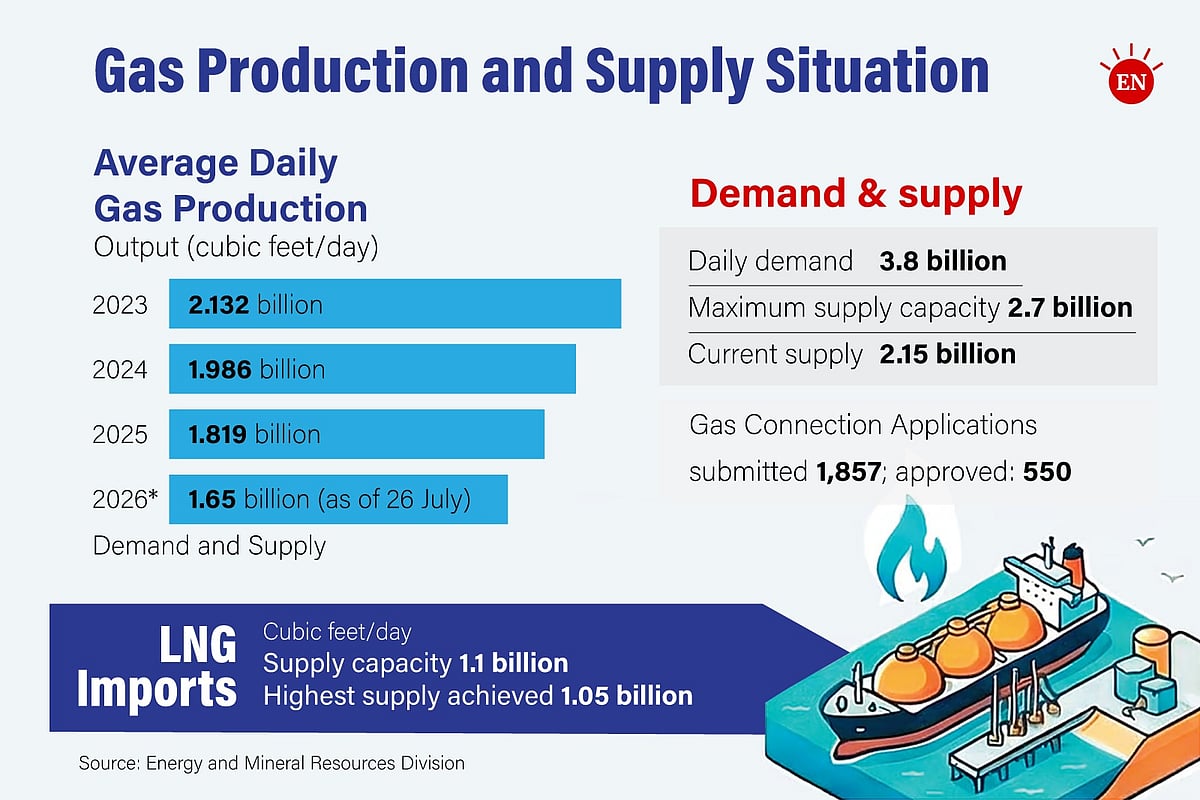
Average domestic gas production in Bangladesh is declining by more than 150 million cubic feet per day each year. Even imports of liquefied natural gas (LNG) have failed to make up the shortfall. Whenever imports are disrupted for any reason, the gas shortage worsens.
The shortage has been affecting power generation and industrial production on a regular basis. Meanwhile, demand for gas continues to rise. Against this backdrop, the government will not provide new gas connections to industries for the time being.
On 14 July, the Ministry of Power, Energy and Mineral Resources sent a letter to the chairman of Bangladesh Oil, Gas and Mineral Corporation (Petrobangla). The letter said that production from domestic gas fields is declining.
At the same time, LNG imports remain constrained by the country's two floating storage and regasification unit (FSRU)-based facilities. As a result, granting new gas connections to industries is not being considered at this time.
An FSRU (Floating Storage and Regasification Unit) stores imported LNG and converts it into natural gas for supply through the pipeline network. Bangladesh has two such floating terminals in the sea off Maheshkhali in Cox's Bazar. Together, they have a gas supply capacity of 1.1 billion cubic feet per day, with a maximum supply of 1.05 billion cubic feet per day.
As one of the terminals is currently out of operation, supply has fallen to less than 500 million cubic feet per day. As a result, the gas shortage has intensified across all sectors over the past week.
However, suspending new gas connections for industries is not a new policy. Because of the gas crisis, new connections for industrial and commercial consumers were halted from 21 July 2009, while new residential connections were suspended from 13 July 2010.
Subsequently, a high-level committee headed by the then prime minister's energy adviser, Tawfiq-e-Elahi Chowdhury, was formed to decide on granting emergency gas connections and increasing gas allocations (loads) for priority industries. That committee approved gas connections for some factories.
However, it later faced allegations of corruption. The committee was eventually dissolved, after which the then government approved some gas connections through the regular process.
Meanwhile, the previous interim government formed a committee to prepare a priority list from applications for approved gas connections.
Bangladesh produced 2.7 billion cubic feet of gas per day in 2017, but output has been declining ever since. LNG imports began in 2018. At present, the maximum daily gas supply from domestic production and imported LNG combined is 2.7 billion cubic feet.
Based on the committee's recommendations, the Energy Division approved 25 gas connections under Titas Gas. That committee was later dissolved as well. After the BNP government assumed office, a meeting chaired by Energy Adviser Iqbal Hasan Mahmud was held at the Secretariat on 17 May. Although the meeting discussed industrial gas connections in detail, no decision was reached.
According to sources at the Energy and Mineral Resources Division, domestic gas production is declining every week, if not every day. Production has not been maintained despite the drilling of new wells. Over the past decade, daily gas output has fallen by more than 1 billion cubic feet.
Bangladesh produced 2.7 billion cubic feet of gas per day in 2017, but output has been declining ever since. LNG imports began in 2018. At present, the maximum daily gas supply from domestic production and imported LNG combined is 2.7 billion cubic feet.
However, there is no scope to increase imports because of infrastructure constraints. Even if the government wants to, it cannot increase supply. It is therefore looking for alternative solutions.
State Minister for Power, Energy and Mineral Resources Aninda Islam Amit told Prothom Alo that the suspension of new industrial gas connections is temporary. The government is working on several alternatives to increase gas supply quickly. Multiple initiatives are under way to bring gas from Bhola to Dhaka.
Discussions are also ongoing to import LNG from Malaysia using ISO tanks (special containers for transporting LNG). Once gas supply improves, new connections will be approved according to a priority list. Those who have already received approval and paid the demand note fees will be given priority.
It will take time to increase supply
Two senior officials at the Energy Division told Prothom Alo that more than half of the country's power plants remain idle because of gas shortages, while fertiliser factories stay shut for most of the year. Granting new gas connections without ensuring supply would not solve the problem, as supplying gas to one consumer would require cutting off another.
The suspension of new industrial gas connections is temporary. The government is working on several alternatives to increase gas supply quickly. Multiple initiatives are under way to bring gas from Bhola to Dhaka.State Minister for Power, Energy and Mineral Resources Aninda Islam Amit
The government is working on several plans to boost gas supply, but officials estimate that it may take at least one year before supply can be increased sufficiently. Only then does the government intend to provide new industrial connections.
People associated with the energy sector say supply cannot realistically be increased within a year. Even if new gas fields are discovered, it could take several years before production begins. Expanding LNG imports would also require at least 18 months to build the necessary infrastructure.
A meeting was held yesterday with Malaysian officials regarding LNG imports. An official who attended the meeting told Prothom Alo that building the infrastructure required for ISO tanks would take a year. Even then, Malaysia would be able to supply only 13 million cubic feet of gas per day, far below the demand of a single large industrial factory.
The system is designed for only a very limited volume of supply and would also make LNG significantly more expensive. As a result, it would be difficult to implement. The official said expanding imports would ultimately require the construction of new LNG terminals.
The previous Awami League government had planned to build two additional floating LNG terminals and one land-based terminal alongside the existing two. A contract for one floating terminal was signed with Summit, while a term sheet for another was signed with US company Excelerate.
People associated with the energy sector say supply cannot realistically be increased within a year. Even if new gas fields are discovered, it could take several years before production begins. Expanding LNG imports would also require at least 18 months to build the necessary infrastructure.
After taking office, the interim government cancelled the Summit contract and decided not to proceed with the agreement with Excelerate. As a result, no new LNG terminal has been added over the past 18 months.
However, building additional terminals alone would not increase gas supply. According to Gas Transmission Company Limited (GTCL), two parallel pipelines carry LNG from Maheshkhali to Anwara in Chattogram, with a combined capacity of 1.7 billion cubic feet per day.
But the downstream pipelines from Anwara are narrower in diameter and can carry no more than 1.1 billion cubic feet per day. Since gas consumption mainly begins beyond Anwara, new transmission pipelines will also have to be built before supply can be increased.
No alternative to increasing supply quickly
According to Petrobangla sources, 11 per cent of the country's gas is used for household cooking. The largest share—41 per cent—is consumed by the power sector, followed by 36 per cent by industry. The fertiliser sector uses 6 per cent, CNG accounts for 5 per cent, and the tea sector consumes 1 per cent.
To manage demand, gas is often diverted from power generation to fertiliser production, or from fertiliser back to the power sector, depending on immediate demands. CNG stations are also shut down at times to curb demand.
The interim government's decision to cancel the LNG terminal agreement was a mistake. Bangladesh now needs to increase domestic gas production while also expanding the infrastructure required for LNG imports.Energy expert M Tamim
Bangladesh's gas sector has been operating under such stopgap measures for years. Petrobangla sources say fulfilling all the gas connections that have already been promised would require an additional 350 million cubic feet of gas per day, but there is currently no way to secure that supply.
Energy experts say Bangladesh's gas field discovery success rate is higher than the global average relative to its level of exploration. Even so, exploration has not been carried out adequately. Fourteen years after securing its maritime boundary, Bangladesh has yet to discover any oil or gas in the Bay of Bengal.
During the Awami League government's tenure, four companies began offshore exploration but left before completing their work. Onshore gas exploration also received little attention.
Later, during the interim government's tenure, no company participated in the tender for offshore oil and gas exploration. Experts say a long-term solution lies in intensifying domestic gas exploration and production, while dependence on imports will always carry risks. The country's economy is struggling because of energy shortages, while weak economic growth has limited its ability to accumulate the foreign currency needed to finance energy imports. Bangladesh has become trapped in a vicious cycle.
The Energy Division says the country's long-standing gas crisis cannot be resolved overnight. The government is trying to address the problem through multiple measures. It has adopted short-, medium- and long-term initiatives to reduce dependence on imports while expanding domestic gas exploration and production. As part of the plan, 100 wells are to be drilled in phases.
New tenders have been invited for offshore oil and gas exploration, while onshore exploration is also continuing. However, energy exploration, well drilling, infrastructure development and the start of commercial production are all time-consuming processes.
The government has also begun the tender process for a new floating LNG terminal and is working to diversify both energy import sources and gas supply infrastructure.
Energy expert M Tamim told Prothom Alo that the decision to increase supply before approving new gas connections is justified. However, businesses that have already obtained approval, paid their demand note fees and taken out loans for investment could face bankruptcy if they are denied gas connections.
He said the government should expand supply as quickly as possible and provide those connections. In the short term, he added, there is no alternative to increasing LNG imports.
He also argued that the interim government's decision to cancel the LNG terminal agreement was a mistake. Bangladesh now needs to increase domestic gas production while also expanding the infrastructure required for LNG imports. "For now, there is no easy way out," he said.