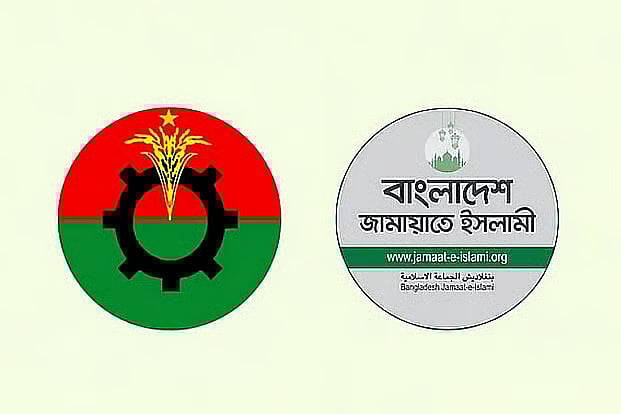
The 7-day deadline set by the interim government for political parties to reach a consensus on the question of implementation of the July Charter or the reform proposals will end soon. However, there have been no visible initiatives to hold discussions from the political parties in this regard.
On Wednesday, the Jamaat-e-Islami formed a two-member committee to discuss the matter. The Bangladesh Nationalist Party (BNP) has also shown a positive intent about holding discussions.
Meanwhile, with the aim of reducing disagreements between the BNP and Jamaat-e-Islami over the implementation of the July Charter and reaching a political consensus, nine parties—including the six-party alliance Ganatantra Mancha, National Citizen Party (NCP), Gono Odhikar Parishad, and AB Party—are considering holding separate meetings with the two parties. After meeting with BNP and Jamaat, they also plan to hold discussions with relevant government representatives. The top leaders of the nine parties reached this consensus at a meeting among themselves yesterday afternoon.
A senior leader of one of these nine parties told Prothom Alo that they will try to bring Jamaat to agreement on the timing of the referendum, while also reducing the BNP’s note of dissent on the July Charter to position the party in a middle ground.
BNP is always open for necessary discussions with other political parties. If we need to talk over these matters, we will do soSalahuddin Ahmed, BNP standing committee member
Yesterday, Jamaat-e-Islami announced in a press release that it has formed a two-member committee to hold discussions with political parties aimed at preparing a “consensus framework” on the electoral structure, implementation of the July Charter, and the referendum. The members are the organisation’s nayeb-e-ameer Syed Abdullah Muhammad Taher and assistant secretary general Hamidur Rahman Azad. The committee was formed following a discussion on the current political situation at a meeting of the central executive council, presided over by the party’s ameer Shafiqur Rahman, on Tuesday evening.
This correspondent spoke to BNP standing committee member Salahuddin Ahmed over the phone on the matter. He said, “BNP is always open to necessary discussions with political parties. If there is a need for us to hold discussions on these matters, we will do so.”
Amid sharp differences among political parties over the implementation of the July Charter, the government expressed concern on the matter at an urgent meeting of the advisory council on Monday.
At the same time, political parties were urged to hold discussions on their own initiative and provide the interim government with a unified direction as soon as possible. The government will not organise the talks. If the political parties fail to reach a unified decision within a week, the government will take decisions at its discretion.
On the matter, AB Party chairman Mojibur Rahman Manju told this correspondent that the government acted irresponsibly by leaving the matter of the July Charter with the political parties. The government could have taken a decision based on the discussions between the Consensus Commission and the political parties.
Mojibur Rahman Manju also said that political parties cannot lag behind in fulfilling responsibilities at crucial junctures of the state. As part of this, they have taken the initiative for a consensus on behalf of the nine parties. He added that discussions will be held with all parties in due course. To prevent any confusion before the talks are concluded, they are not engaging in open discussions with the media at this stage.
Meanwhile, politically aware individuals do not see any likelihood of a consensus being reached solely through the initiative of political parties without government mediation. The main parties could not be brought to agreement on certain reforms despite eight months of the Consensus Commission’s efforts.
Formal and informal discussions have also failed to move the parties from their respective positions. In such a situation, many do not expect the political parties to reach a consensus on their own; either the government will have to take the initiative to mediate, or the government will have to announce the decision itself.