The National Curriculum and Textbook Board (NCTB) is set to introduce a number of changes to the textbooks for the next academic year, which begins in January 2027.
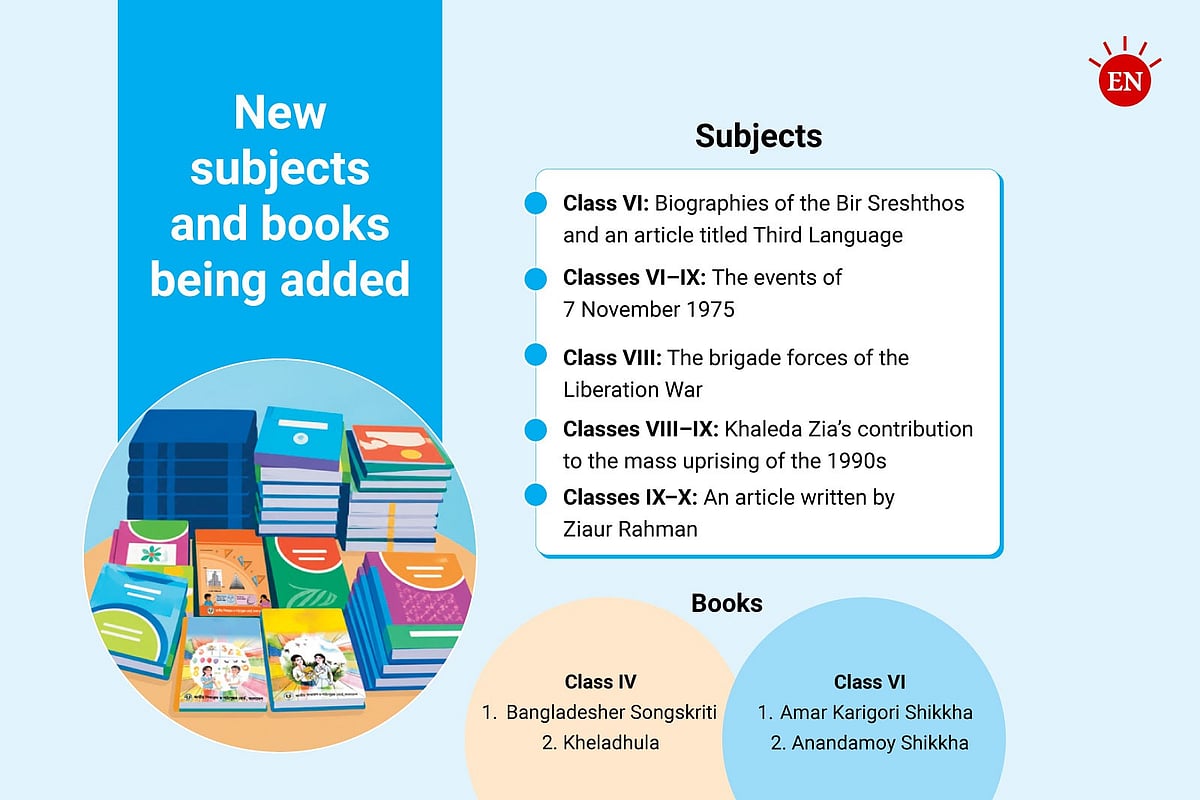
The changes will include the addition of content on the sectors and brigade forces of the Liberation War, biographies of the Bir Sreshthos, the events of 7 November 1975, and former prime minister Khaleda Zia’s role in the mass uprising of the 1990s. An article written by former president Ziaur Rahman will also be included in the textbooks.
Alongside changes in the history books, new content will be added to Bangla and information and communication technology (ICT) books. Apart from this, two new books each will be introduced for Class-IV and Class-VI, making four in total.
Work is now under way to finalise their content, which is expected to be completed this month. Particular emphasis has been placed on illustrations in the preparation of the books.
Changes in history-related content
According to NCTB sources, biographies of the Bir Sreshthos will be added to the Class-VI Bangladesh O Bishwa Porichoy (Bangladesh and Global Studies) textbook. The Class-VIII Bangla textbook will include a piece on the brigade forces of the Liberation War. The Class-IX–X Bangla textbook will include an article titled Memories of the War of Independence, written by former president Ziaur Rahman.
Content on the events of 7 November 1975 will be included in the Bangladesh and Global Studies textbooks for Classes VI to IX. The textbooks for Classes VIII and IX will also contain material on former prime minister Khaleda Zia’s contribution to the mass uprising of the 1990s.
The NCTB has said the curriculum will undergo extensive revision in 2028. Until then, the existing textbooks will be revised for 2027, alongside the introduction of four new books.
A new article titled “Third Language” will also be added to the Class-VI Bangla textbook. One of its main aims is to highlight the importance and necessity of learning a third language.
Changes are also being made to the secondary-level ICT textbook. It will contain a detailed discussion of artificial intelligence (AI). The topic is being given importance to familiarise students with rapid technological change.
An NCTB source said the extent to which these subjects will be covered has been determined separately for each grade. The books for Classes VI to VIII will contain comparatively less detail, while the Class-IX textbook will present the subjects in greater detail.
A number of changes had also been made to textbooks during the tenure of the interim government. At the time, the 2012 curriculum was brought back after the 2022 curriculum was scrapped, and it remains in use. However, despite scrapping the curriculum, the government did not take any effective steps to formulate a new one.
The NCTB has said the curriculum will undergo extensive revision in 2028. Until then, the existing textbooks will be revised for 2027, alongside the introduction of four new books.
710 illustrations in 4 new books
Two new books each will be introduced for Classes IV and VI in the next academic year, making four in total. The books will be compulsory for students in the two grades. However, there will be no annual examinations on these subjects; students will be assessed continuously. More than 15 million copies of the new books will be printed. The tendering process for printing them is currently under way, while work on preparing the books is also continuing.
One of the new Class-IV books is “Bangladesher Songskriti” (Bangladesh’s Culture). It will cover the concept of culture, the influence of culture on individual life, national, religious and social festivals, Victory Day, 21 February and the importance of cultural practices.
A visit to the NCTB last Sunday found experts carrying out the final-stage review of the content of the four new books.
Several teachers involved in the process said one of the new Class-VI books is “Amar Karigori Shikkha”. One of its main aims is to encourage students to take an interest in vocational education. The book has been divided into several chapters: Introduction to Vocational Education; Technology Around Us and the New World; Those Who Build Change the World; Let’s Solve Problems; Small Initiatives, Big Possibilities; Future Careers and Skills; Green Technology and Sustainable Living; and Glossary.
The other new Class-VI book is “Anandamoy Shikkha” (Learning with Happiness). It places emphasis on values and is also divided into several chapters. Its topics include Me and Us; My Nutrition and Healthy Living; Playing with Technology; Let’s Create Something New; Stay Clean, Keep Things Clean; Days of Celebration; and Let’s Be Happy and Make Others Happy.
One of the new Class-IV books is “Bangladesher Songskriti” (Bangladesh’s Culture). It will cover the concept of culture, the influence of culture on individual life, national, religious and social festivals, Victory Day, 21 February and the importance of cultural practices.
So far, the printing of the books is progressing according to our target. We hope to be able to print and distribute the books within the stipulated timeframe.NCTB Member (Textbooks) Professor Mohammad Abu Naser
The other new book for the same grade is “Kheladhula” (Sports). It focuses on eight sports: football, cricket, badminton, kabaddi, chess, athletics, swimming and martial arts.
Teachers involved in the process said particular emphasis had been placed on illustrations in the four new books. The books will contain a total of 710 illustrations, with more than 300 of them in the Sports textbook alone.
Four teachers involved in preparing the books told Prothom Alo that particular emphasis had been placed on illustrations so that students could understand the subjects more easily.
Nearly 310 million textbooks to be printed
Nearly 310 million textbooks will be printed for students from pre-primary to Class-IX in the next academic year, including books for students from ethnic minority communities and visually impaired students.
More than 220 million of these will be for the secondary level and around 82 million for the primary level. The estimated cost of printing the textbooks this year is around Tk1,879 crore (18.79 billion).
Primary-level textbooks are being printed in four colours. The paper used for the books must have a minimum brightness of 85 per cent. Various printing companies are being assigned the work through a tender process. So far, 52 companies have been awarded contracts to print primary-level books, while 76 companies have so far been awarded contracts for secondary-level books.
According to NCTB sources, as of 20 September, pre-delivery inspection (PDI) had been conducted on nearly 21 per cent of the primary-level books that had been printed. More than 18 per cent of the books had already been delivered.
The NCTB aims to complete the main printing work and send the books to the field by 30 November. However, printing of the four new books may not be completed within this timeframe.
Speaking about the overall situation, NCTB Member (Textbooks) Professor Mohammad Abu Naser told Prothom Alo, “So far, the printing of the books is progressing according to our target. We hope to be able to print and distribute the books within the stipulated timeframe.”