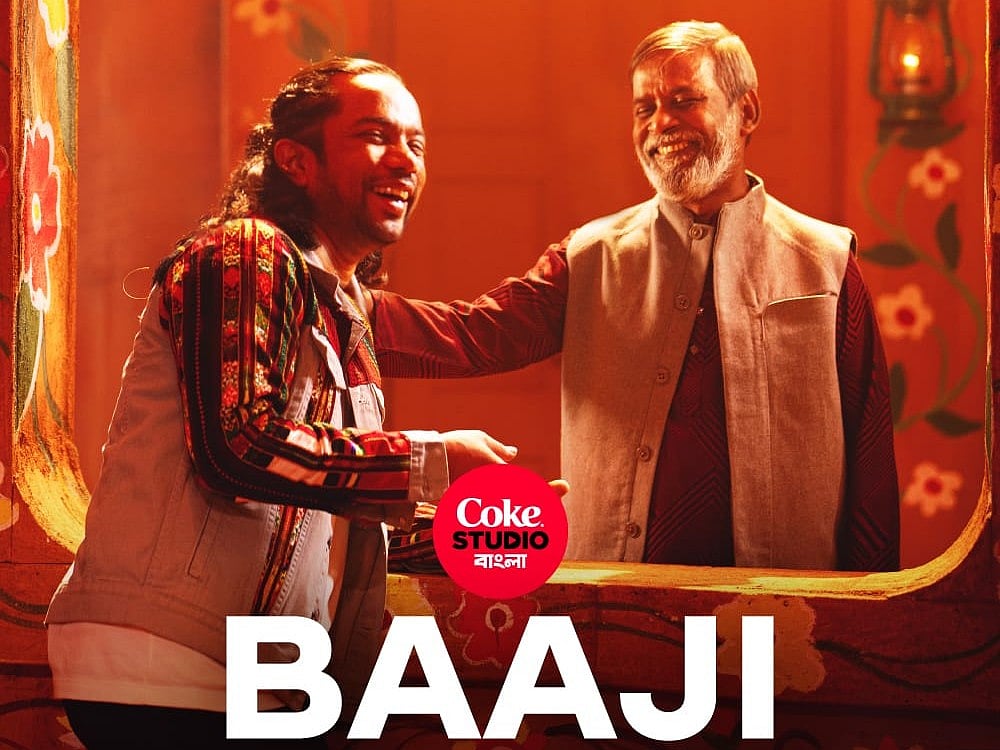
Baaji: A journey through time, tradition, and Bangladesh’s musical heart
The Deepto TV studio was buzzing with people -- technicians, agency people, artists and so much more. Dancers moving from one place to the next with their props, others checking on their ornaments and costumes, while musicians checking on their strings and membranes, artists interacting with BTS photographers, having coffee with officials from the agency -- the entire floor was abuzz with activities and conversations.
However, amidst all the activity, one could see that Hashim Mahmud, the singer-songwriter was stuck in a world of his own. The creator of the latest Coke Studio Bangla release, Baaji – Hashim seemed oblivious to the noise around him, unable to interrupt his thoughts.
He only seemed to come alive on the sets; his smiles were reserved for anything that amused him -- instruments, colours and soft conversations. Curious bystanders and fans of his music were trying their best to interact with Hashim bhai-- but tucked within his comfort zone, Hashim Mahmud was more than comfortable to let his siblings speak on his behalf.
There were of course rare moments, when Hashim bhai himself would respond and take an interest in conversing with people around. It was during such a rare moment that he spoke about Baaji.
“The song Baaji was actually written in 1996,” Hashim Mahmud recalls. “But I never write a song all at once. I write in stages. The first part came during a trip to Boga Lake with three of my friends. Around eight or nine months later, during a visit to Saint Martin’s Island, I wrote the remaining verse and completed the song.”
“The inspiration came from the people and landscapes I experienced,” he says. “The first verse was inspired by the expressive eyes of a young girl in Bandarban. Later, the sea and its depths at Saint Martin’s Island shaped the imagery of the final lines.”
It's a wonder how music and words float along for generations, until they finally settle down like fairy dust – but wrapped in new lyrical compositions, yet carrying the same essence. In the case of Baaji however, the energy surpassed the original.
The song and the video begin with the voice and the presence of Mrakoi Ching Marma. Singing an almost extinct Kapea tune, Mrakoi Ching managed to capture hearts of music lovers, who came across this tune for the very first time.
Being on the busy set was an exciting experience for her, says her grandson Kyo U Pru Marma. She rarely ever left her village, Thana Para, located in Bandarban. Travelling to Dhaka was indeed a surreal experience for her. On set, she seemed happy but a little nervous. She had even asked her grandson to click a picture of her on set so that she could keep the memory with her.
Once a cherished part of village festivities, the soulful strains of Kapea or Langa—named after the flute or harmonium that echoed its melodies—are now fading into silence. These story-like tunes, rich with narrative depth, once drew people together, weaving moments of reflection and joy.
But with the rise of digital entertainment and booming party anthems dominating festival grounds, audiences no longer pause to listen. Many of the older artists who carried the tradition are gone, and younger generations rarely step forward to preserve it. What was once a living heritage now lingers on the edge of memory.
For Kyo U Pru Marma, the tune is tied to childhood memories of festivals and moonlit celebrations—Sangrai, Prabarana Purnima, Buddha Purnima, or the winter mela. Artists would gather, their voices rising with the melody, while crowds leaned in to listen. It was here, amid the music and the throngs, that his grandmother first fell in love with the tradition.
One can say that through Baaji, a soulful picture of Bangladesh was portrayed for the global space. The collaboration of cultures, lyrics and of course rhythm played a significant role in redefining deshi music in both local and international arenas. Emon Chowdhury, who played a pivotal role in shaping the Coke Studio version of Baaji, spoke about how three different songs were brought together to create Baaji.
Not only did Baaji touch hearts and create a buzz within the audio industry, the video production of the song also raised eyebrows and amazed by the scenes.
“It starts with a Marma kappya song, moves into a traditional Bawm bamboo dance with humming, then transitions into Baaji,” he says. “The song also includes the beautiful words of ‘Asmaane tor chhaya re konnya, jomine tor baari’, written by Jalaluddin Khan and composed by me.”
Along with the kapea tune, the entire composition was further enriched with the additions of local dances, styles of singing and of course a unique rhythm section. An ancient tune set the tone for the song’s historical depth, while the Bawm group performed their traditional bamboo dance accompanied by humming. “It was amazing to integrate these rarely-seen musical forms,” Emon said.
The team also incorporated Manipuri rhythms, specifically Pung Cholom, performed by artists who traveled from Srimangal. The production also featured Dhua gaan, a century-old tradition from areas near Dhaka, alongside a choir, traditional flutes, and the Dhaka String Orchestra. Mithun Chakra led the rhythm section, collaborating with musicians from multiple cultural backgrounds to produce a sound that was both cohesive and richly layered.
Not only did Baaji touch hearts and create a buzz within the audio industry, the video production of the song also raised eyebrows and amazed by the scenes. Krishnendu Chattopadhyay, the director who translated Baaji into visuals, managed to capture the cultural depth and communal spirit the song carries.
“The visual interpretation was meant to accommodate the sons and daughters of the soil of this region,” Krishnendu reflected. Drawing from the landscapes of Santal villages, Tikoil in Chapainawabganj, and the serene hill settlements, the video honours the voices of the Manipuri, Marma, and Bawm communities, alongside the Dhua musicians of the plains.
To a visitor, this particular shooting set would seem massive, and rightly so – the Deepto TV shooting floor has to date accommodated some of the biggest indoor reality shows and continues to do so. However, when one tries to frame the topography of Bangladesh, bringing to the scene the vibrant colours, layouts and landscapes, even one of the busiest shooting floor spaces in the country seem bounded and insufficient.
On screen, a symbolic Bangladeshi village unfolds—alive with musicians, colours, and stories. “It was a challenge with the shooting floor space,” Chattopadhyay admitted, “but our art director, Tarek Bablu, and cinematographers led by Kamrul Hassan Khosru, gave it soul.”
The response has been nothing short of euphoric, especially with Hashim Mahmud’s surprise presence—Baaji resonated as both music and memory, a celebration of belonging.
What would it take to bring our stories to the world? Contemporary music, haunting visuals, ancient tunes, traditional dances, poetry, and a dynamic rhythm section – Baaji carries all of this and more. It is a celebration of our roots, a bridge between past and present, and a call for everyone to listen, feel, and remember.
* Elita Karim is a singer and a journalist. IG: elitaalive; X:elitakarim