Bangladesh
Climate financing falls far short of needs
A water pump powered by solar energy serves a slum in Amlapara, Sirajganj town. Since the pump was installed two years ago, residents have faced somewhat less difficulty in accessing water. On a midday in June, several women, including Maksuda Begum and Rahela Khatun, spoke about their experiences there. Rahela said, “Previously, water from the municipal supply line came twice a day. We had to stand in a queue for it. There was no guarantee when it would arrive. Now, we can get water whenever we want.”
The pump was installed through a local NGO initiative funded by a climate fund. However, one pump is far from enough to meet the growing demand. According to locals and municipal officials, there are around 30 slums in the town, but no other slum has a similar facility. In other words, climate financing falls far short of what is needed.
For those who move to towns after losing their homes to floods and river erosion, access to safe drinking water, housing and sanitation remains extremely limited. The experience with the pump in Amlapara shows that even a small project with modest funding can bring significant changes to people's lives. At the same time, a look at the other slums in the town reveals just how limited the available funding is.
Bangladesh's National Adaptation Plan (NAP) estimates that nearly US$230 billion (approximately Tk 28.52 trillion) will be required by 2050. However, the climate-related allocation for 25 ministries and divisions in the 2026–27 fiscal year stands at Tk 517.46 billion. Of this, the Climate Change Trust Fund, which is financed by the government itself, has received only Tk 1 billion. A large portion of international public climate finance also comes in the form of loans. Despite the increase in funding, the question remains whether it is reaching the people most at risk.
Huge gap between needs and financial flows
Mita Rani Das (52), a marginal farmer from Ashashuni upazila in Satkhira, suffered major losses twice last year. The widow runs her household with income from a small fish enclosure. During an intense heatwave, nearly 30 per cent of the fish in her enclosure died. Later, heavy rainfall in July caused the enclosure to overflow, destroying most of the remaining fish. She received no advance weather warning.
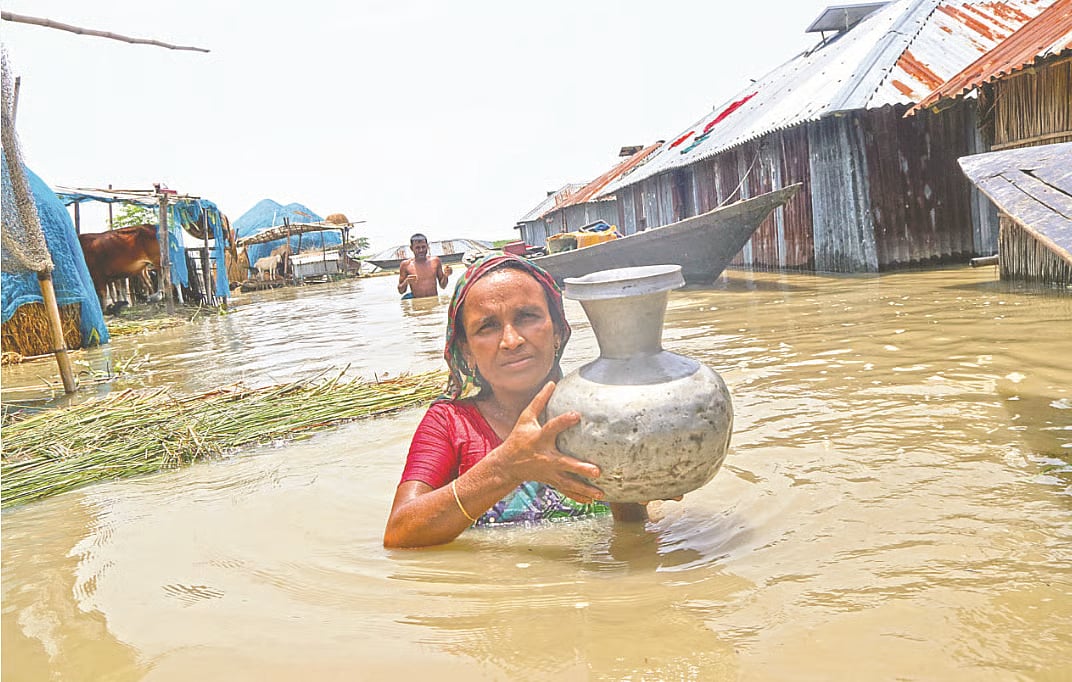
From the coastal areas of Satkhira to the slums of Sirajganj, the impacts of climate change are no longer a future concern. River erosion, salinity, cyclones, excessive rainfall, waterlogging, heatwaves and irregular monsoon patterns are putting people's livelihoods, housing, health and food security at risk every day. Although Bangladesh contributes very little to global carbon emissions, it bears a disproportionate share of the damage.
Bangladesh's National Adaptation Plan (NAP) estimates that nearly US$230 billion (approximately Tk 28.52 trillion) will be required by 2050. However, the climate-related allocation for 25 ministries and divisions in the 2026–27 fiscal year stands at Tk 517.46 billion. Of this, the Climate Change Trust Fund, which is financed by the government itself, has received only Tk 1 billion.
However, it would be incorrect to attribute every incident of unusual rainfall, heatwaves or river erosion solely to climate change. Natural river dynamics, land use, unplanned urbanisation and weak infrastructure also increase the damage. In many cases, climate change intensifies and increases the frequency of risks, making these longstanding problems even more dangerous. Climate financing plans must therefore take into account not only climate risks but also local environmental conditions and governance weaknesses.
According to the National Adaptation Plan (NAP) 2023–2050, nearly US$230 billion will be required by 2050 to implement 113 initiatives. An average of US$8.5 billion will be needed annually, of which US$6 billion is expected to come from international funds and development partners.
The NAP identifies eight priority sectors, including water, agriculture, fisheries, transport, urban development, health and disaster management, under six adaptation goals and 23 strategies. This means the estimated funding is not meant solely for embankments or large infrastructure projects. Local early warning systems, climate-resilient agriculture, safe drinking water, healthcare, livelihoods and support for displaced people moving to cities are also part of the plan. Reaching Mita Rani Das with timely weather alerts or installing more water pumps in Amlapara are therefore also part of the country's national adaptation efforts.
On the other hand, according to Bangladesh's Third Nationally Determined Contribution (NDС 3.0), US$116.18 billion will be required to achieve its emissions reduction targets by 2035. Of this amount, US$25.95 billion is expected to be mobilised domestically, while the remaining US$90.23 billion will depend on international financing, technology transfer and capacity-building support.
The figures in the NAP and NDC cannot be added together directly. The NAP primarily estimates the cost of long-term adaptation. The figure in the NDC relates to mitigation, or emissions reduction activities. The two documents also have different timeframes and sectoral coverage. However, both demonstrate that the financial requirements of Bangladesh's climate plans far exceed the capacity of its domestic budget.
Three types of activities must also be distinguished in discussions on climate financing. Mitigation means reducing emissions, such as through renewable energy and energy-efficient technologies. Adaptation means helping people and the economy adjust to risks that have already emerged or are expected to arise. Loss and damage financing is needed when losses cannot be prevented even after adaptation measures have been taken. The loss of land to river erosion or property destroyed by cyclones are examples. Covering up shortfalls in one sector with progress in another cannot provide a true picture of the actual needs.
Climate budget: Figures rise, but questions remain
According to the Finance Division's climate budget report for the 2026–27 fiscal year, the climate-related allocation for 25 ministries and divisions stands at Tk 517.46 billion. This represents 5.52 per cent of the national budget of Tk 9.38 trillion. As a proportion of the combined allocations for the 25 ministries and divisions concerned, the figure is 11.03 per cent, up from 10.07 per cent in the previous fiscal year.
The budget includes initiatives such as afforestation, control of air and plastic pollution, carbon trading, and the ‘One Child, One Tree’ programme. A large portion of climate-related expenditure is spread across ministries responsible for local government, water, agriculture, disaster management and infrastructure. Therefore, looking only at the allocation for the Ministry of Environment does not provide a complete picture of the government's overall climate spending. Similarly, the entire budgets of these ministries cannot be counted as climate expenditure; only the portions identified as such are included in the report.
A large portion of international public climate finance also comes in the form of loans. Despite the increase in funding, the question remains whether it is reaching the people most at risk.
The allocation of Tk 1 billion is a separate matter. It does not represent Bangladesh's entire climate budget, but only the allocation for the Bangladesh Climate Change Trust Fund. The government can use this fund for relatively small and urgent initiatives beyond the large projects undertaken by different ministries. Although the national budget has increased more than eightfold, the annual allocation for the fund, established one and a half decades ago, has not increased proportionately.
Environment and climate expert Haseeb Md Irfanullah told Prothom Alo that this year's budget showed some positive trends in environmental conservation and tackling climate change. However, there are no clear guidelines on where the funding for implementing major goals will come from. In his view, the allocation of Tk 1 billion to the trust fund is disappointing compared with the actual requirements.
The publication of the climate budget report and the identification of expenditure by 25 ministries represent institutional progress. However, questions remain about how effective all the expenditure classified as ‘climate-related’ actually is. Roads, bridges, drainage systems or water projects do not automatically become climate-resilient infrastructure simply because of their classification. Their designs must take climate risks into account, along with beneficiary selection and long-term outcomes.
The link between allocations and results should also be made public. Without indicators showing how many people were protected from waterlogging through the excavation of a canal, how many health centres were made ready to deal with heatwaves or how much the distance to safe drinking water has been reduced in coastal areas, it is impossible to assess the quality of expenditure. It is also essential to determine from the outset where the funding for maintenance will come from after a project is completed. Otherwise, the infrastructure may remain in place, but services could cease after a few years.
A 2025 review by the Centre for Policy Dialogue (CPD) found that the implementation rate of the climate-related development budget had remained at around 85 per cent for several years. CPD Distinguished Fellow Fahmida Khatun, who was involved in the research, told Prothom Alo that the problem was not just the amount allocated but also the quality of expenditure. It is necessary to examine whether the funds are reaching the areas that are most vulnerable to climate change and whether women, children, older people, persons with disabilities, farmers and fishers are at the centre of the projects.
Commitments rise, but adaptation lags behind
According to the latest figures from the Organisation for Economic Co-operation and Development (OECD), developed countries provided US$132.8 billion in climate finance to developing countries in 2023 and US$136.7 billion in 2024, or helped mobilise funds from private sources. The annual target of US$100 billion, which was supposed to be achieved by 2020, was met for the first time in 2022, two years behind schedule.
Beyond the overall amount, the questions arise on where the money is going and under what conditions. The United Nations Environment Programme's Adaptation Gap Report 2025 says developing countries may need between US$310 billion and US$365 billion annually for adaptation by 2035. However, international public adaptation finance amounted to only US$26 billion in 2023, US$2 billion less than the previous year. The gap between requirements and available funding is 12 to 14 times.
The latest picture of global financial flows reveals the same contrast. According to the Climate Policy Initiative's Global Landscape of Climate Finance 2026, total climate finance exceeded US$2 trillion for the first time in 2024. Of this, US$1.9 trillion went towards mitigation. In contrast, adaptation finance declined in 2023 and remained almost unchanged in 2024. In other words, while investment is increasing in different sectors with sizable markets, such as solar power, electric vehicles and clean energy, funding for safe drinking water, agriculture, health and disaster-resilient livelihoods is not growing at the same pace.
The United Nations Environment Programme's Adaptation Gap Report 2025 says developing countries may need between US$310 billion and US$365 billion annually for adaptation by 2035.
Financing from multilateral development banks is also increasing rapidly. According to the joint figures of 10 major banks, their own climate finance reached approximately US$163 billion in 2025. Of this, US$103 billion went to low- and middle-income economies. Adaptation accounted for US$35 billion. This funding is important for major projects in developing countries. However, since a large portion of financing from development banks comes in the form of loans, the terms and the borrowers' ability to repay them are equally important.
The figures from Organisation for Economic Co-operation and Development (OECD), United Nations Environment Programme (UNEP) and Climate Policy Initiative (CPI) are not directly comparable. The OECD counts finance provided or mobilised by developed countries; UNEP tracks international public adaptation finance; and CPI presents a picture of global flows combining domestic and international, public and private sources. Failure to understand these differences creates a risk of counting the same funding more than once.
Large portions are loans
One of the major debates on international climate finance is whether assistance should come in the form of grants or loans. The historical responsibility for climate change lies primarily with industrialised countries. Therefore, vulnerable countries argue that it is unfair to impose additional debt burdens on countries that have contributed little to emissions but are struggling to cope with the damage caused by climate change.
According to the OECD, loans accounted for 73 per cent of the public climate finance provided by developed countries in 2023 and 67 per cent in 2024. Grants accounted for 24 per cent and 29 per cent, respectively. However, not all loans have the same terms. Some carry market rates, while others offer lower interest rates and longer repayment periods. Therefore, interest rates, repayment periods, grace periods, currency and whether a project will generate revenue are all important considerations.
International public adaptation finance amounted to only US$26 billion in 2023, US$2 billion less than the previous year. The gap between requirements and available funding is 12 to 14 times.
The problem is that many adaptation projects do not generate direct revenue. Although embankments, canal re-excavation, mangrove restoration, early warning systems and safe housing for poor people offer significant social benefits, their commercial returns are limited. Ultimately, the responsibility for repaying loans for these projects falls on the government budget. Depreciation of the taka can further increase the cost of foreign currency loans.
It is also important to consider where the loans are being used. Projects that save electricity and generate revenue or reduce expenditure may be able to repay loans obtained on favourable terms. However, projects to rehabilitate families who have lost their homes to cyclones or provide safe drinking water in salinity-affected areas have little scope for generating revenue. Grants or long-term financing on highly concessional terms should be prioritised for such initiatives. Otherwise, the burden of climate-related losses ultimately falls on taxpayers in the affected countries.
Process of accessing international funds is complicated
Bangladesh has so far received approval for US$464 million in financing from the global Green Climate Fund (GCF) for a total of 10 projects. However, only one project has been completed so far, for which US$9.7 million was received from the GCF. As a result, Bangladesh has received only a very small portion of the approved funding. An additional US$6.1 million in support has been approved for project preparation and capacity-building. However, the overall size of a project may be larger if other organisations provide co-financing.
This funding is important, but it is limited compared with the annual requirement of US$8.5 billion under the NAP. Moreover, approval, agreement, disbursement and expenditure at the field level are four separate stages. It is difficult to understand the actual progress without the publication of simple and up-to-date official figures showing how much funding has reached each stage. Accessing GCF funding also requires navigating complex proposals, technical capacity requirements, environmental and social safeguards, financial management procedures and lengthy accountability processes.
Therefore, the ability to access international funds does not simply mean being able to write an application. There must be a list of project proposals ready with information on the specific risks in different areas, the amount of investment required, the potential outcomes of each project and how activities will continue after the funding ends. Unless information from ministries, local governments, research institutions and private organisations is brought together, similar small projects are repeatedly undertaken, while proposals for large and integrated initiatives remain undeveloped.
A test case for local financing
The Climate Bridge Fund (CBF) was established in 2019 with support from BRAC and Germany's KfW Development Bank. The fund provides grants to local non-governmental organisations to support people in cities who have been displaced or are at risk of displacement due to climate change.
Bangladesh has so far received approval for US$464 million in financing from the global Green Climate Fund (GCF) for a total of 10 projects. However, only one project has been completed so far, for which US$9.7 million was received from the GCF.
According to the OECD's 2025 review, the CBF had initial capital of approximately US$22 million. By investing in government bonds, it generates an annual income of around US$2 million. This income is used to provide grants for local adaptation projects. As of September 2025, grants had been provided for 26 projects, with an average of less than six months between application and the first disbursement.
The OECD also reported that these projects had provided social and economic support to 15,000 vulnerable households. Water, sanitation and hygiene infrastructure had been developed for more than 100,000 people, while 27,000 slum residents had benefited from flood-resilient walkways and drainage systems. The management, financial and technical capacities of 20 grassroots organisations had improved, while more than 200 organisations had received training. However, these are primarily documented results reported by the fund. Independent and long-term evaluations are needed to understand how sustainable these changes are.
This is an alternative way of delivering funding directly to local organisations beyond large international projects. However, the fund should regularly publish information on what will happen to grants if interest income from government bonds declines, how the real value of its capital will be protected amid inflation, and how much people's vulnerability has been reduced after project completion. In addition to rapid disbursement, the fund's success must also be assessed based on its impact several years later.
Md Golam Rabbani, director of the Centre for Climate Change and Environmental Research at BRAC University, told Prothom Alo that new initiatives should be welcomed. However, small initiatives can only go so far; the government must also focus on large-scale financing to address the major climate crisis.
New sources, but not a substitute for grants
Fifteen houses have been built for people who lost their homes to river erosion in the Puthiabari area near the river protection embankment in Sirajganj. Farida Parvin is one of them. After river erosion destroyed her home, she took shelter with her husband and three children in a small room in a slum in the town. She has now moved into a new house with a green tin roof. It has an insulation layer beneath the roof, as well as safe drinking water and a toilet. Compared with her previous home, this one feels like a mansion to her.
The water pump in Amlapara and the houses in Puthiabari offer hope. However, scattered small-scale projects are not enough to meet the needs of hundreds of thousands of vulnerable people. Bangladesh faces three realities simultaneously: risks are increasing, public funding is limited, and international financing is uncertain and conditional.
Therefore, funding sources such as private investment, green bonds, blended finance, impact investment, carbon markets, disaster risk insurance, local adaptation funds and urban climate finance need to be expanded. However, these are not substitutes for grants. Since adaptation projects offer limited commercial returns, public funds and international grants must be used as catalytic capital to attract private investment where appropriate.
These funding sources also serve different purposes. Green bonds can raise funds for long-term environmentally friendly infrastructure. Under blended finance, public or grant funding takes the first loss, reducing risks for private investors. Insurance can provide rapid financial assistance after disasters, but subsidies are necessary if premiums are beyond the reach of poor people. Carbon markets can generate revenue, but unless reliable emissions reduction accounting, local people's rights to land and resources, transparent verification and fair distribution of revenue are ensured, they could create new disputes.
The role of local governments must also be strengthened. Information on where waterlogging occurs, which settlements face water shortages and who is most vulnerable to heatwaves is most readily available at the local level. However, small municipalities and local organisations have limited capacity to develop projects, manage tenders and accounts, and meet the requirements of international funds. Providing funding alone will not be enough; technical assistance for project preparation, simplified application procedures, and funding for operation and maintenance must also be ensured.
The Finance Division and the United Nations Development Programme (UNDP) are working on developing Bangladesh's first National Climate Finance Strategy. The Economic Relations Division also has an International Climate Finance Cell. What is now needed is a comprehensive public database in one place, showing domestic allocations, foreign commitments, approvals, loan and grant terms, disbursements, expenditure and outcomes.
The international assistance landscape is also uncertain. According to preliminary OECD estimates, official development assistance (ODA) from members and partner countries of the Development Assistance Committee fell by 23.1 per cent in real terms in 2025, the largest annual decline on record. Climate finance and development assistance are not the same, but budget cuts in donor countries could also put greater pressure on climate grants. Therefore, it is essential not only to explore new sources of funding but also to ensure that available funds are prioritised and used effectively.
Bangladesh therefore needs three types of measures: consistent and adequate allocations from its own budget, increased grants and concessional financing from international sources, and mechanisms that allow local institutions to access funds directly. Climate risks and outcomes must be measured for every project, and vulnerable people must be involved in planning and monitoring. Otherwise, large figures will remain on paper, while residents of many slums like Amlapara will continue waiting for a single pump providing safe drinking water.