Lead and cadmium from waste burning in Dhaka’s air raise cancer concerns
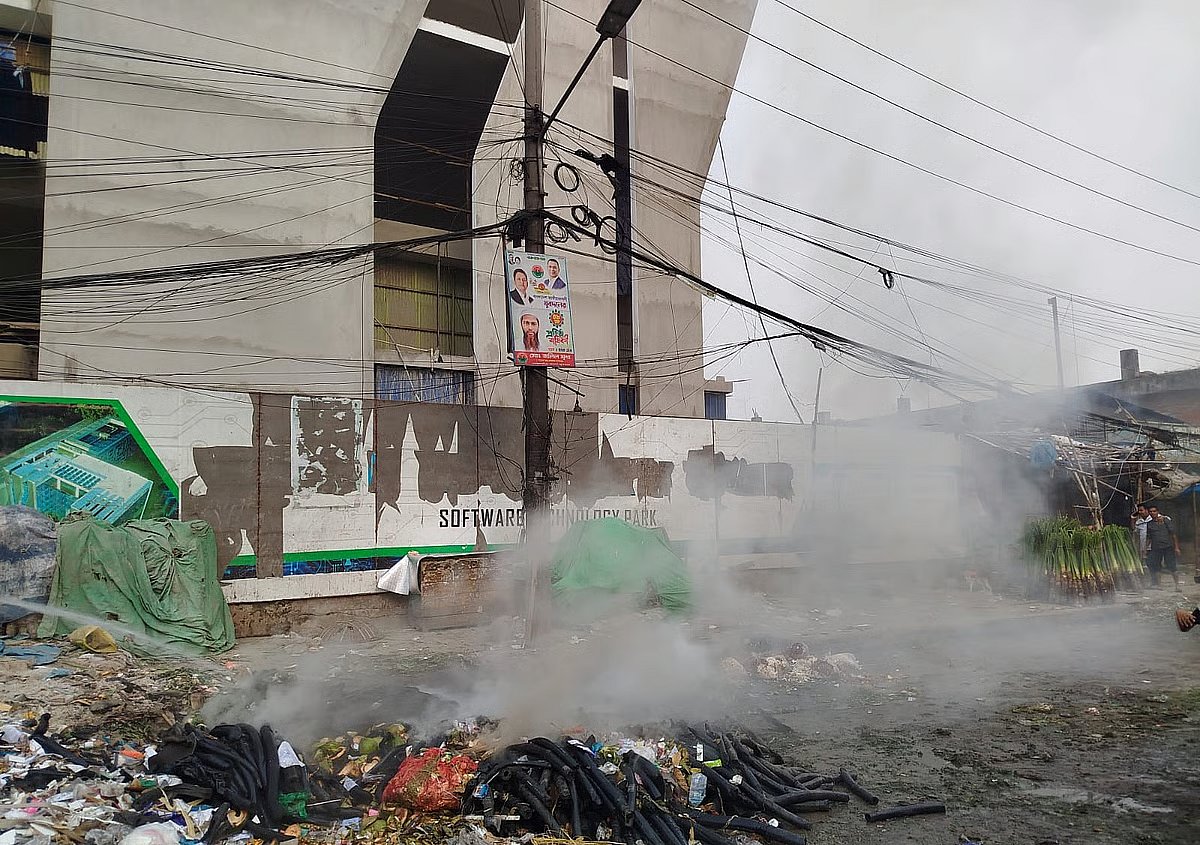
Seeing plumes of smoke from a distance, many people looked on, wondering whether a fire had broken out somewhere. This was the scene in capital’s Karwan Bazar on Tuesday afternoon. Actually, rubbish dumped beside a road in the bazar was being burned.
On approaching the site, it was found that various kinds of waste were being set alight, including rotten vegetables, straw, old clothes and even tyres. When moved closer, people from a nearby building were found using a hose to spray water to put out the fire. But the smoke was spreading quite extensively.
Usually waste is burned in this market this way, particularly during winter. People had gathered at the spot. Almost none of them were wearing a mask. One of them, Khalil, said, “It’s bad to set fire to rubbish. The smoke gets into your chest, and you start coughing.”
A recent study has found that waste burning at various locations in Dhaka releases heavy metals such as lead, cadmium, chromium and nickel into the air. Prolonged exposure to lead and cadmium among these metals may increase the risk of cancer. The risk is higher for children than for adults.
Burning rubbish in various parts of the capital is an everyday occurrence. Yet little thought is given to the serious effects this smoke can have on people’s health.
A recent study has found that waste burning at various locations in Dhaka releases heavy metals such as lead, cadmium, chromium and nickel into the air. Prolonged exposure to lead and cadmium among these metals may increase the risk of cancer. The risk is higher for children than for adults.
A team of researchers reached these findings after examining waste collected from 30 locations across Dhaka city.
The study, titled ‘Assessment of Heavy Metals and Levoglucosan Emissions from Municipal Solid Waste Burning in Dhaka and Its Impact on Human Health’, was published in the international journal Environment, Development and Sustainability.
Researchers from several institutions, including the University of Dhaka and Bangladesh University of Engineering and Technology (BUET), took part in the study.
How the study was conducted
The researchers collected waste samples from 30 locations, including residential areas, markets, roadside spots, healthcare facilities and waste disposal sites.
A 500-gram portion of each sample was burned in a specially designed steel chamber. Smoke from the burning waste was carried through a pipe and trapped in a filter. The filters were then examined to determine the levels of various pollutants in the smoke.
How much pollutant was found?
The study found that the average concentration of lead in smoke from burning waste was 28.36 micrograms per cubic metre. The average concentrations of cadmium, chromium and nickel were respectively 12.23, 26.96 and 10.75 micrograms per cubic metre.
However, the concentrations of these metals varied considerably from one location to another. The researchers believe this variation was due to differences in the types of waste and the methods used to burn it.
The study was led by Dhaka University pro vice-chancellor and renowned researcher Professor Abdus Salam.
He said, “Various studies have been conducted on air pollution in Dhaka and its sources. We wanted, perhaps for the first time, to examine how much pollution is produced by burning waste. The findings are alarming. This pollution from smoke is creating serious health risks for us.”
The study says that, according to the EPA, a cancer risk index ranging from one in a million to one in 10,000 is generally considered an acceptable level of risk. The researchers’ calculations showed that the index for lead and cadmium exceeded this range.
How high is the cancer risk?
The researchers used mathematical models recognised by the United States Environmental Protection Agency (EPA) to assess the potential health risks posed by the metals. They calculated the cancer risk (CR) and non-cancer health risk (HI).
The study says that, according to the EPA, a cancer risk index ranging from one in a million to one in 10,000 is generally considered an acceptable level of risk. The researchers’ calculations showed that the index for lead and cadmium exceeded this range. For chromium and nickel, however, the index was within or below that threshold.
Professor Shimul Halder of Dhaka University’s Department of Pharmaceutical Technology believes the study’s findings on the presence of levoglucosan are significant.
It is a chemical compound produced by the thermal breakdown of cellulose when wood, straw and other plant-based organic materials are burned, added the professor.
He said the function of our lungs is to filter out harmful substances as we breathe. However, some of the ultrafine particles in smoke can become trapped and fail to pass through. This can then cause lasting problems in the lungs.
The study was conducted by burning waste in a chamber and examining the resulting smoke. The actual risk to people will also depend on factors such as the level of pollution, distance from the waste-burning site, wind speed and how long they are exposed to the smoke.
Which areas have higher concentrations of which metals?
The study found the highest concentrations of arsenic and chromium in Armanitola in Old Dhaka. The researchers believe the high level of arsenic there may be due to the burning of electronic waste and specially processed materials.
Relatively high concentrations of lead were found in Azimpur and Mohakhali. The researchers believe this may be due to the burning of lead-acid battery waste and plastic-rich waste.
They cited the burning of leather waste, pieces of tyres and chromium-treated materials as possible reasons for the high concentration of chromium in Armanitola.
Meanwhile, relatively high concentrations of lead were found in Azimpur and Mohakhali. The researchers believe this may be due to the burning of lead-acid battery waste and plastic-rich waste.
The highest concentration of cadmium was found in a sample from New Eskaton Road. The researchers suggested that the waste there may have contained plastics, pigments used in paint production and coal ash.
Although the study identifies Azimpur and Mohakhali as the locations where the highest lead concentrations were found, it does not separately specify the exact level of the highest cadmium concentration recorded on New Eskaton Road.
Nickel concentrations ranged from 2.44 to 63.67 micrograms per cubic metre. However, the main article of the research paper does not specify which area had the highest concentration of nickel.
Flaws in waste management
According to World Bank data, the smoke from waste burning accounts for 11 per cent of air pollution in Dhaka. However, Mohammad Abdul Motaleb, deputy director (air quality) of the Department of Environment, believes its actual contribution is higher.
Speaking to Prothom Alo on Thursday, he said local waste was a major source of air pollution in Dhaka. Yet there was no proper system for managing this waste. When so much waste is generated, it ends up being burned, naturally causing pollution, he said.
When asked what the Department of Environment was doing to prevent this waste pollution, Abdul Motaleb said, “Waste is burned at every level, from households to institutions. At the individual level, by the time our teams arrive, the waste has already been burned.”
“At the institutional level, many are fined. But how can this be addressed without a system to manage such a huge volume of waste?” he questioned.