Fish worth Tk 70m–80m traded annually here, you can also buy fresh catches
The lives and livelihoods of people in 70 villages in Gomostapur upazila of Chapainawabganj and Porsha upazila of Naogaon are closely linked to this wetland. One part of the wetland, which is known by several names, is called Beel Kujain. Abul Kalam Muhammad Azad writes about the wetland after travelling from Rajshahi to Gomostapur to explore it.
Boats laden with fish are pulling up at the landing station. Baskets of fish are being unloaded. Two men carry a basket between them and run towards the wholesale market. A wholesaler calls out, “Khaira, khaira, khaira ... small fish, khaira.”
In an instant, people swarm around the basket like bees. The wholesaler calls out, “Three hundred and twenty, three hundred and twenty, three hundred and twenty ...” Then the bidding begins, “Three hundred and thirty, three hundred and thirty ...”
It feels like a grand festival of fish. As the water has receded from one end of the wetland, a patch of land has emerged. The fish market has set up there. One end of the wetland lies in India, the other in Bangladesh. From early morning, traders from three or four neighbouring districts arrive here on bicycles, motorcycles, motorised three-wheelers and CNG-run auto-rickshaws.
From the Bengali month of Asharh until Falgun–Chaitra (from mid-June until mid-April), this paddy-growing wetland becomes a fishing hub.
According to local traders, fish worth Tk 70–80 million (7 to 8 crore) are traded here every year.
The paddy and fish from this wetland are central to the lives and livelihoods of people in around 70 villages across four unions in Gomostapur upazila of Chapainawabganj and Porsha upazila of Naogaon. It is almost like a wonderland of rice and fish.
Located in Radhanagar Union of Gomostapur upazila in Chapainawabganj, one part of this wetland is called Beel Kujain. It is leased out as a government waterbody. However, the wetland extends around with six other names: Chonsada, Telkuch, Gumrail, Doblaind, Ruhimari and Shukduba.
During the dry season, Boro rice is cultivated there. The rest of the year, they remain submerged. Fish are then found in these very paddy fields. During that period, a wholesale fish market is set up at the Islamganj playground. As the water level falls, a portion of Beel Kujain emerges first, and the fish market moves there. Local people call this landing station ‘Ganjer Ghat’.
I set out from Rajshahi for the wetland at 6:30 am on 14 November. After travelling around 70 kilometres, I reached Adda Bazar in Gomostapur upazila of Chapainawabganj. After having breakfast there, I travelled another 16 kilometres to Ganjer Ghat in Beel Kujain.
The shops and fish wholesale market at the landing station are housed in small mud huts. These structures are submerged during the monsoon, so they have to be rebuilt every year. From a distance, they look like rows of tents.
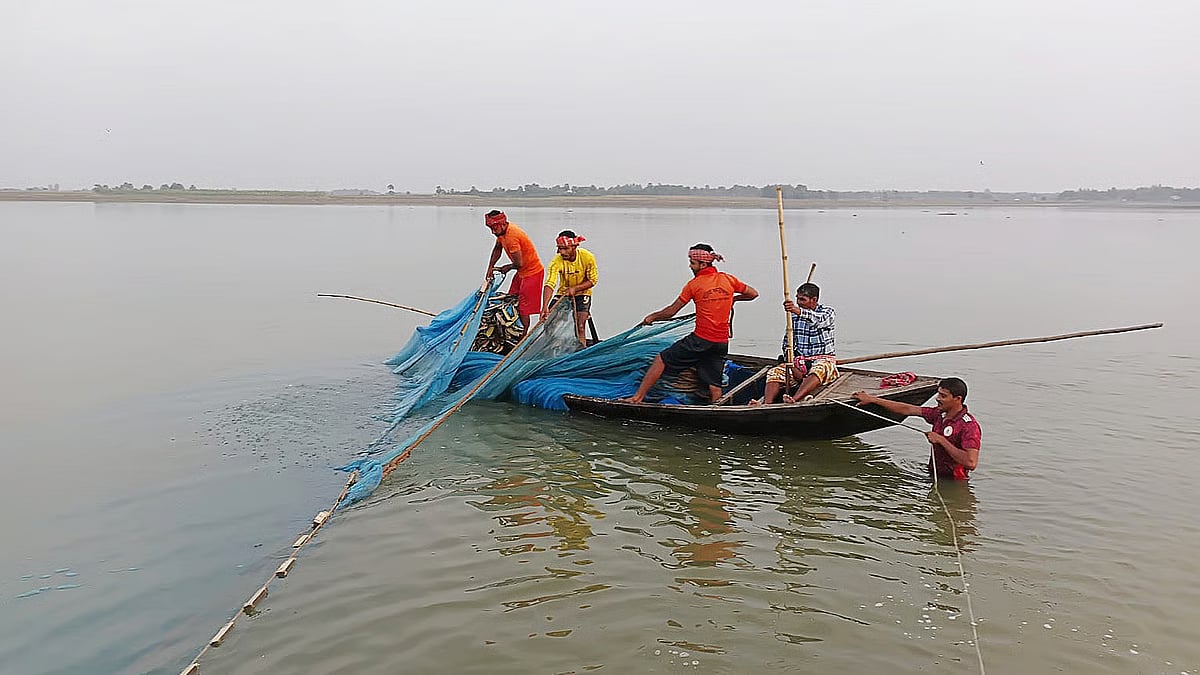
As soon as I reached the landing station, I was greeted by a flurry of calls and shouts. The water level in the wetland had begun to fall. Boats laden with fish were arriving at the landing station via the Punarbhaba River.
Once the fish were unloaded, they were sorted. Some people rushed about carrying fish boxes, while others carried blocks of ice. An ice factory has been set up here to preserve the fish caught in the wetland. Ice is brought from there and placed in the fish boxes.
Asmaul, from Rokonpur village, said that 20 other people were involved in fishing with him as partners. They had set eight boats and 100 nets in the wetland overnight. After unloading the fish from the boat, he reeled off the names of various species in one breath: tengra, puti, kantapatasi, guchi, boal, baim, aor, gothi and prawns.
Beyond the bustle of the landing station, the wetland has another side. Water stretches as far as the eye can see. In the distance, some trees appear like indistinct images. Local resident Ripon Ali said, “What you can see in the distance is Indian territory.”
The fish trade
The government leases out just 83 acres of waterbody at Beel Kujain for three years. This time, the bid reached Tk 13.5 million (1.35 crore). The wetland is leased every three years through a competitive tendering process. This time, Noman Ali secured the lease.
Noman Ali explained that although the lease is taken for three years at a time, payments have to be made according to the seasons. At the time of taking the lease in the first year, Tk 4.5 million (45 lakh) must be paid. The remaining Tk 9 million (90 lakh) is paid in instalments over the next two years.
I asked how much fish was traded at the wetland in a single season. A wholesaler took me to Yusuf Ali, a former member of Radhanagar Union Parishad, to get an idea. He was sitting at a fish wholesale market.
Taking into account all the mouzas of the wetland, he said, “The amount varies from year to year. However, fish worth Tk 70–80 million (7 to 8 crore) are caught here in a single season.”
Lutfur Rahman, a resident of Islampurganj village, said he owns 20 bighas of paddy land in the wetland. His family depends on the rice grown there. For most of the year, they also get fresh fish from the wetland every morning. Thanks to this wetland, they have been able to uphold the saying that Bengalis live on fish and rice.
How to get there
Take the 9:15 am commuter train from Rajshahi and get off at Rahonpur station in Chapainawabganj after a two-hour journey. From there, take a CNG-run auto-rickshaw to Adda in Gomostapur upazila for a fare of Tk 60.
A further 16-kilometre journey by rickshaw, costing Tk 50, will take you easily to Ganjer Ghat. You can return to Rajshahi along the same route by taking the 5:00 pm commuter train. The journey can also be made by bus.