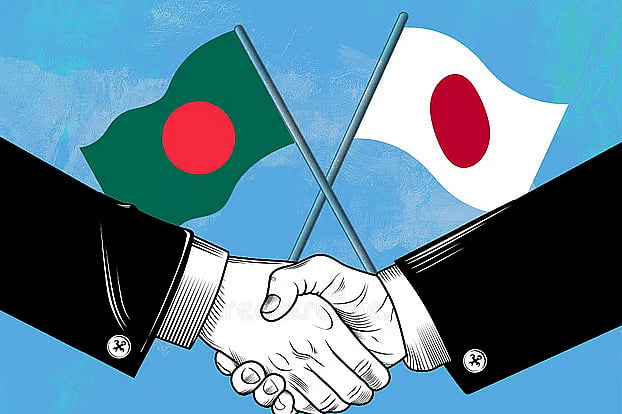
The upcoming visit of Prime Minister Tarique Rahman to Japan presents a significant opportunity to strengthen Bangladesh's economic potential and international partnerships. According to government statements, the primary focus of this visit, scheduled for 26 October, is bilateral relations, economic partnerships, and investment. To transform these expectations into sustainable achievements, clear preparation and consistent implementation are necessary.
The foundation of this relationship was established during the post-independence reconstruction period. On 10 February 1972, Japan recognised Bangladesh, and diplomatic relations were established. Since then, the continuity of relationships and cooperation has been maintained during various governments. This five-decade trust is a valuable diplomatic asset for Bangladesh.
Collaboration on projects like the Jamuna Multipurpose Bridge, Japanese financing, and technical involvement in Dhaka's metro rail and Jamuna railway bridge have significantly contributed to the communication system. The Bay of Bengal Industrial Growth Belt (BIG-B) initiative in 2014 unveiled the integrated potential of infrastructure, industry, and regional connectivity. Matarbari and Araihazar are the foundations for expanding that cooperation. Evaluating the achievements of existing projects and the potential of ongoing initiatives can enhance production, employment, and local businesses.
The first priority could be preparing to leverage the benefits of the Economic Partnership Agreement (EPA) signed on 6 February 2026. Joint action plans on essential processes for implementing the agreement, tariff regulations, rules of origin, certification, and customs procedures are required. Guidelines for small and medium exporters and training for officials will be helpful. Besides garments, market research can be conducted on leather goods, processed food, and light engineering sectors. To transform market advantages into sustainable trade, standards, punctuality, and consistent supply are essential.
In investment discussions, specific proposals, including prepared land, electricity, water, transport connections, and approval systems, could be fruitful. Based on the Araihazar Economic Zone, feasibility studies on machinery, electrical equipment, packaging, and food processing can be conducted. Encouraging joint ventures among Japanese medium-sized enterprises and Bangladeshi entrepreneurs, considering local suppliers, skilled workers, and market demand, is essential alongside large corporations.
Administrative reliability will support these efforts. A system for resolving investors' issues within a specified timeframe can increase predictability in approvals, tariff applications, and financial transactions. If the benefits of similar reforms reach domestic businesses as well, the overall investment environment will improve.
In infrastructure cooperation, connecting the development of Matarbari Port and the Maheshkhali-Matarbari area with roads, railways, warehouses, customs, and industrial zones is crucial. Joint initiatives to reduce the time and cost of goods transportation through digital customs, risk-based inspections, operational training, and information exchange can be undertaken. Considering loan terms, foreign currency repayment obligations, usage, and maintenance expenses in new projects will enhance the economic sustainability of cooperation.
Collaboration with Japanese partners on joint research and practical training with universities, polytechnics, and industrial enterprises will be beneficial in this regard. Cooperation can be increased in machinery maintenance, quality control, water management, and disaster-resilient construction. Alongside technology acquisition, capabilities in management, repair, and adaptation to local needs must be developed.
In human resource collaboration, the 2019 framework on skilled workers needs to be more effectively linked with the practical needs of employers. Joint curricula could emphasise language and technical training, comprehensible employment contracts, cost transparency, prevention of unscrupulous mediation, and grievance resolution. With an increase in worker numbers, equal importance must be given to improving skills, income, and protection.
The long-term goal should be to enrich the country's production and knowledge base alongside overseas employment. Training in Japanese institutions, joint factories in Bangladesh, and opportunities for returning workers to become entrepreneurs can be integrated into a single plan. The recognition of qualifications, research environment, and investment facilities will encourage voluntary return and the dissemination of skills within the country. This will extend the benefits of migration beyond remittances.
Bangladesh's industrial history provides significant examples in this context. In the late 1970s, the country's garment sector spread production and management knowledge across the clothing industry with the assistance of trained workers and South Korea's Daewoo. This experience shows that the enduring achievements of international cooperation lie in the learning capabilities of people and institutions. In the current partnership, it is essential to consider what skills remain in the country after a project's completion.
Collaboration with Japanese partners on joint research and practical training with universities, polytechnics, and industrial enterprises will be beneficial in this regard. Cooperation can be increased in machinery maintenance, quality control, water management, and disaster-resilient construction. Alongside technology acquisition, capabilities in management, repair, and adaptation to local needs must be developed.
In environment and energy sectors, the cooperation memorandum of February 2026 can be utilised to assess opportunities for energy savings, waste management, rooftop solar power, and disaster preparedness in industries. Considering local capability and long-term operational costs, choosing initiatives will reduce production costs and environmental risks.
These Japan-focused initiatives need to be part of Bangladesh's integrated East Asia strategy. The production and supply network of China, Japan's industrial technology, and quality management, combined with South Korea's production and technology experience, can be coordinated with Bangladesh's priorities.
Bangladesh's strategic position of development-centric autonomy can be useful. Recognising the unique value of each relationship, mutual trust, national interests, and freedom of decision-making must be maintained. Closer cooperation with Japan and close ties with China can create complementary developmental opportunities. Common standards in loan sustainability, transparent procurement processes, information security, environment, and effective state control over critical infrastructure will make this position credible.
Utilising its location in the Bay of Bengal, Bangladesh can be an effective connector between the markets of South Asia and the production systems of East Asia. For this, along with integrated transportation and customs, mutually agreed trade systems with neighbours are necessary. If local production, repair services, research, and suppliers are developed, the benefits of the connection will remain within the country. Diversity in financing, technology, and import sources will also increase economic resilience.
In a five to ten-year East Asia cooperation plan, priority industries, supplier capabilities, training, joint research, and production stages can be determined. Opportunities for local procurement and learning on mutually agreeable terms need to be increased. Indicators of evaluation will be realistic investment, domestic value addition, worker income, local orders, and technical capabilities.
There are opportunities to expand cooperation in maritime security, disaster assistance, international law, and peaceful dispute resolution. Japan's consistent diplomatic involvement is expected in creating a conducive environment for humanitarian aid for the Rohingya and for safe, voluntary, and dignified repatriation.
After the visit, publishing an implementation list with responsible agencies, timelines, and a review process will be helpful. In the six-month and one-year progress assessments, announced investments, actual cash flow and production, and training and employment need to be considered separately. Five decades of trust can be the foundation for the next decade's industrialisation if production is linked with infrastructure and knowledge is intertwined with migration.
#AKM Ahsan Ullah is Professor, University of Brunei Darussalam, Brunei. *Email: akmahsanullah@gmail. com
#The opinion expressed here is the author's own.
#The article, originally published in Prothom Alo print and online editions, has been rewritten in English by Rabiul Islam.