Opinion
Are these decisions a pre-emptive move to put next govt under pressure?
The Jatiya Sangsad (national parliament) election is scheduled for 12 February. Campaigning has gathered momentum. Although there has so far been no major violence or incident serious enough to cause a breakdown in law and order, deep public anxiety persists over security and the overall voting environment. The country formally entered the campaign period on 22 January.
At this moment, the interim government is, in effect, an election-time administration in terms of both responsibility and mandate. Many believe its activities should therefore remain confined to organising the election and carrying out routine duties. Yet, as its tenure draws to a close, a series of decisions, initiatives, appointments and contracts has raised questions and fuelled scepticism.
These include the formation of the 9th Pay Commission for government employees; plans to construct lavish flats for ministers and senior bureaucrats; agreements relating to Chattogram port; the announcement of an arms zone in the Mirsarai Economic Zone; the decision to procure 163 vehicles for RAB (Rapid Action Battalion); and the unusually rapid process of recruiting primary school teachers.
The question now being asked is whether these hurried decisions and initiatives, taken at the very end of the government’s term, are driven more by the interests of domestic and foreign groups than by the public good. Most importantly, some of these decisions involve long-term economic risks and sensitive issues of national security. The burden and liability will ultimately fall on the next elected government and on the public for years to come.
When upper-middle-class families in Dhaka typically live in flats of 1,500–1,600 square feet, and lower-level government employees manage with 650–700 square feet, what is the justification for constructing such vast residences for ministers? It is not that there is a shortage of ministerial housing.
On Tuesday, the Ganatantrik Odhikar Committee (Democratic Rights Committee) said in a statement that such contracts and efforts to sign agreements deemed “harmful” to the country would place the newly elected government in jeopardy as well. (Suspicious high-cost allocations at the last moment, Prothom Alo, 28 January 2026)
A report published in Prothom Alo on 25 January, titled “Govt to build 9,030-sq-ft flats for ministers”, reveals that the interim government has taken an initiative to construct three new buildings in the ministers’ enclave in Dhaka. These buildings will contain 72 flats, each measuring between 8,500 and 9,030 square feet.
Under a project titled construction of multi-storey residential buildings in Ramna, Dhaka, for ministers, state ministers, deputy ministers and heads of constitutional bodies, the larger flats will be allocated to ministers, while the smaller ones will go to state ministers, deputy ministers and constitutional office-holders. The proposal also includes swimming pools in the buildings. A budget of Tk 200 million has been allocated for purchasing furniture, including curtains.
When upper-middle-class families in Dhaka typically live in flats of 1,500–1,600 square feet, and lower-level government employees manage with 650–700 square feet, what is the justification for constructing such vast residences for ministers? It is not that there is a shortage of ministerial housing. At present, there are 13 bungalows in the ministers’ enclave, the Ministers’ Apartments on Bailey Road, and a total of 71 residences for ministers across Dhanmondi and Gulshan. Even setting aside the palatial facilities of the bungalows, existing ministerial flats already measure around 5,500 square feet. The question is: what will ministers do in 9,000-square-foot flats—play football or cricket?
Had such a proposal been prepared by bureaucrats under a political government, one might at least have found some vested interest or logic behind it. But why are bureaucrats pursuing such initiatives under an interim government that emerged from an anti-discrimination movement and a mass uprising of students and citizens? Are they seeking to curry favour with ministers of the next elected government by pushing through such projects? In a country where more than 40 million people struggle to secure two square meals a day, can anyone with a normal sense of proportion even contemplate such wasteful and luxurious schemes?
Under the Hasina government, a crony capitalist economy and an authoritarian system of governance took root, in which bureaucrats were key stakeholders alongside politicians, business elites and senior law enforcement officials. Bureaucrats also played a significant role in one-sided elections, midnight voting and stage-managed polls. After the mass uprising, people hoped for reform of the bureaucracy and for it to be brought under accountability. Ordinary citizens have long suffered in accessing government services, and that hardship has not ended under the interim government.
From the outset, rather than standing on the strength of the uprising, the government became dependent on the bureaucracy. As a result, the report and recommendations of the commission formed to reform the bureaucracy faced the greatest resistance. Under pressure from protests, those recommendations were quietly shelved. “Reform” has effectively meant replacing old faces with new ones.
To quote him in conclusion, “You leave behind a burden of a task you yourself will not carry out, placing it on the next government so that if it rejects it, the political authority faces non-cooperation from the bureaucracy. This is a form of blackmailing in advance.”
Officials who had been promoted or retired on the grounds of deprivation have been reinstated. At a time when a neutral government could have set an example of working above political considerations in the public interest, the bureaucracy has once again become divided along political lines. Not only were its own reform recommendations discarded, but the reports on reforms of the Anti-Corruption Commission, the police and the National Human Rights Commission were also altered to suit vested interests.
On 12 January, Transparency International Bangladesh claimed at a press conference that reforms had gone off track due to the government’s capitulation to the bureaucracy. Its executive director, Iftekharuzzaman, said: “Due to surrendering to these vested forces, many important recommendations have been scrapped and numerous anti-reform decisions have been taken. Even the July Charter has been irrationally violated, setting negative precedents that future governments may also follow. In particular, reforms have been derailed because of the government’s submission to a section of the bureaucracy engaged in subversive activities.” (TIB says reform drive stumbled as interim government ‘caved to bureaucratic pressure’, bdnews24)
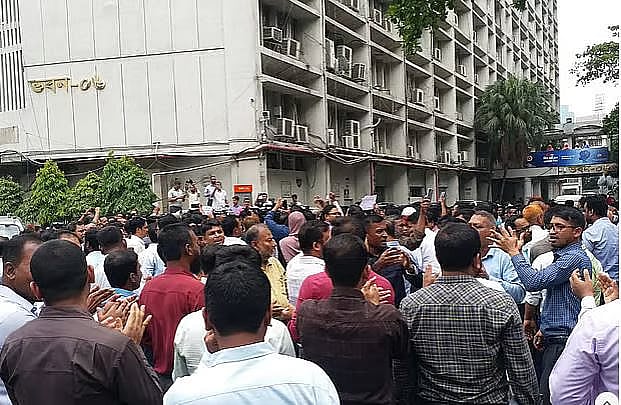
People want government services without bribes or harassment. Their anger has not subsided because they continue to be denied this. Muhammad Fouzul Kabir Khan, a powerful adviser to the interim government and a former bureaucrat, openly spoke at an event on Tuesday about the hostility he faced from within the bureaucracy while trying to work. He recounted being told that the aircraft which crashed at Milestone School and College should have fallen on the Secretariat instead. “People are that angry,” he said. “Not just the Secretariat—there is enormous public anger against every government office.”
At the end of the interim government’s term, the 9th Pay Commission has recommended increases in pay and allowances for government employees. The government has said that the decision and its implementation will be the responsibility of the next interim government. It is true that wages at the lower tiers of public service are not aligned with current market realities. But how will the state finance the Tk 1.06 trillion required to raise salaries across all tiers by 100–147 per cent?
Despite hikes in electricity, fertiliser and fuel prices, and an increased burden of indirect taxes such as VAT, revenue collection has not exceeded Tk 4 trillion in recent years. Bangladesh’s revenue-to-GDP ratio is the lowest in South Asia. Investment and employment remain stagnant. High inflation has persisted for three consecutive years. Hundreds of thousands of people have lost jobs and slipped into poverty. The private sector, the main engine of the economy, is in its most fragile state. What, then, is the real objective of imposing such a massive burden on an already broken economy?
In this context, the pay commission’s recommendations could become a major source of pressure and anxiety for the next political government, which may face discontent among public servants. Kamal Ahmed, head of the Media Reform Commission, has described this as a form of “advance blackmail”.
To quote him in conclusion, “You leave behind a burden of a task you yourself will not carry out, placing it on the next government so that if it rejects it, the political authority faces non-cooperation from the bureaucracy. This is a form of blackmailing in advance.”
This is why questions are now being raised as to whether some of the interim government’s end-of-term decisions are, in fact, a pre-emptive attempt to put pressure on the next government. It is the government’s responsibility to answer these questions.
* Manoj Dey is an assistant editor at Prothom Alo.
* Views expressed are the author’s own.