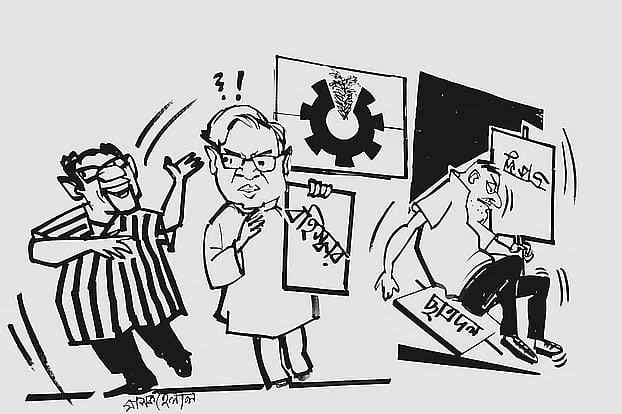
Given the reactions of Chhatra Dal leaders regarding the results of the Dhaka University and Jahangirnagar University student union elections, it seems they are trying to cover up their own failures by shifting the blame onto others.
After the DUCSU elections, not just Chhatra Dal but BNP’s central leaders also began loudly claiming that Islami Chhatra Shibir had won the elections by colluding with the banned Chhatra League.
This allegation has two sides. First, it implies that the banned student organisation still plays a decisive role in determining the outcome of student union elections on campus. If Chhatra Dal leaders had already anticipated such influence of the Chhatra League, why didn’t they try to win over its supporters? The organisation may be banned, but no one has taken away the voting rights of its sympathisers.
In reality, the hollowness of BNP and Chhatra Dal’s allegations becomes clear if we look at the results from a single hall. In that hall, Chhatra Dal’s VP candidate Abidul Islam received 1,276 votes, while the Shibir-backed united student alliance candidate Sadiq Kayem got only 10. For the GS post, Chhatra Dal’s Sheikh Tanvir Bari Hamim secured 398 votes, while the Shibir-backed panel’s GS candidate SM Forhad received 5.
The hall in question has traditionally been Chhatra League-dominated. In the past, when Chhatra Union, Chhatra Dal, or Chhatra Front won in other halls, this hall still went to the Chhatra League.
Chhatra Dal leaders allege that during the Awami League government’s 15 years in power, they could not enter the campuses. Chhatra Shibir, under the guise of being Chhatra League, continued to operate and maintain its presence there. However, over the past 13 months, Chhatra Dal leaders and activists have faced no difficulty in staying on campus.
After the July uprising, I attended a book launch event organised at Bangla Academy. Around 50 to 60 leaders and activists of Dhaka University Chhatra Dal were present there. On television talk shows too, whenever a Chhatra Dal leader appeared, I noticed that 20 to 25 activists and supporters accompanied him.
During the Awami League government, whenever a Chhatra League leader appeared on television, he would be accompanied by 30 to 40 supporters, some riding in his car, others on motorbikes. The faces may have changed, but the culture has not.
According to those concerned, ordinary students cast their votes for the leaders and activists who stood by them in times of need. They did not vote on the basis of symbol or leadership. BNP leaders are also critical of Shibir for contesting under an anonymous panel.
Whether Chhatra Dal will prove to be a burden or a blessing for BNP, remains to be seen. BNP leadership has spoken about rebuilding the trust of young people. But why that trust broke down is a question BNP does not seem to be asking
This means that while Shibir has understood the changed political reality, Chhatra Dal or the BNP has not. Shibir realised that by putting forward a united student alliance panel, they could win support even from students outside their ideological circle. Symbolically, they even included an ethnic minority candidate on their panel.
Of Dhaka University’s 40,000 students, half live outside the halls. If one were to check how many of them Chhatra Dal and Shibir leaders actually engaged with before the election, the victory and defeat would become clear. Another reason for Chhatra Dal’s loss was overconfidence. They assumed that since the BNP is unchallenged in national politics, no one could defeat Chhatra Dal on campus either.
Obviously the results of the DUCSU and JUCSU elections have energised Jamaat-e-Islami while delivering a major blow to BNP. The question is, how will they recover from that setback?
According to a report published in The Daily Star on 17 September, at a time when BNP is struggling to control its grassroots amid allegations against its leaders and activists of extortion and various other crimes, the party has drawn up a plan to rebuild a clean image. At a meeting of the party’s standing committee on Monday, it was decided that from mid-October, grassroots-level meetings, rallies, and discussion sessions would be organised in every locality. Many have described this as a wake-up call.
In a message posted on his verified Facebook page on Thursday, BNP’s acting chairman Tarique Rahman stressed the need to restore discipline within the party. He said, “Organisational action has been taken against more than seven thousand BNP members on various charges. Some have been removed from their posts and many expelled due to corruption, extortion, and misconduct.”
Unless the political culture that enables corruption, extortion, and muscle power among leaders and activists is brought to an end, BNP will not be able to restore its clean image simply through “expulsions and reprimands.”
Tarique Rahman has claimed that BNP has always modernised itself to meet the demands and challenges of the times. Yet Chhatra Dal has not changed at all. During the Awami League era, Chhatra League became a burden for them, and in the end, it was because of Chhatra League that they had to step aside. Whether Chhatra Dal will prove to be a burden or a blessing for BNP, remains to be seen. BNP leadership has spoken about rebuilding the trust of young people. But why that trust broke down is a question BNP does not seem to be asking.
On the very day Tarique Rahman’s message appeared in the media, I saw that in Alokbali union of Narsingdi, an elderly man was shot dead during clashes between two local BNP factions over establishing dominance. He was not a member of the party. Even so, the incident could easily have serious repercussions in local politics. Why should ordinary people lose their lives in BNP’s internal feuds?
In this case, one faction was led by union BNP convener Shah Alam Chowdhury, and the other by recently expelled member-secretary Abdul Kaiyum Mia. Abdul Kaiyum had been expelled from the party recently following allegations, including involvement in illegal sand extraction from the Meghna River.
There are allegations that, to block Abdul Kaiyum, Shah Alam Chowdhury instigated and intervened to bring Awami League leaders and activists back to the area. As part of this plan, at around 5 am on Thursday, several local Awami League leaders who had been in hiding began returning to the area in motor boats. Supporters of Abdul Kaiyum tried to stop them. Both sides clashed, armed with sticks, firearms and homemade weapons.
The incident did not end there. Following media coverage of the clash between the two BNP factions, a journalist was attacked in the courtyard of Narsingdi Sadar Hospital. The victim, Ayub Khan Sarker, is a local correspondent for the private channel Jamuna Television. He was repeatedly assaulted. He received head injuries, requiring four stitches.
At the time of the attack, Ashiqur Rahman, a journalist for Somoy Television, was present at the scene. According to him, the argument began over why Jamuna TV’s report described the incident as a clash between two BNP factions.
Ayub Khan repeatedly explained that it was not his words and the information had come from the local police and residents. After that, the attackers demanded, “Why did you write that?” and “Correct it now,” and began assaulting him, repeatedly hitting him.
Such incidents like this are happening all over the country, not just in Narsingdi alone.
* Sohrab Hasan is a journalist and poet
* The views expressed here are the author's own.