Zahed Ur Rahman's column
Has Jamaat-Shibir lost politically by winning in DUCSU-JUCSU
As discussions continue around the unprecedented results of Islami Chhatra Shibir in the DUCSU and JUCSU elections and the potential implications for the upcoming national parliamentary elections, some important questions need to be raised: Has Jamaat-e-Islami and Islami Chhatra Shibir taken a long-term political risk in pursuit of short-term gains? Shibir may have won in the DUCSU and JUCSU elections, but did they lose politically?
Shibir did not officially contest the DUCSU and JUCSU elections under its own name, so it is not entirely accurate to attribute every action or outcome directly to them — such tangential arguments have not been considered in this article’s discussion.
Ahead of the DUCSU elections, Shibir released a 36-point manifesto focused largely on improving academic standards at the university and introducing various welfare initiatives for students. However, the preamble of Shibir’s constitution is entirely centered on belief in Islam and the establishment of Islamic principles. Let us now look at some specific sections of that constitution—
Goals and objectives: The goal and objective of this organisation is to attain the pleasure of Allah by reorganising all aspects of human life in accordance with the laws given by Allah and shown by the Prophet (peace be upon him).
Programmes: 1. To convey the message of Islam to the younger student community, inspiring them to gain Islamic knowledge and feel a sense of responsibility to fully practice Islam in their daily lives; 2. To unite those students who are ready to participate in the struggle to establish an Islamic way of life under the organisation’s banner; 3. To educate the organised students in Islamic knowledge and build them into individuals of ideal character, capable of proving the superiority of Islam by confronting all the challenges of ignorance (Jahiliyyah); 4. To advocate for changes in the education system based on Islamic values in order to produce ideal citizens, and to lead the struggle to solve the real problems faced by the student community; 5.To make all-out efforts toward building an Islamic society for the liberation of humanity from economic exploitation, political oppression, and cultural subjugation.
Needless to say, none of these goals, objectives, or programmes were reflected in their election manifesto. It is abundantly clear that Chhatra Shibir is, at the very least, not thinking too deeply about the 'Islam' attached to its name.
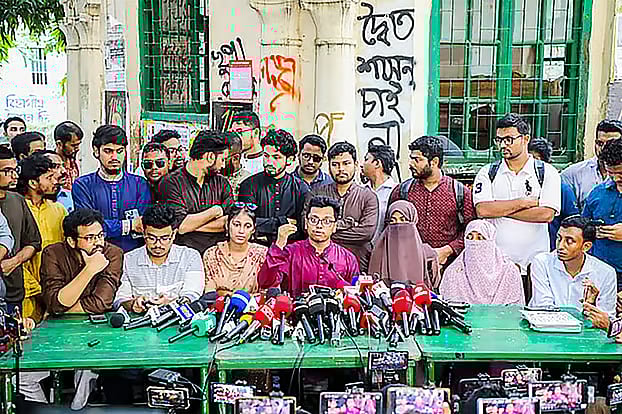
The candidate selection by Chhatra Shibir for the DUCSU election generated considerable discussion. A non-Muslim (Chakma) candidate and a female candidate who does not wear the hijab came as a surprise to many. In fact, a press conference was held where that female candidate was seated alongside the VP and GS candidates.
Not only that, the candidates for president and general secretary were also seen interacting freely with female students who do not wear the hijab—something previously unheard of among Shibir leaders. Moreover, many of their activists and members were not seen adhering to Islamic dress codes or other religious guidelines as strictly as they traditionally have.
This naturally raises the question: according to Chhatra Shibir’s own constitution, can a member behave in this way? The constitution states that a member must “...properly observe all obligatory and mandatory duties as prescribed by Islam, avoid major sins, and not maintain any affiliation with organisations whose goals and activities are contrary to those of this organisation; only then can he be eligible for membership.”
In many cases, political parties adopt strategies that contradict their own principles and ideology. Citizens in countries like ours often tend to accept such contradictions. However, while this may apply to most political parties, the matter is not so simple when it comes to ideology-based—especially Islamic—political parties.
Chhatra Shibir’s election strategy has been widely praised from various quarters. Many have said that, through this approach, Shibir has demonstrated a somewhat liberal political ideology, which should be welcomed. There is no doubt that elections are a game of strategy.
In many cases, political parties adopt strategies that contradict their own principles and ideology. Citizens in countries like ours often tend to accept such contradictions. However, while this may apply to most political parties, the matter is not so simple when it comes to ideology-based—especially Islamic—political parties.
Like all religions, Islam also has various schools of thought. Even among Islamic parties that operate within constitutional frameworks, there are deep ideological differences. Moreover, there is often a tendency for one faction to completely delegitimise another’s claim to Islam.
However, when an Islamic party takes a definitive stance on matters of religion, any significant deviation from that position inevitably raises serious questions. For example, according to Jamaat-e-Islami’s own claims, their ideology is not man-made. Therefore, while a man-made party breaking its own constitution or behaving inconsistently may raise some concerns, when Jamaat-e-Islami or its student wing Chhatra Shibir—whose entire foundation is based solely on Islamic principles—does the same, it invites far greater scrutiny.
In the lives of Bangladeshi people, religion holds a special place. While many may not strictly follow Islamic principles in their personal lives or strive to be morally upright according to Islamic standards, there is still a deep emotional and cultural sensitivity around religious rituals and sentiments. From that perspective, Islamic parties should, in theory, perform well in elections in Bangladesh. However, contrary to such logical expectations, the public has largely rejected this type of religious politics.
During Sheikh Hasina's tenure, there were at least three elections that did not take place. As a result, we haven’t been able to clearly gauge the public's voting behaviour. Nonetheless, there is ongoing discussion in political circles that during this period, there has been a noticeable increase in people's inclination toward Islam. Consequently, it is assumed that Islamic political parties may gain significantly more votes.
By any measure, the DUCSU and JUCSU elections do not reflect broader national voting trends in Bangladesh. Nevertheless, discussions and analyses continue over how much these student union election results might influence the upcoming national elections.
Many speculate that Jamaat-e-Islami could perform surprisingly well in the next parliamentary election. Some view the post-election meetings between business leaders and the Jamaat chief as an early indicator of this potential trend, following the student union results.
This article does not aim to analyse how well or poorly Jamaat-e-Islami may perform in the national elections.
However, it is reasonable to assume that, in light of the DUCSU and JUCSU results, Jamaat-e-Islami may present a similar welfare-oriented agenda to the public in the national elections. Their manifesto and campaign will likely contain little more than generic statements such as “no law will be enacted outside the framework of the Holy Quran and Sunnah”—a line also used by parties like the BNP and Awami League—with little substantive difference.
However, important leaders and intellectuals of the party often say that if they come to power, they will establish Sharia law. No matter what they say publicly, Jamaat-e-Islami’s leaders probably do not truly believe they will win this election and come to power. Yet their statements and body language clearly show strong confidence in performing very well in the election.
At first glance, it might seem this was the perfect moment for Jamaat-e-Islami to present their vision of Sharia to the public and make it their main electoral promise. So far, however, there is no sign of that happening.
Although Chhatra Shibir achieved unprecedented success in the two student union elections, this success did not come through their politics. They are adapting in ways that reflect the realities and demands of the electoral field. Even if they win elections, their politics have been defeated. These student union elections demonstrated that the majority of the people in Bangladesh still want moderate, welfare-oriented politics; they continue to reject identity politics based on religion as before.
This article ends here. However, I would like to pose a new question for future discussion. Looking at Jamaat-e-Islami’s politics, it seems that regardless of what their constitution states, they are becoming quite similar to BNP. So, in the new political landscape, what should BNP’s politics look like?
*Zahed Ur Rahman is university lecturer and political analyst.
* The opinions expressed are the author’s own.