Opinion
Now is the best time for a leader to become a statesman
One of our distinguished poets, Helal Hafiz, wrote an outstanding poem titled “Forbidden Editorial.” Two widely quoted lines from the poem are:
"Now is the prime of youth; Now is the time to go to war."
For our country, this is very much a “time of struggle”—a struggle to bring the nation back onto the right path. We are lost in thought, wondering who will lead us in this “struggle.” No one seems particularly promising.
At this critical moment, we need a statesman. If poet Helal Hafiz were still alive, he might write another poem:
"Now is the best time
For the one who is a leader
To become a statesman."
The election is scheduled for 12 February 2026. The election will certainly take place. However, there is doubt about how “free and fair” the election will be, as announced by Professor Muhammad Yunus.
All around, there is nothing but bluster and threats! The attacks on Prothom Alo and The Daily Star have further heightened concerns about the election. Without independent newspapers, the idea of a neutral election is unrealistic.
Leaders say they must ensure their own security. Licences for firearms have been issued to them. Senior leaders are all preoccupied with their own protection—so who will provide security for the general public?
The Ministry of Foreign Affairs has summoned foreign diplomats, assuring them that the country’s security arrangements are adequate. This may reassure the diplomats, but will it reassure the people?
Despite all obstacles, the election must take place. Only an elected government can restore a calm and peaceful environment in the country and protect the nation from the instability caused by mob violence and terrorism.
The people of Bangladesh are exhausted from a climate of conflict—they now want peace. They no longer want the clangor of autocracy, threats of death, or divisions based on religion.
The time has come to establish a lawful government and run the country through constitutional means.
Our Liberation War should no longer be dishonoured; no one should ridicule our Baul music or culture; no one should set fire to our newspapers or cultural spaces. We want to elect our representatives through voting, and our foreign policy should not be dictated by street demonstrations—these are very basic demands.
Can anyone fulfill these demands? Will any of our leaders step forward and boldly say, “People, place your trust in me; I can meet your demands and bring peace to the country”?
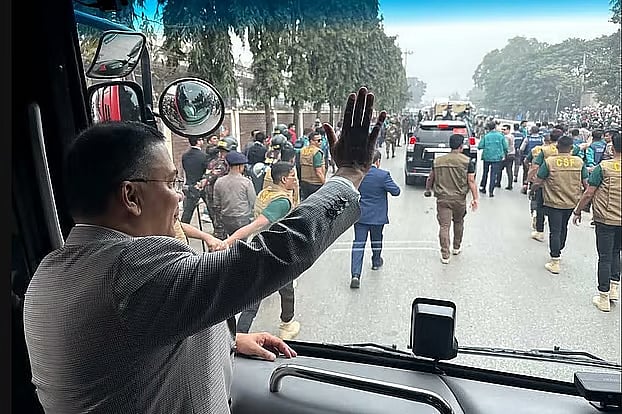
As a leader of a major political party, all eyes are now on Tarique Rahman. Everyone is eager to see what he says, what he does, and what steps he takes to restore order within his party.
A survey conducted by Prothom Alo shows that among the two major political parties, BNP is likely to win more seats. According to the survey, BNP is projected to secure 65.9 per cent of the seats, while Jamaat-e-Islami would get 25.9 per cent.
Broadly, the survey also reflects the popular support for these two parties. Whether we call it probability or support, the balance clearly leans in BNP’s favour.
Thus, there is strong discussion that BNP will form the government if elected. But what will BNP do after forming the government?
Who will be the opposition party? According to the survey, Jamaat will assume that role. If that happens, then those who led the July movement and appointed this government will lose power. Will BNP be able to overturn the politics of pressure and mob rule?
Will they be able to create a democratic environment where all problems are resolved in parliament? The true test of BNP’s leadership will come after the election. That is why it was said: now is the best time for the one who is a leader to become a statesman.
Leaders will be elected; prime ministers and presidents will come to office. A new ruling class will emerge. But will we be able to establish a system of orderly, rule‑based governance?
Our country has never lacked rulers. So why has peace not come? Why has there been so much violence and bloodshed?
Two of our heads of state lost their lives, and others were forcibly dragged out of power. Why must there be a movement every time a government is to be changed?
Those who have held power, or seek to come to power, will find the answer if they look into their own mirrors.
The answer is simple: our rulers have loved their own power more than the country.
No one wanted to remain in power by demonstrating the merit of their work; no one wanted to relinquish power by admitting the failure of their actions; and no one wanted to come to power by proving their competence.
Those in power have sought to keep others out through force and repression. Those seeking power have tried to drag the incumbents out through confrontation and upheaval.
Since the people of the country had no better alternative, they have at times applauded one side, and at times the other, trying to remain relevant.
Why has this happened? Because none of our leaders were able to rise from being mere rulers to becoming true statesmen. They failed to build a strong foundation.
No one left behind a proper example of orderly, rule-based governance that others could follow.
Those in power—men, women, generals, civilians—all left the same legacy: seizing power for themselves, blocking others from coming to power, and finding ways to neutralise their rivals.
Sometimes power has changed hands, through movements or legal or illegal means. Those who were once oppressed, upon gaining power, have themselves become oppressors.
What we need is a statesman who can show the path like Nehru, Mandela, Lee Kuan Yew, or Mahathir, and establish a foundation of rule-based governance, with two core principles:
Ensuring equal opportunity for others to come to power, and
Holding peaceful elections every five years and transferring power in accordance with the rules.
There is much discussion about reforms in government, but everyone remains silent on political reform. True, political reform cannot be achieved merely by writing laws on paper.
If Tarique Rahman can become a statesman, a good ruler, and an effective political leader, his name will be inscribed in our political history in golden letters, leaving an exemplary legacy for future political leaders. Even as a statesman alone, his contributions will be remembered with gratitude.Now is the best time for the one who is a leader to become a statesman. Can Tarique Rahman become that statesman?
Political reform comes from politicians practicing good governance and being accountable for the progress of the state.
Without accountability among politicians, our state can never return to rule-based governance. The one who can fulfill these two conditions for becoming a true statesman will be our greatest reformer.
Our ancestors could not fulfill these two demands. As a result, we had to endure one-party rule, “yes-no” votes, military rule, attempts to make caretaker governments partisan, enforced disappearances and killings, nighttime elections, and sham or manipulated elections.
Embedded within these two demands are several prerequisites, such as free and fair elections, a political culture free from oppression, and efforts toward good governance.
If these two demands are met, a stable political future will be created for the country, where the people entrust a ruler with governing for five years. If the ruler fails to meet expectations, another will peacefully take office in the next election.
The question is: who will be the statesman capable of leading us on the path of rule-based governance?
As the leader of the country’s largest political party, Tarique Rahman’s name comes to mind first. At this critical juncture for the nation, can he fulfill these two modest demands, become our statesman, and guide us toward a rule-based system?
If he becomes a statesman and, at the same time, a good ruler, it will be a great blessing for the country. The people of this country have long aspired to have a statesman, a good ruler, and a capable leader.
If Tarique Rahman can become a statesman, a good ruler, and an effective political leader, his name will be inscribed in our political history in golden letters, leaving an exemplary legacy for future political leaders. Even as a statesman alone, his contributions will be remembered with gratitude.
Now is the best time for the one who is a leader to become a statesman. Can Tarique Rahman become that statesman?
#Saleh Uddin Ahmed is teacher, writer, and political analyst
*Email: salehpublic711@gmail.com