Sohrab Hassan's column
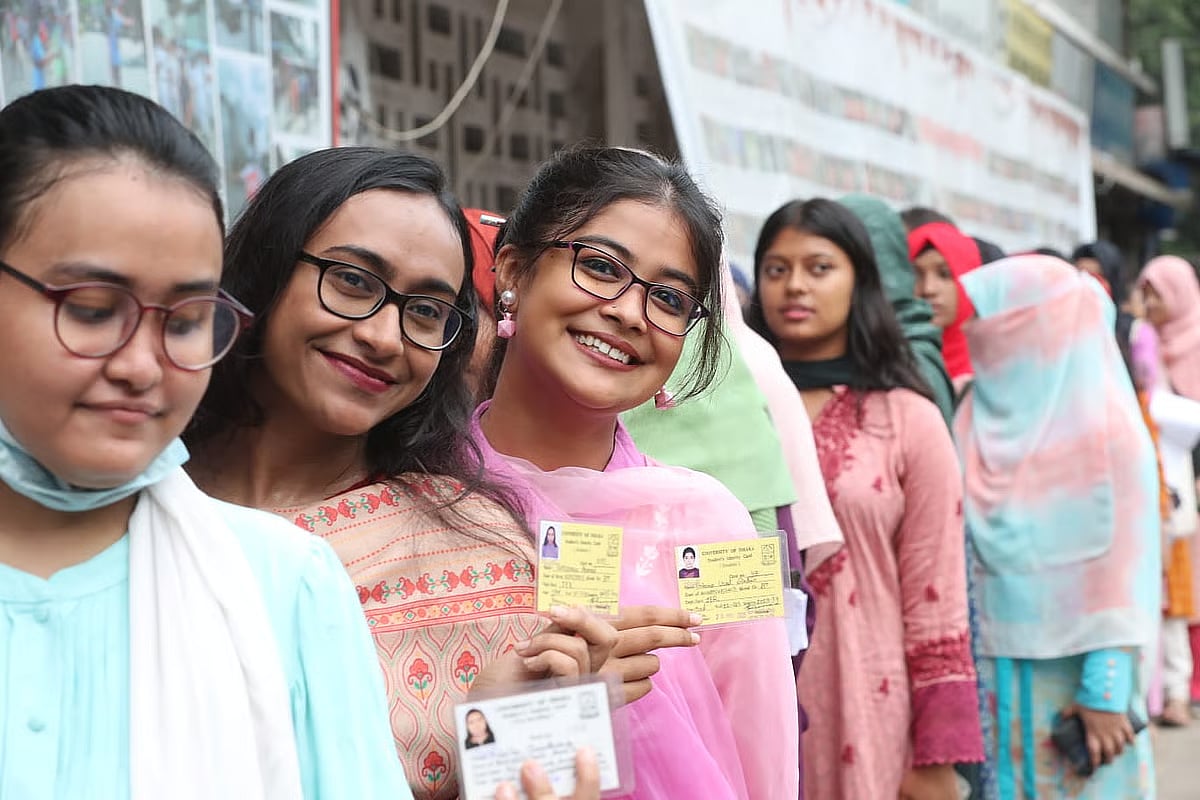
Student union polls: So what have we learnt from 2024?
Last Thursday afternoon, I spoke with a former teacher of Jahangirnagar University. When asked about the position of left-leaning student organisations in the university’s central student union (JUCSU) election, he said, “The situation there is even worse than at Dhaka University. At DUCSU, at least one candidate from the Pratirodh Mancha won, and though GS candidate Meghmallar Bosu did not win, he was at least in the contest. At Jahangirnagar, I don’t think anyone like that will even enter the competition.”
About an hour later, I got the news that at Jahangirnagar, five panels, including those backed by Chhatra Dal and the left, had withdrawn from the race, declaring a boycott. In doing so, they effectively conceded their moral defeat even before the results were announced, a realisation their leaders likely do not have.
After the voting, I spoke with another teacher, who had played an extremely courageous role in the 2024 mass movement at Jahangirnagar. His speeches had inspired not only the students but the entire nation. He blamed the administration for various irregularities and mismanagement in the JUCSU election process. Questions have also been raised about whether those responsible for conducting the election had the competence and capability to do so.
If the DU administration were to earn star marks for organising the student union election, the Jahangirnagar University administration would not even pass. Although voting ended at 5 pm on Thursday, the counting process had not been completed at the time this editorial was written.
A tragic incident occurred in Jahangirnagar on Friday morning during vote counting, when Assistant Professor Jannatul Ferdous Moumita of the university’s Fine Arts Department fell ill and passed away. She had been serving as a polling officer. Earlier, while gathering news on the DUCSU election, STV journalist Tariqul Islam Shibli also fell ill and died inside the campus.
Amid the turmoil of the student union election, preparations for the national election are also underway. At a meeting of the National Unity Commission on Thursday, Chief Adviser Professor Muhammad Yunus said, “The national election scheduled for February is not just an ordinary election; it is a foundational election that will determine the path of Bangladesh’s future. Therefore, in anticipation of the election, we must finalise the fundamental reforms.”
The Chief Advisor’s press wing reported that the meeting included detailed discussions on the proposals of the Consensus Commission and the political parties regarding the implementation of the July Charter. This is not new. Meanwhile, there are already rumours of changes within the Advisory Council. If the Chief Advisor feels that adding or removing members is necessary to create a free and fair environment for the election, it must be done now.
The DUCSU election results surprised many. In this case, the personal reputation and approachability of the candidates played a greater role than national politics; ordinary students voted for those they felt close to in times of trouble. The biggest victory went to Chhatra Shibir. Regarding Chhatra Shibir’s overwhelming win, an NCP leader commented: “Stepping beyond traditional religious politics, Shibir organised its campaign and panel from a centrist, liberal standpoint. By avoiding right-wing or religion-based rhetoric and campaigning from a moderate position, this approach played a major role in their victory.”
Other student organisations, if they believe in democracy, must respect the panel chosen by ordinary students in DUCSU and JUCSU. They must also work with them and examine why they were defeated. Meanwhile, several BNP leaders have claimed to have discovered collusion between Shibir and the banned Chhatra League. If there is evidence behind this claim, it should be shared with the nation. But this also raises the question: what have they done over the past year?
Elections are the first step of democracy. Over the past 54 years, our politicians have not been able to even complete this step. Even when in power, they have failed to demonstrate that free and fair elections are possible under a party-led government. It was the politicians themselves who, through struggle and movement, established the caretaker government.
BNP, trying to use the caretaker system for their own interests, failed to hold the 2007 election. Meanwhile, the Awami League, in an attempt to make power permanent, annulled the very caretaker system that was the fruit of their own movement. They are now facing the consequences.
If the student leadership fails to hold a fair and proper student union election, or if they do not accept the verdict of ordinary students after the election, then many more hazards lie ahead
Currently, the Awami League is absent from the field. BNP is active. So are Jamaat-e-Islami, the NCP, and other parties. Yet, despite months of continuous discussion, these parties have been unable to reach a consensus on the election or the future state structure. Blaming this failure on the “fallen dictatorship” to feel self-satisfied will not advance democracy even a single step.
Our astute politicians and student leaders never seem to learn from past mistakes. Many of them talk daily about the ousted Awami League and vow to foil its conspiracies. Yet they cannot reach a consensus on how to conduct an election themselves.
Leaders of Chhatra Dal, leftist student organisations, and Bangladesh Ganatantrik Chhatra Sangsad have spoken extensively about national politics and continue to do so. But they have said very little about the problems of students within educational institutions. From various sources, it appears that this work was done by leaders and activists of Chhatra Shibir.
Chhatra Dal, citing an absence of a fair environment, had initially tried to block the student union election. Later, under pressure from all student organisations, they agreed to hold the election. Meanwhile, the leftist student leadership that had led the 2024 anti-discrimination movement broke into many factions, the benefits of which went solely to the Shibir-supported panel.
Chhatra Dal leaders believed that a national election would set everything right. At one time, leftist politicians thought similarly. They used to say: “Change society first; then people’s fortunes will change.” But they never considered that if people themselves do not change, nothing in society, the state, or education will change.
If the student leadership that, through the 2024 mass uprising, was able to overthrow a powerful government cannot conduct a student union election smoothly, it raises serious questions. While the DUCSU election went relatively well, JUCSU witnessed a catastrophe, for which the university administration cannot shirk responsibility. Unfortunately, even those who spoke of new arrangements after the 2024 uprising are following the old ways.
If the political parties active on campus cannot reach a consensus on the elections, if the student leadership fails to hold a fair and proper student union election, or if they do not accept the verdict of ordinary students after the election, then many more hazards lie ahead.
* Sohrab Hasan is a journalist and poet
* The views expressed are the author’s own