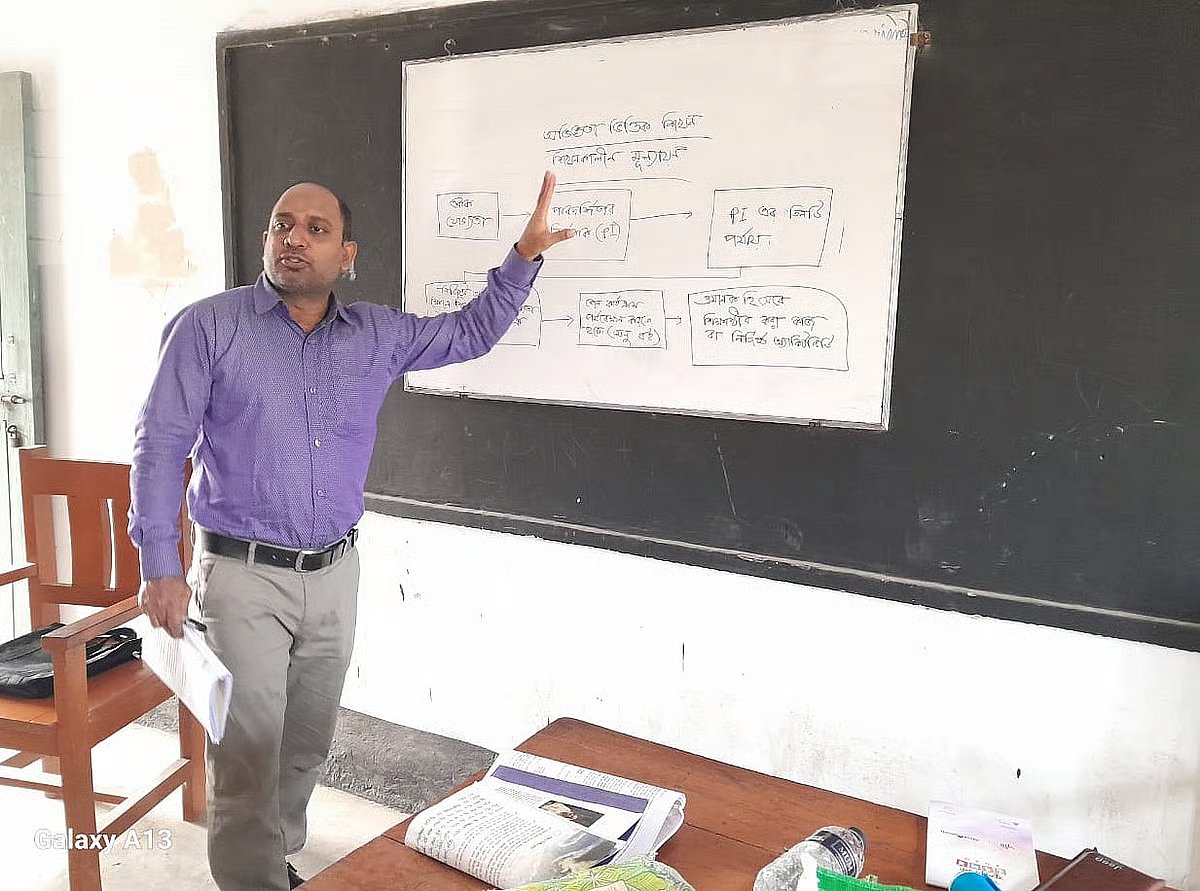
Teacher training in primary schools stalled by severe staff shortage
Government primary schools make up the largest segment of Bangladesh’s education system with millions of children studying in them. The quality of their education largely depends on how effectively teachers conduct their lessons.
However, the training system that equips teachers with the scientific methods of teaching has practically collapsed. Acute manpower shortages at the Upazila Resource Centres (URC) and Primary Teachers’ Training Institutes (PTI) have brought primary teacher training activities to a standstill.
Taking classes without training
In many developed countries, to become a teacher one needs not only a subject-specific degree but also an additional qualification such as a Bachelor in Teaching or an equivalent degree.
Without knowledge of scientific teaching methods, it is difficult to engage students in the classroom. In Bangladesh, however, anyone who passes the recruitment exam can start teaching immediately, often without any formal training.
Haider Ali, an assistant teacher at Hatibandha no. 2 Model Government Primary School in Lalmonirhat, has been teaching for over a decade. He said, “A teacher begins taking classes right after joining the job. Without training, these classes cannot be scientifically sound.”
“The teacher training centres have become dysfunctional due to a shortage of staff. If experienced and capable primary school teachers are appointed as trainers, the situation will improve quickly,” the teacher added.
Teacher training activities are being disrupted due to manpower shortages. To ensure quality and modern education, there is no alternative to training. We have taken new initiatives to address the shortage and hope the problem will be resolved soon.Abu Noor Md Shamsuzzaman, director general, Directorate of Primary Education
Vacant posts in URCs
Upazila Resource Centres (URC) play a crucial role in training teachers, enhancing teaching quality, and fostering students’ interest in learning. But these activities have nearly come to a halt now.
According to the Directorate of Primary Education, there are 505 posts for assistant instructors (grade 10) in URCs across the country, but only 18 officials are currently in service.
That means 487 positions remain vacant, rendering the centres almost inoperative. As a result, newly recruited teachers are teaching in classrooms without receiving any effective training.
PTIs facing the same crisis
Basic training for primary teachers is provided through Primary Teachers’ Training Institutes (PTI), which are also suffering from a severe shortage of staff.
Out of 133 posts for assistant superintendents, only 52 are filled, leaving 81 vacant. Among 794 instructor (general) posts, 424 are filled, while the other 370 remain vacant.
This crisis has made it nearly impossible to provide teachers with proper training. A PTI official, requesting anonymity, said, “One officer is often managing the work of two or even three districts. It’s impossible to deliver quality training under such pressure.”
Why training is essential
Educationalists emphasise that subject knowledge alone cannot make a good teacher. Teachers must know how to explain lessons to children and how to make learning engaging for them.
Professor SM Hafizur Rahman of the Institute of Education and Research at the University of Dhaka said, “Teaching is a specialised profession. In most countries, one cannot become a teacher without a teaching licence.”
“Unfortunately, we have no such system here. If teachers don’t even understand the curriculum, how can they help improve students’ learning?”
The professor added, “In our country, teacher training is still called ‘training’, but what we really need is teacher education. Along with training, teachers’ salaries, professional grades, and benefits must be improved otherwise talented individuals will not join the profession.”
In many developed countries, a specialised degree in teaching is mandatory. One cannot become a teacher merely by doing well in their subject. Learning pedagogical techniques is essential. Even those with PhDs cannot teach without a teaching licence in many parts of the world.
Educationalists point out that there is a difference between knowing and teaching. A teacher must not only be knowledgeable but also be able to communicate that knowledge in a way students can grasp, and that skill is developed through training.
Ground reality
During training sessions at URCs and PTIs, experienced trainers usually conduct demonstration classes, followed by practice sessions for teachers. Through these, teachers learn new teaching techniques, modern methods for teaching Mathematics and English, child psychology, and the use of technology in education.
However, due to the large number of vacant posts, these activities no longer occur regularly. Many teachers go years without receiving any training and continue teaching in outdated ways.
Several trainers involved in primary school teacher training, speaking on condition of anonymity, said, “Improving education quality is not just about modern buildings or materials. The key is the teacher and the curriculum. If teachers are not provided quality training, no form of development will be of any use.”
They added, “With money, buildings can be built overnight and materials purchased. But producing skilled teachers takes time and investment. That’s why prioritising this sector is essential.”
Steps towards a solution
Director general of the Directorate of Primary Education, Abu Noor Md Shamsuzzaman, told Prothom Alo, “Teacher training activities are being disrupted due to manpower shortages. To ensure quality and modern education, there is no alternative to training. We have taken new initiatives to address the shortage and hope the problem will be resolved soon.”
According to sources at the directorate, plans are underway to begin new recruitment process. Efforts are also being made to modernise the training system through the use of information technology, including the introduction of online training programmes.
Education stakeholders stress that primary education forms the foundation of a child’s learning journey. If the quality of teaching at this stage is poor, it will affect every step that follows. Therefore, it is high time to revitalise the teacher training system. Unless the staff shortage is addressed quickly, progress in improving education quality will stall.