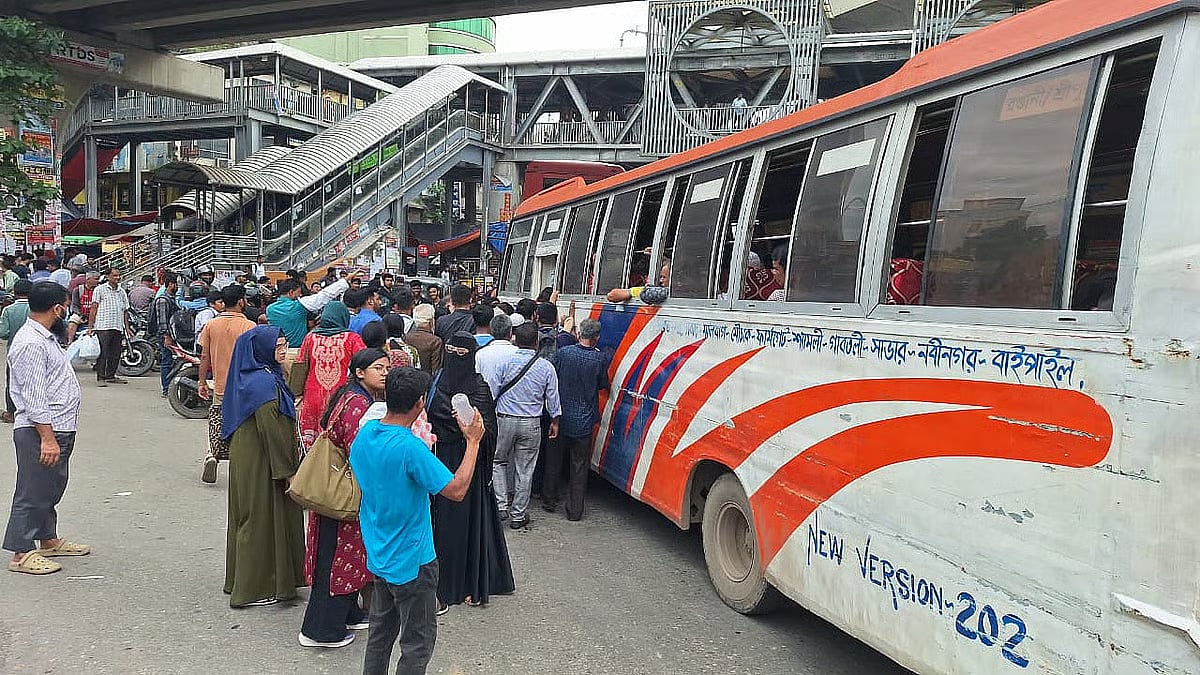
Some buses raise fare Tk 10 to 15, warn passengers, ‘fares higher today’
With fuel prices rising, some buses in Dhaka have started charging an additional Tk 5 even before the government has officially published a new fare chart. The minimum fare of Tk 10 is being raised to Tk 15.
Visiting various routes in the capital on Tuesday it was found that bus conductors were warning passengers as they boarded, saying, “Fares are higher today.”
In some places, arguments broke out between passengers and transport workers when passengers refused to pay the additional fare. The absence of a new fare chart has created confusion over how much passengers should pay. Many passengers also reported hassles caused by having to pay higher fares.
This was the picture found after travelling on different buses in the Shonir Akhra, Asad Gate, Farmgate and Banglamotor areas from morning until noon and from speaking to passengers and transport workers.
Tk 10 fare raised to Tk 15
At around 10:45 am, at least seven buses arriving from Signboard, Bhulta and Matuail in Narayanganj were seen waiting at the Shonir Akhra bus stop. The buses operate up to Gulistan. Their drivers said the buses had previously run on diesel but had been converted to gas several days ago after fuel prices increased. They said they were therefore charging the previous fares.
However, a bus conductor said that Labbaik Paribahan, which operates on the Signboard–Savar route, had been charging higher fares since Monday night. Passengers said they were being charged an additional Tk 5 at each stop.
Fares had also increased by the same amount on Anabil Paribahan, which operates on the Signboard–Gazipur Chowrasta route. However, fares had not increased on Meghla Paribahan, which runs between Bhulta and Gulistan.
At around 11:00 am, a bus operated by Moumita Paribahan, which runs from Chashara to Chandra in Gazipur, arrived at Shonir Akhra. As passengers boarded, the bus conductor, Saddam Hossain, warned them, saying, “Fares are higher today.”
After boarding the bus, it was found that Saddam Hossain was arguing with one passenger over the additional fare and with two others over the half fare for students. Passengers also questioned why they were being charged extra when the new fare chart had not yet been published.
Saddam Hossain told Prothom Alo that the government had suddenly increased fuel prices without informing them in advance. As a result, they had been informing passengers about the fuel price increase and charging an additional Tk 5 at each stop since this morning. However, he said they were not able to collect the extra money from every passenger.
On this bus, the fares from Shonir Akhra to Chankharpul and Nilkhet had previously been Tk 20 and Tk 25, respectively. On Tuesday, passengers were being charged Tk 25 and Tk 30. Previously, the fare for students travelling to these two destinations was Tk 10. On Tuesday, it was Tk 15.
Similarly, the fare from Asad Gate to Farmgate and from Farmgate to Shahbagh, which had previously been Tk 10, was found to have increased to Tk 15.
‘We live on counted money, where will we get extra money?’
The Moumita Paribahan bus continued along its route. On the way, private-sector employee KM Al Amin boarded the bus to travel from Elephant Road to Mirpur Mazar Road. He spoke to Prothom Alo inside the bus in the Asad Gate area.
Referring to the additional hassle caused to people by rising fuel prices and higher fares, Al Amin told Prothom Alo that it would have been better if the government had informed people in advance that fuel prices would increase.
Because the price had been raised suddenly, buses were charging an additional Tk 5 at every stop. Although he had left home prepared to pay a fare of Tk 20, he had to pay Tk 25 after boarding the bus. This was creating suffering for the public, he said.
This reporter boarded a bus operated by Gabtoli Service (Pvt) Ltd to travel from Asad Gate to Farmgate. The fare on this route had previously been Tk 10, but it was Tk 15 on Tuesday. The same picture was found while travelling from Farmgate to Shahbagh on a Bihanga Paribahan bus.
Small business owner Monir Hossain was travelling from Farmgate to Gulistan on the Bihanga Paribahan bus. He told Prothom Alo, “It’s not just about the inconvenience, brother. We are people with lower-middle incomes, and this is difficult for us.”
“We live on counted money. We don’t have any extra money. There is no additional income. It is difficult to run our families with the money we earn. If bus fares increase again, it will be oppressive for us,” he added.
However, many people do not want to pay higher fares until new fares are officially set. Contractor Aminul Islam Rana, who was travelling on the Bihanga Paribahan bus, said, “I haven’t paid any additional fare so far, and I won’t. Until they discuss the matter with the government and set the fare, I won’t pay them any extra money.”
Some are waiting for instructions
After speaking to bus conductors and passengers in the Farmgate area around 1:00 pm, it was found there were differences in fare collection. Some were charging higher fares, while others were not. Those who were not charging extra said they were waiting for the new fare chart. In some cases, passengers refused to pay even when assistants demanded higher fares.
Rubel Hossain, an assistant on Airport–Bangabandhu Avenue Paribahan, which operates on the Abdullahpur–Fulbaria route, said, “The fares haven’t been increased. But look at the situation with our fuel—the fuel price has been raised. We ask passengers for extra money, but they don’t pay properly.”
Sajib Mia, conductor on a Welcome Paribahan bus operating on the Savar–Motijheel route, said they had been charging higher fares since Monday night. However, Matin Mia, a conductor on another bus operated by the same company, gave the opposite account. He told Prothom Alo that they would start charging higher fares once the new fare chart was published.
Conductors from Shikor and Bikalpa Paribahan said they were still charging the previous fares. Conductors on two BRTC buses in the Shonir Akhra and Farmgate areas also said they were charging the old fares. Passengers confirmed they did not have to pay extra on these buses.
Old buses, new fare
Most buses and minibuses operating in Dhaka look worn out, and ramshackle from outside. Most buses do not have rear lights, indicators, and mirrors to see to the sides or behind them. The seats inside are greasy, and passengers have to travel packed together while standing.
In 2009, the Awami League government announced that vehicles without fitness certificates would not be allowed to operate. Since then, three terms of Awami League rule and the interim government have passed, and the Bangladesh Nationalist Party (BNP) is now in power. Yet the appearance of most buses in the capital has not changed.
The pressure of higher fares has now been added on top of the issue of these old, ramshackle buses. Many transport workers are charging fares as per their own decisions without waiting for a government decision. And, the passengers are forced to bear the burden of this additional cost.