Investigation
Sundarbans: Surrendered bandits return to robbery, 14 groups, including ‘Dulabhai Bahini’ active
Fayez Ali (not real name) was wiping his eyes. He said, “Getting my son back felt like I was born again.” On the face of this elderly man of Koyra lay both relief and fear. The bandits had warned, if he did not pay Tk 30,000, he would only get back his son’s corpse.
On 18 August, standing on the bank of the Shakbaria River flowing past the village, this father said, “After much hardship and borrowing, I managed to raise the ransom money and secured my son’s release.” His son had been held captive for three days after he went to catch crabs in the Sundarbans. He barely got food and was forced to row the bandits’ boats day and night.
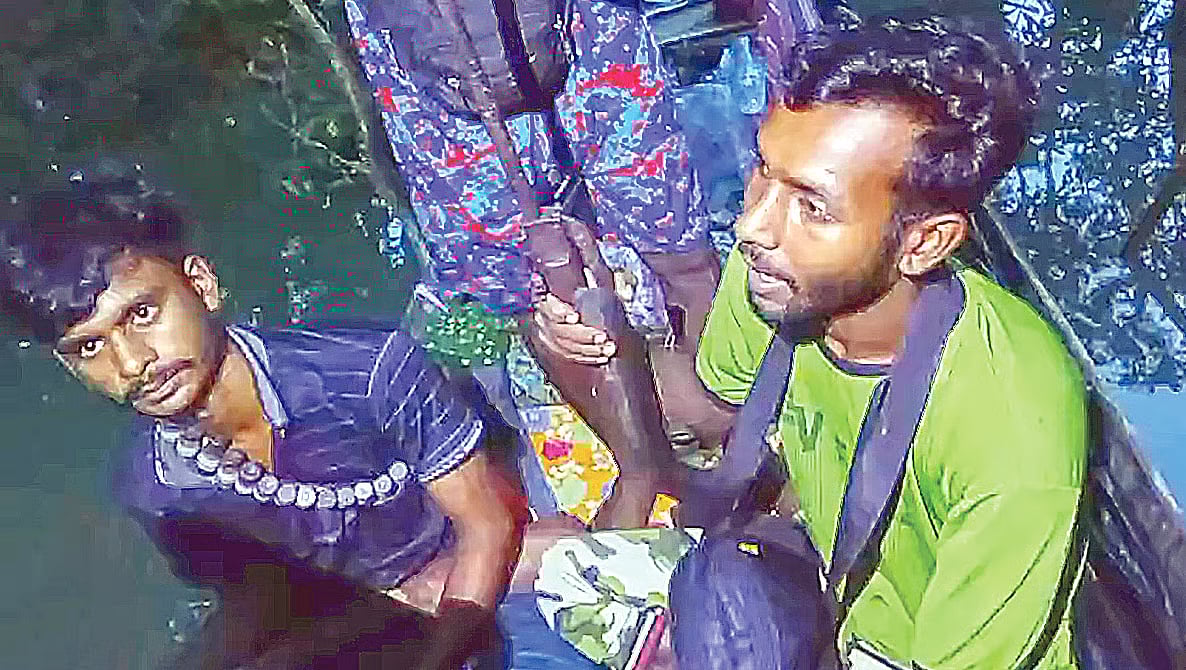
His son had been held hostage by the ‘Dulabhai Bahini’. The name of this bandit group may sound funny (brother-in-law gang), but it's no joke, behind it lies fear, torture and the dread of ransom.
Once, the terror of the Sundarbans was ‘Ilias Bahini,’ whose dominance stretched from the Bay of Bengal to deep inside the forest. Ilias surrendered later and has already passed away. In August last year, when Ilias’s brother-in-law Rabiul formed a new gang, locals named it the ‘Dulabhai Bahini’.
Fayez Ali's son had been held hostage by the ‘Dulabhai Bahini’. The name of this bandit group may sound funny (brother-in-law gang), but it's no joke, behind it lies fear, torture and the dread of ransom.
In November 2018, the government declared the Sundarbans free of robbers after the surrender of 32 robbery groups. But Prothom Alo’s investigation reveals that, at least 14 bandit groups, including Dulabhai Bahini, have reemerged in the Sundarbans taking advantage of political turmoil during last year’s fall of the government. They regularly hold forest-dwellers hostage at gunpoint to extort ransom. At least 11 former bandits who had surrendered have returned to piracy.
These bandits are backed by a section of influential coastal fish traders, known locally as ‘company mahajans (company lenders)’. Under their directives, fishermen poison rivers to catch fish. These traders provide permits from the robbers, and often send ransom money as well. This supplies the robbers with money, weapons stockpiles, and leads to environmental destruction of the Sundarbans due to poisoning.
Since last July, Prothom Alo began an investigation into the resurgence of piracy in the Sundarbans. Prothom Alo spoke to forest-dwellers, surrendered former robbers, and individuals secretly involved in robbery. Their accounts reveal the organised secret lives of the robbers, their floating hideouts in the rivers, and the stories of helpless people imprisoned in boats.
Prothom Alo’s investigation reveals that, at least 14 bandit groups, including Dulabhai Bahini, have reemerged in the Sundarbans taking advantage of political turmoil during last year’s fall of the government. They regularly hold forest-dwellers hostage at gunpoint to extort ransom. At least 11 former bandits who had surrendered have returned to piracy.
Fishermen, forest-dwellers held hostage
Fayez Ali’s son fell into a robber's trap in the Patakata area of the Sundarbans. While catching crabs in a canal, he suddenly saw five boats of armed bandits approaching. Frightened, he tried to row away through the canal but could not escape. The bandits intercepted him by crossing through the jungle.
On 31 July, we learned in a market of Koyra upazila that poor local forest-dweller Zahirul Islam (we are not revealing his real name due to security concerns) had been held hostage by robbers for four days. His daughter, in a tearful voice, said, “We are poor, if we do not go to the forest, we cannot eat. If we tell anyone about the kidnapping, the robbers will kill my father. So we are only asking close acquaintances for help.”
After arranging Tk 20,000 ransom through loans, Zahirul returned home on 2 August. Visiting his house the next day, we found fear still coming out of his voice. He said, “As soon as I entered the Jolakhali canal of the Sundarbans, 11 robbers of the Dulabhai Bahini surrounded me with three boats, all armed with guns. I was held for a week, given food only once a day, and forced to row boats the rest of the time.”
The robbers initially demanded Tk 30,000. After much pleading, they agreed to take Tk 20,000, on the condition that he would pay the remaining Tk 10,000 the next time he entered the forest.
Honey collectors, locally knows as mouals, and Nipa palm leave or golpata collecters, locally known as bawalis, also have to pay ransom to robbers. A moual from a village in Koyra said, “In the Sundarbans, there are crocodiles in the water, tigers on the land, and now added to this is the reign of robbers.”
When seven of their group were captured, they had to pay Tk 52,000 in ransom. He said that if robbery is not eliminated, they will not go into the forest in the next honey-collecting season.
A bawali from another village said he had to pay Tk 30,000 to three different robber groups while collecting Nipa palm leaves this year. He said that if robbery continues, many will abandon their Sundarbans-based livelihoods.
On 26 July, robbers seized the boat of Abu Sayeed (not real name) from Maheshwaripur union of Koyra. That day, Afzal Bahini captured a total of 16 fishing boats in the Jeler Canal area near the Koyra River, realising Tk 20,400 in ransom from each boat.
We are poor, if we do not go to the forest, we cannot eat. If we tell anyone about the kidnapping, the robbers will kill my father. So we are only asking close acquaintances for help.Abducted Zahirul Islam's daughter
While visiting Abu Sayeed’s home on 2 August, his wife was seen feeding their young child in a dilapidated house’s veranda. Fear and suffering were evident on her face.
She said her husband had once given water to robbers of Jahangir Bahini. Out of anger, Afzal Bahini’s men tied him to a tree, stuffed a gamcha, locally made scarf/towel in his mouth, and beat him. Since then, he has been in severe pain and had just gone to a physician for medicine.
This correspondent spoke to at least 10 fishermen in Koyra. They said that after the robbers’ surrender in 2018, there had been peace in the forest. But since last August, kidnappings and ransom have returned. Hostage fishermen are paying anywhere from Tk 20,000 to Tk 100,000 for release.
Md Saiful Islam, member-secretary of the civic platform ‘Upokul O Sundarban Songrokkhon Andalon (Coastal and Sundarbans Conservation Movemen),’ told Prothom Alo on 2 September that robbery has increased due to lack of surveillance. If immediate measures are not taken small groups would grow into larger forces.
The livelihoods of forest-dwellers, tourism, and government revenue will all be endangered. Out of fear of robbers, honey collection by mouals has decreased by almost 35 per cent this year, he added.
This correspondent spoke to at least 10 fishermen in Koyra. They said that after the robbers’ surrender in 2018, there had been peace in the forest. But since last August, kidnappings and ransom have returned. Hostage fishermen are paying anywhere from Tk 20,000 to Tk 100,000 for release.
Robbers, mahajans go hand in hand
While visiting the coastal areas near the Sundarbans, this correspondent spoke to forest-dwelling fishermen, as well as robbers who previously surrendered. Fishermen live in constant fear of robbers.
This fear stretches across the rivers from Baleshwar to Raimangal. Even families of fishermen who go to Dublar Char near the Bay of Bengal in the south worry continuously. On the other hand, robbers themselves live in fear of being caught by the authorities.
Amid the pretext, several fish and crab traders, known as ‘company mahajans,’ have colluded with bandits to expand their businesses across the forest. These mahajans play an active role behind both poisoning rivers and canals to catch fish and facilitating forest robbery. However, the outside world knows very little about this grim reality.
Recently, Hafizur Rahman (not real name), a fisherman from Shyamnagar, returned after paying ransom following five days of captivity by Majnu Bahini. He said, “Many company mahajans have direct ties with the robbers. Fishermen have to pay money to mahajans to get a ‘card.’”
This “card” is actually a 10-taka banknote, the serial number of which is recorded in the robbers' ledger. Hafizur said, “When the robbers caught me, the first thing they asked was which mahajan’s fisherman I was. But since I did not have a card, they held me and finally extorted Tk 20,000.”
A fisherman from Koyra who returned after paying ransom to Dulabhai Bahini said he had arranged a card through a mahajan before entering the forest. But when caught, the number on the card did not match the robbers’ ledger, thus, began his ordeal.
A robber, who was recently released on bail, said on condition of anonymity that there are agreements between mahajans and robbers for a fixed number of boats. Those with prepaid tokens are spared, while the rest are detained for ransom.
The robber added that when fishermen are captured, mahajans step in to negotiate. They mainly send the ransom money. But through this “help,” fishermen fall into debt traps, forced to fish and collect crabs day and night to repay the mahajans.
According to Anarul Islam, a surrendered bandit from Mathbari village in Koyra, the company mahajans keep control over fishermen by paying the bandits. Robbers are not just in the forest any longer even the traders on land now act as another kind of bandit.
On 29 July, participants in the monthly law-and-order committee meeting in Koyra upazila, adjacent to the Sundarbans, expressed concern over the matter. At the meeting, Imdadul Haque, officer-in-charge (OC) of Koyra police station said intelligence reports indicated that a number of people locally known as company mahajan were supporting forest bandits.
A fisherman from Koyra who returned after paying ransom to Dulabhai Bahini said he had arranged a card through a mahajan before entering the forest. But when caught, the number on the card did not match the robbers’ ledger, thus, began his ordeal.
He specifically mentioned the names of Abu Sayeed, Mintu, Nur Hossain, Mosharraf and Amirul Islam.
Each of them later claimed to Prothom Alo that the allegations were false. However, even before the Sundarbans were officially declared free of bandits, there were similar accusations against them. Some had even been arrested in multiple cases and served time in jail.
On 13 February, the navy arrested Abu Sayeed. A press release sent out from the Koyra Contingent office stated that he had been detained on charges of illegal arms trading, supplying weapons to bandits, providing them with food, and running a syndicate that caught fish by poisoning the water in the Sundarbans.
However on 3 August, this reporter met Abu Sayeed near the Kashiadabad forest station, who said he had been released on bail. He claimed that the charges brought against him were completely false. He admitted that he once had a small business in the Sundarbans but said he gave it up after last year’s fall of the government.
Across the coastal belt, there is widespread confusion over who these company mahajans backing the bandits are. But during visits to Mongla, Koyra, Shyamnagar and Dacope upazilas some names repeatedly came up in conversations with former bandits and fishermen.
They were: Ayon Company, Abu Saleh Company, Hossain Company, Shahidul Company, Kamrul Company, Bipul Company, Mintu Company, Riasad Company, Khokon Company and Shaheen Company.
In addition, Bikash Company is quite known to be close to bandit Majnu. After Bikash’s death, his relatives now control the company’s business.
Two senior forest department officials said that after the recent change of government, escaped prisoners and known criminals have joined the resurgence of bandits.
Resurgence of bandits and the arms network
The campaign to suppress bandits in the Sundarbans began in 2016, when the largest group, Master Bahini, surrendered to the home minister, handing over firearms and agreeing to rehabilitation.
Several Rapid Action Battalion (RAB) officers involved in the surrender process said that another 328 bandits from 32 bandit gangs including their chiefs also surrendered afterwards, depositing 462 firearms and 22,504 rounds of ammunition. Finally on 1 November 2018, the government declared the Sundarbans bandit-free.
The most notable groups to surrender included Master Bahini, Chhoto Jahangir Bahini, Sumon Bahini, Khokababu Bahini, Munna Bahini, Anwarul Bahini, Dada Bahini, Hannan Bahini, Chhoto Raju Bahini, Al Amin Bahini, Sattar Bahini, Alif Bahini, Jahangir Bahini, Shanto Bahini, Elias Bahini, Alam Bahini, Majnu Bahini and Sharif Bahini.
But after 5 August 2024, bandit activity once again resurfaced in the Sundarbans. Accounts from kidnapped fishermen who paid ransom, corroborated by Coast Guard information, suggest that at least 14 gangs armed with local and foreign weapons have re-emerged across the forest.
On 25 July, the ‘Dulabhai Bahini’ surrounded our patrol boat in Khorkhoria Canal and opened fire. Immediate joint operations are now essential to suppress the increasingly reckless robbers.Lutfar Rahman, officer-in-charge of the Bajbaja Patrol Outpost in the Sundarbans.
Identified on the law enforcement list, Majnu, Karim Sharif, Doyal, Robiul, Abdullah, Mama-Vagne, Asabur, Dulabhai, Al Amin, Jahangir, Afzal, Kajol-Munna, Ranga and Chhoto Sumon Bahini groups are collecting ransom by abducting fishermen. Of these, seven are new ones.
Two senior forest department officials said that after the recent change of government, escaped prisoners and known criminals have joined the resurgence of bandits.
For instance, Abdullah Tarafdar, 42, of Kalinchi village in Shyamnagar upazila, Satkhira, had been jailed in a women trafficking case. On the night of 5 August last year, when Satkhira District Jail was stormed Abdullah escaped and later joined the bandits in the Sundarbans. He now leads a group of 10–12, most of whom are also escaped convicts.
Anarul Islam of Koyra upazila, once a notorious forest bandit, led the dreaded Anarul Bahini, which fishermen feared like a tiger. In November 2017, he had surrendered with his men.
Speaking to Prothom Alo, Anarul said that the government had provided Tk 100,000 (Tk 1 lakh) to each for rehabilitation. But because of multiple court cases, he still had to appear in court regularly, and the government’s promised amnesty had not been delivered.
He said that people like him, who genuinely want to lead a normal life, are trying to live well. “But those who don’t want to change won’t change, no matter how many opportunities you give them,” he remarked.
I told them clearly there is no going back for me.Alam Sardar, surrendered robber
On 16 August, in Munshiganj bazar, near the Sundarbans, this reporter spoke with surrendered bandit Alam Sardar. He said many former bandits he knew had returned to robbery.
Two of them had repeatedly called him to rejoin, but, he said firmly, “I told them clearly there is no going back for me.” With his rehabilitation money, he bought a second-hand auto-rickshaw and now makes a decent living.
Back to forest with arms after release on bail
According to the Coast Guard sources, Al Amin from Koyra also previously surrendered. However, he was caught by the Coast Guard with weapons on 18 April. After being released on bail, he returned to robbery. Similarly, Karim Sharif, who surrendered in 2018, has also resumed criminal activity in the forest.
Locals from Munshiganj in Satkhira said that robber Milon Patwari, which once surrendered, has returned to robbery with Majnu Bahini. A victim fisherman from Gabura in Shyamnagar, also said that Khokababu of the area has resumed robbery.
On 12 November last year, the Coast Guard arrested two robbers, including Asabur Sanas, 42, head of the Asabur Bahini, in possession of two single-barrel guns and four rounds of ammunition from the Thakurbaria Ghat area of the Sundarbans.
After the arrest, when Asabur was brought to the local area, a crowd gathered on the riverbank. A mobile phone video of the scene circulated on social media, showing Asabur standing on the Coast Guard boat with his hand raised, saying, “I am Asabur, and I will continue robbery until my death.”
After being released on bail, Asabur returned to the forest armed. On 4 August, the Coast Guard launched an operation in the Shorbotkhali area of the Shibsa River after learning of his group’s presence. Asabur escaped, but two of his men were captured, along with three single-barrel guns, 10 rounds of fresh ammunition, and weapon-making materials.
But how do bandits in the Sundarbans obtain weapons? Several surrendered former bandits told this correspondent that these arms mostly come from licensed gun shops in various districts across the country. Behind the legal sales, illegal trade of weapons takes place.
After removing the engraved legal numbers from the guns, they are sold at high prices to forest robbers. The main intermediaries delivering the weapons are Blacker Bachchu, Hatkata Saleh, Bikash Babu, Galkata Masud, and Majnu from Khulna city. Bikash Babu and Galkata Masud have passed away.
A member of the Dayal Bahini, who returned to robbery, said arms weapons are collected from various illegal arms dealers in the city. They are concealed in pillows or mattresses and transported by bus to areas near the Sundarbans.
He admitted that Majnu is his primary contact for purchasing weapons, as Majnu maintains direct connections with the arms dealers. Each weapon costs more than Tk 100,000.
Attempts to contact Majnu for comment were unsuccessful. Those this correspondent contacted said Majnu would reach out at an appropriate time.
The robbers this correspondent spoke with in the Sundarbans said that after Majnu formed a new group and returned to the forest, many collected weapons through him. Traditionally, a large portion of the money paid for the arms goes to the head of the supplying bandit group.
A new robber, requesting anonymity, said that those who work mechanically in arms workshops are capable of manufacturing firearms that resemble genuine weapons. In some cases, some have brought the necessary parts and materials directly into the Sundarbans to assemble weapons on site.
In the robbery world, hiding weapons is referred to as “chapano”. Weapons are stored in drums or pipes and buried underground or beneath canal beds. Only the robber leader or one of his trusted associates knows the exact location.
Several former robbers who surrendered have confirmed that between 2009 and 2016, many of the more than one hundred robbers killed in crossfire had hidden arms stockpiles within the Sundarbans. However, the precise locations remain unknown.
Secret life of forest robbers
The Raimangal River flows through the southern Sundarbans and merges into the Bay of Bengal. Originating from the Indian Sundarbans, the river first connects with the Mamdo River, later merging with the Mathabhanga and Chunkuri Rivers before flowing into the Chuna River in Munshiganj.
The source of the Chuna River is Kholpetua, with the inhabited island of Gabura along its course. To the east lies Bedkashi of Koyra, and to the south, the Kholpetua leads into the Kalagachhia River, which eventually merges with the Malancha River.
Locals said that robber groups are active across this region. Their hideouts exist in areas such as Mallakhali, Puraton Jhopsi, Shibsa River, Bawani Canal, Muchirdoani, Kamarkhola and Adachai, among various other sites within the Sundarbans. Smaller groups sometimes collude among themselves to carry out robbery, though armed clashes also occur over territorial control and ownership of weapons.
Fishermen who have returned after paying ransom said that each robber vessel typically carries several armed members and a cook. The robbers take meals twice daily—morning and evening. While one group eats, others remain on guard.
Each gang maintains a clerk (muhuri), usually someone with a basic education, who reports daily income and expenditure to the leader. Extortion money and ransom payments are primarily collected via mobile financial services such as bKash. For communication, they build platforms on tall trees and use them to make phone calls.
They use varies codes, including “dhora lok” (captured fisherman), “tower” (a location for making phone calls), and “zamin” (payment of ransom). A robber explained, “We intimidate and beat the fishermen, but not to the extent that they stop fishing, because these fishermen keep us supplied.”
Local fishermen have alleged that they are compelled to pay regular ‘tips’ or unofficial fees not only to the robbers but also to the forest officials who are supposed to provide them protection.
Forest officials fear robbers
On 15 August, this correspondent met Nasir Uddin, an officer of the Kashiabad Forest Station in the Sundarbans, at Koyra Sadar. When asked, “Combating robbery, poaching and other crimes in the Sundarbans is your responsibility. How do you manage?”
“The pressure from the bandits is so intense that just returning alive now will be a relief. Without the robbers, other crimes could be easily controlled.”
Another forest officer, speaking anonymously, said, “We often witness crimes in in front of us, but we have to pretend otherwise. Nowadays, the robbers abuse us verbally and mistreat us. With limited manpower and no arms, how are we to resist them?”
Local fishermen have alleged that they are compelled to pay regular ‘tips’ or unofficial fees not only to the robbers but also to the forest officials who are supposed to provide them protection.
Lutfar Rahman, Officer-in-Charge of the Bajbaja Patrol Outpost in the Sundarbans, reported, “On 25 July, the ‘Dulabhai Bahini’ surrounded our patrol boat in Khorkhoria Canal and opened fire. Immediate joint operations are now essential to suppress the increasingly reckless robbers.”
On 20 July, four forest officials of the Shakbaria Patrol Outpost were attacked by robbers while attempting to prevent poison fishing. The officials were beaten and their uniforms torn. Similarly, on 10 July, forest officers of the Koyra Patrol Outpost were assaulted in another attack.
Sajal Majumder, Officer-in-Charge of the Koyra Outpost, said, “We approached two boats that were spreading poison in the water. They abandoned the boats and fled into the forest. Soon after, they returned in the shadows armed with sticks and attacked us.” He added that the assault was led by Harun of Koyra, a former robber who had previously surrendered.
The Chief Conservator of Forests (CCF), Md. Amir Hossain Chowdhury, recently described the resurgence of robbers’ activity in the Sundarbans as somewhat concerning.
However, he confirmed that during a recent coordination meeting, the Adviser to the Ministry of Environment and Forests instructed the RAB, Coast Guard, Navy and Forest Department to commence joint operations without delay.
According to Coast Guard reports, during the past six months, 18 robbers have been arrested, 16 firearms and 228 rounds of ammunition have been recovered and 12 criminal cases have been filed.
Administrative operations
Over the past six months, the Coast Guard has conducted continuous operations to suppress robbers’ activity in the Sundarbans. On 12 September, two members of the Ranga Bahini were arrested with firearms in the Adachagi area of the forest and nine abducted fishermen were rescued. Earlier, on 6 September, four members of the Suman Bahini were detained with arms from the area adjacent to the Pasur River.
According to Coast Guard reports, during the past six months, 18 robbers have been arrested, 16 firearms and 228 rounds of ammunition have been recovered and 12 criminal cases have been filed.
Lieutenant Commander Siam-ul-Haque, Coast Guard Media Officer, stated that alongside repelling currently active robbers inside the Sundarbans, continuous and systematic operations are being undertaken to eradicate banditry. Numerous abducted fishermen and honey collectors have already been rescued alive as a result.
On 8 September, police in Shyamnagar arrested three members of the Kajal-Munna Bahini, rescuing two abducted fishermen and recovering Tk 74,000 in ransom money.
On 23 June, local residents in the Sundarbans-adjacent areas of Shyamnagar apprehended two armed robbers and handed them over to the police.
Earlier, on 27 January, during a robbery attempt on a fishing trawler in the Bay of Bengal near the Sundarbans, fishermen captured three armed members of the Majnu Bahini and turned them over to the Coast Guard.
AZM Hasanur Rahman, Divisional Forest Officer of the Sundarbans West Forest Division, told Prothom Alo that they, too, regularly receive reports of fishermen being abducted.
He added that forest guards have engaged in armed exchanges with robbers in Takkakhali and noted that previously when law enforcement agencies conducted joint operations, the activities of forest robbers were quickly brought under control.
A fisherman tying his boat to the bank of the Shakbaria River explained, groups with ‘managed connections’ spray poison in the water to kill fish. As a result, fish and crabs are no longer found in the same quantities as before. The robbers enable this poisoning to take place.
Threats to forest, environment and communities
At dawn on 14 September, heavy rain fell. At the ebb tide, a fishing boat returning from the Sundarbans was sighted at Gariyabari village in Koyra.
A fisherman tying his boat to the bank of the Shakbaria River explained, “Groups with ‘managed connections’ spray poison in the water to kill fish. As a result, fish and crabs are no longer found in the same quantities as before. The robbers enable this poisoning to take place.”
Another fisherman, requesting anonymity, said that robbers hunt deer in the forest every day for their own consumption and also force abducted fishermen to kill and eat those.
He further reported that powerful company financiers, in order to secure their own interests in crab collection and poison fishing in restricted areas, comply fully with robber demands.
One such company financier from Koyra, speaking anonymously, admitted, “Robbers do not trouble the fishermen under our control, because we pay them their demanded sums in advance. To conduct business in the Sundarbans, it is unavoidable to maintain relations with the robbers.”
According to Forest Department regulations, fishing, crab collection and tourism in the Sundarbans are prohibited from 1 June to 31 August each year. However, these restrictions are not enforced. Instead, locals allege that under the patronage of the robbers, the closed season saw a marked increase in poison fishing, the use of illegal nets and deer hunting.
Mofizul Islam, a fisherman who relies on the Sundarbans for his livelihood, explained that without paying advance extortion fees to the robbers, or if captured, there is always the threat of huge ransom demands. To raise such sums, he is often forced to borrow at high interest rates.
Mofizul added, “These moneylenders are the real robbers. If you borrow Tk 50,000 once, you end up paying interest for life without ever settling the principal. Our lives continue in this way—constantly paying, never free.”