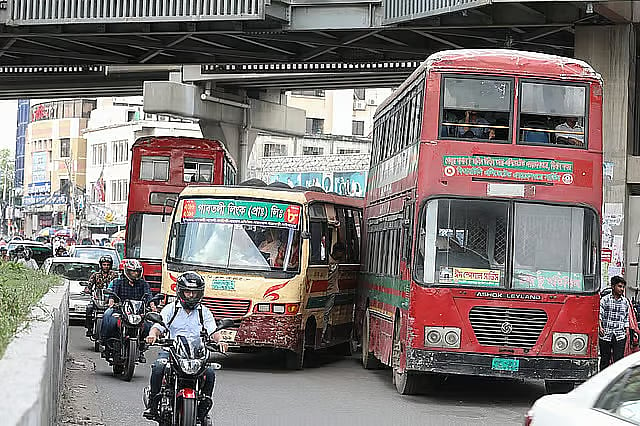
Women-only buses, cycle services, monorail: new additions coming to Dhaka’s public transport
The government is taking a range of initiatives to restore discipline in Dhaka’s public transport sector. These include short-term measures such as dedicated bus services for women and bicycle ride-sharing, medium-term plans for bus route rationalisation and the introduction of electric buses, and the development of light rail or monorail systems alongside the existing Metro Rail.
Since taking office last February, Prime Minister Tarique Rahman has held two meetings with experts and relevant departments regarding these issues. Discussions focused on short, medium, and long-term actions, and the Prime Minister's Office and respective ministries are currently drafting action plans. Furthermore, the government has directed every ministry and division to prepare a 180-day roadmap.
As part of these efforts to bring discipline to the roads, the Ministry of Road Transport and Bridges has drafted a 38-page action plan. It outlines the tasks for the next six months and the upcoming fiscal year, while providing a detailed description of the initiatives to be taken in the road and transport sector over the next five years.
As part of these efforts to bring discipline to the roads, the Ministry of Road Transport and Bridges has drafted a 38-page action plan. It outlines the tasks for the next six months and the upcoming fiscal year, while providing a detailed description of the initiatives to be taken in the road and transport sector over the next five years.
Mohammad Ziaul Haque, secretary of the Road Transport and Highways Division, told Prothom Alo, “Work is underway by coordinating both the suggestions from the prime minister’s meetings with experts and the ministry’s own action plan. The primary goal is to bring order to public transport and improve passenger services. Results will be visible soon.”
Special buses for women
To ensure the safety of women commuters at all times, the government has adopted a short-term plan to introduce ‘women-only buses (pink buses)’ on several routes in Dhaka. The prime minister has already provided directives to experts on this matter, and the Ministry of Road Transport has included the initiative in its 180-day action plan.
According to the action plan, nine buses will initially be launched across eight routes. These buses will be operated entirely by female staff, including drivers and assistants. To facilitate this, female drivers will be provided with professional training and licences. The government believes this initiative will enhance both the safety and the participation of female passengers in public transport.
Work is underway by coordinating both the suggestions from the prime minister’s meetings with experts and the ministry’s own action plan. The primary goal is to bring order to public transport and improve passenger services. Results will be visible soon.Mohammad Ziaul Haque, secretary of the Road Transport and Highways Division
Furthermore, the Ministry of Road Transport’s plan includes incentives to promote the use of bicycles as an eco-friendly mode of transport.
Among the initiatives is a ride-sharing bicycle service centred around the Uttara metro rail stations. Under this scheme, six bicycle stands will be constructed in the Uttara area and 150 bicycles will be provided. Around six kilometres of cycle lanes will also be developed. The Road Transport Ministry is considering implementing the initiative through a public-private partnership (PPP).
Bus route rationalisation and franchise system
To restore order to Dhaka’s public transport sector, the implementation of bus route rationalisation and a franchise-based system has been under consideration for a long time. However, expected progress has been lacking. Prior to the elections, the BNP’s manifesto pledged to bring discipline and safety to public transport, alongside integrated smart management and bus route rationalisation.
In the current 180-day action plan, a decision has been made to draft legislation regarding this matter. As part of this medium-term plan, new buses are to be introduced on the existing Route 21 and Route 26 in the capital, along with the launch of several additional routes.
According to the action plan, nine buses will initially be launched across eight routes. These buses will be operated entirely by female staff, including drivers and assistants. To facilitate this, female drivers will be provided with professional training and licences.
Bus route rationalisation involves consolidating all of the capital’s existing bus routes into a few select corridors. Buses of the same colour will operate under a limited number of companies. Under this system, drivers will not compete to overtake one another; buses will stop only at designated locations, and doors will open and close automatically.
In 2018, a board meeting of the Dhaka Transport Coordination Authority (DTCA) decided to issue new route permits in Dhaka as part of efforts to restore discipline in public transport and introduce company-based bus services under route rationalisation. Subsequently, buses were introduced on several routes under this system, but it is no longer effectively in operation.
Electric Buses
As part of a broader plan to reduce dependence on fossil fuels in public transport, the government also intends to introduce electric buses. In the first phase, a decision has been made to waive all import duties on electric school buses for students. The 180-day plan also mentions duty concessions for the import of electric buses intended for public transport.
To improve the quality of public transport, the Ministry of Road Transport’s plan outlines the expansion of the licensing system for bus conductors and supervisors. A target has been set to issue these licences to 5,000 workers by September.
Furthermore, as a welfare initiative, a policy will be formulated to introduce special fare concessions on the Metro Rail and long-distance transport for students, persons with disabilities, and those over the age of 60. Additionally, an initiative has been taken to provide uniforms to 2,500 transport workers, including summer and winter attire as well as footwear.
However, experts argue that if bus route rationalisation is fully implemented, separate planning for drivers may no longer be necessary.
Monorail alongside Metro Rail
The Metro Rail represents the highest tier of public transport. Currently, one Metro Rail line is operational in Dhaka, running from Uttara to Motijheel, with work underway to extend it to Kamalapur.
Many areas of the capital are so densely populated that implementing a Metro Rail is unfeasible. Monorails could serve as an alternative in such locations, creating a coordination between the Metro Rail and other modes of public transport.Shamsul Hoque, professor, Department of Civil Engineering, BUET
The previous Awami League government had planned to construct six Metro Rail lines in Dhaka. In addition to the operational line, two other Metro Rail projects are ongoing, and another has received approval. However, allegations have been raised over inflated costs in metro rail construction. The current government is therefore considering introducing light rail or monorail alongside the metro system.
A monorail is a transport system that operates on a single track, with the train running along a single beam. Unlike conventional rail or the Metro Rail, it does not require dual tracks. For the existing Uttara-Motijheel Metro Rail, large overhead pylons were necessary to carry power lines. In a monorail system, the power supply is integrated into the track itself, eliminating the need for structures capable of supporting the extra weight of overhead cables or pylons.
Currently, an underground Metro Rail project is underway from Kamalapur to the Airport. Under this project, an elevated section will also be built from Nadda to Purbachal. This combined underground and elevated route is officially known as MRT Line-1.
Additionally, work is ongoing on MRT Line-5 (North), spanning from Hemayetpur in Savar through Gabtoli, Mirpur, and Gulshan to Vatara. This line is planned as an elevated track from Hemayetpur to Gabtoli, with the remainder being underground.
As part of a broader plan to reduce dependence on fossil fuels in public transport, the government also intends to introduce electric buses. In the first phase, a decision has been made to waive all import duties on electric school buses for students. The 180-day plan also mentions duty concessions for the import of electric buses intended for public transport.
The cost for MRT Line-1 is estimated at Tk 525.61 billion (52,561 crore), while MRT Line-5 (North) is projected at Tk 412.38 billio (41,238 crore). However, since the commencement of the tendering process, authorities have noted significant cost escalations. The Metro Rail authorities forecast that the combined cost for these two projects could soar to Tk 1,845 billion (184,500 crore).
An integrated system is essential
Transport experts believe that rather than relying solely on the Metro Rail, an integrated rail-based system featuring various versions such as light rail and monorail should be introduced. The government has sought opinions on these matters from experts, including Professor Shamsul Hoque of the Department of Civil Engineering at the Bangladesh University of Engineering and Technology (BUET).
Professor Shamsul Hoque told Prothom Alo that many areas of the capital are so densely populated that implementing a Metro Rail is unfeasible. Monorails could serve as an alternative in such locations, creating a coordination between the Metro Rail and other modes of public transport.
He added that many people live in the densely populated areas of East Dhaka—such as Basabo, Goran, and Madartek—as well as Old Dhaka, where bus services are inadequate. Beyond the Metro Rail centred on major roads, alternative rail-based or low-cost, implementable systems could be adopted in these neighbourhoods.