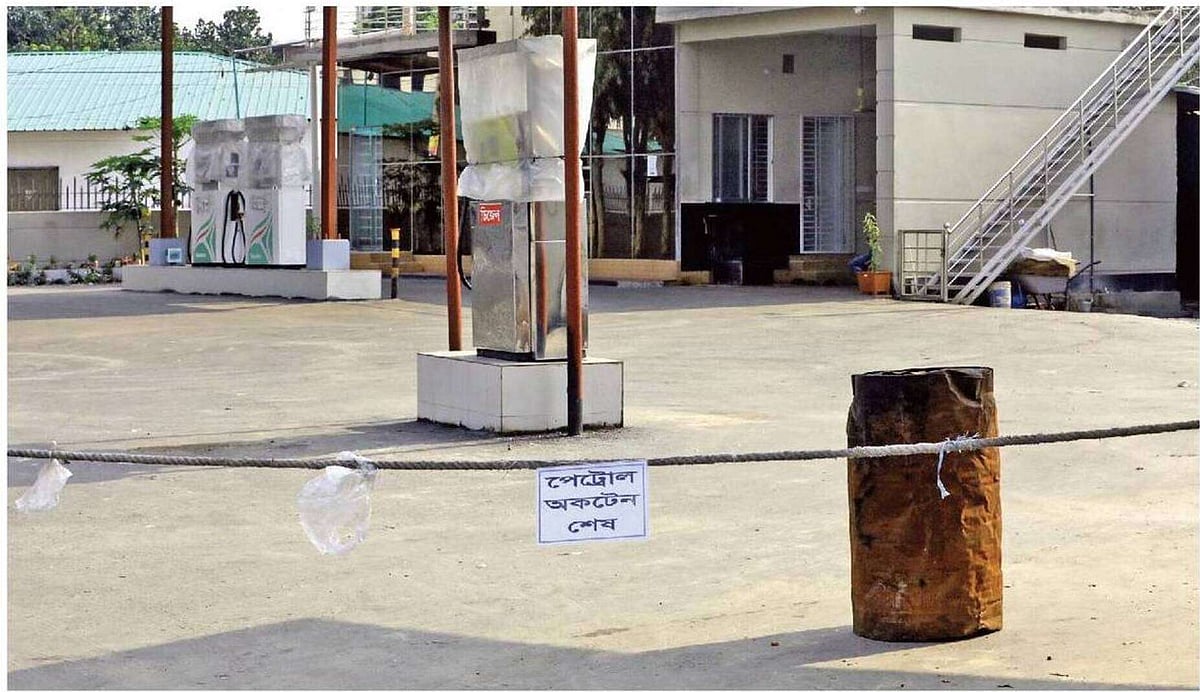
Middle East crisis: Concerns grow over fuel supply
Concerns are mounting over fuel supply in the country as several fuel-laden vessels have failed to arrive on schedule due to the ongoing conflict in the Middle East. Although the government is attempting to source fuel from alternative suppliers, assurances remain inconsistent, raising uncertainty over whether supply can be kept stable in April.
According to sources at Bangladesh Petroleum Corporation (BPC), the country had diesel reserves sufficient for around 14 days as of Monday. Fearing a worsening situation, consumers have begun purchasing diesel, octane and petrol in advance. In some areas, people have had to wait for hours, yet still failed to obtain fuel.
State Minister for Power, Energy and Mineral Resources Anindya Islam told Prothom Alo that no actual fuel crisis has yet emerged in the country. Several shipments have already arrived, with more expected, while the import schedule for April is being finalised.
If necessary, refined diesel will be procured from the open market, he stated.
The state minister, however, acknowledged that panic buying has created temporary pressure on the supply system.
Anindya Islam further noted that the main challenges stem from delays in vessel schedules and the sharp rise in global oil prices, which in turn increases import costs and places strain on the broader economy.
The current crisis follows air strikes carried out on 28 February in Iran by the United States and Israel, triggering heightened tensions in the Middle East.
Amid escalating retaliatory attacks, the closure of the strategically vital Strait of Hormuz was announced, severely disrupting one of the world’s major maritime routes for oil transport. This has, in turn, created uncertainty over Bangladesh’s fuel imports.
Energy experts note that, provided imports continue as usual, the current stock management is adequate. Yet, the combined pressures of delayed shipments, rising international prices, and sudden demand surges due to panic have increased risk considerably.
According to BPC data, Bangladesh imports between 6.5 and 6.8 million tonnes of fuel annually. Of this, around 1.5 million tonnes is crude oil, primarily sourced from Saudi Arabia and the United Arab Emirates (UAE).
The BPC data also shows about 20 per cent of total demand is met through domestic refining of crude, while the remaining 80 per cent is imported in refined form. The ongoing conflict has placed significant pressure on this supply chain.
Fuel stock situation
According to sources at the Bangladesh Petroleum Corporation (BPC), a significant portion of the country’s energy consumption is diesel-dependent. Diesel underpins agricultural irrigation, road transport, and even electricity generation. Consequently, any pressure on the diesel market quickly spreads throughout the economy.
BPC data indicates that the nation’s total diesel storage capacity stands at 624,189 tonnes. As of Monday, available supply was approximately 185,000 tonnes, representing roughly 29 per cent of total capacity. This stock is sufficient to meet demand for around 14 days.
From 1 March until last Sunday, approximately 264,000 tonnes of diesel were sold nationally, equating to an average daily sale of around 12,000 tonnes. By comparison, sales during the same period last year were close to 12,500 tonnes per day.
The country’s total storage capacity for octane is 53,616 tonnes. Current stocks stand at roughly 11,000 tonnes, sufficient for approximately nine days of demand. Petrol has a total storage capacity of 37,013 tonnes, of which 16,605 tonnes remain in reserve, covering around 11 days of supply.
Furnace oil stocks are at 70,833 tonnes, enough to satisfy roughly 29 days of demand. Jet fuel reserves stand at 34,877 tonnes, covering about 23 days of supply. Kerosene stocks total 8,571 tonnes, sufficient for 46 days, while marine fuel reserves are approximately 1,500 tonnes, enough for 44 days of supply.
Meanwhile, the Eastern Refinery currently holds 80,000 tonnes of crude oil. Considering a daily refining capacity of 4,500 tonnes, this stock allows for a further 17 to 18 days of production. However, delays in new shipments could disrupt production.
Energy experts note that, provided imports continue as usual, the current stock management is adequate. Yet, the combined pressures of delayed shipments, rising international prices, and sudden demand surges due to panic have increased risk considerably.
Import schedule in disarray
Since the outbreak of the war, the country’s pre-determined fuel import schedule has become highly erratic. According to the BPC, a total of 17 vessels carrying diesel and furnace oil were scheduled to arrive this month. However, as of yesterday, only eight ships could reach the country, delivering approximately 200,000 tonnes of fuel.
The Bangladesh Petrol Pump Owners Association says that the volume of fuel being supplied by companies is insufficient relative to demand, leaving many pumps unable to provide adequate fuel.
Two more vessels were expected, but BPC is yet to receive confirmation regarding the remaining six. This has created uncertainty over the arrival of around 150,000 tonnes of fuel.
BPC records indicate that the two major suppliers, China’s Unipec and Malaysia’s Petroliam Nasional Berhad (Petronas Trading), have already notified that, due to the ongoing war, they are unable to adhere to the previously agreed delivery schedule. Some of the shortfall has been mitigated by a 10,000-tonne pipeline delivery from India, with an additional 5,000 tonnes expected later this month.
Crude oil supplies are also facing significant disruption. A 100,000-tonne shipment from Saudi Arabia’s Ras Tanura terminal, scheduled for 3 March, has been delayed. Furthermore, the charter for the vessel MT Omera Galaxy, arranged to import crude from Abu Dhabi National Oil Company (ADNOC), has been cancelled. As a result, no new crude shipments are expected to arrive this month.
As an alternative, assurances have been received for a 100,000-tonne crude delivery from Saudi Arabia’s Yanbu port next month. However, this will incur an additional cost of 25 cents per barrel for the government.
April and May import plans
To manage the situation, the BPC has drawn up a preliminary import schedule for April and May. In April, a total of 14 vessels and three pipeline consignments are planned to bring in 300,000 tonnes of diesel, 50,000 tonnes of jet fuel, 25,000 tonnes of octane, and 50,000 tonnes of furnace oil. However, so far, only 110,000 tonnes of diesel and 20,000 tonnes via pipeline have been confirmed.
For May, 17 vessels are scheduled to deliver 350,000 tonnes of diesel along with other fuels, though suppliers are yet to provide final confirmation.
Pressure at filling stations
Since the outbreak of the war, crowds at filling stations across the country have increased. Yesterday, several stations in the capital and various district towns ran out of fuel, while at others, supply delays were caused by heavy demand.
The Bangladesh Petrol Pump Owners Association says that the volume of fuel being supplied by companies is insufficient relative to demand, leaving many pumps unable to provide adequate fuel.
Association president Syed Sajjadul Karim Kabul told Prothom Alo that even where the allocated fuel arrives from depots, sudden spikes in demand have created localised pressure.
State-owned companies Padma Oil, Meghna Petroleum, and Jamuna Oil Company supply fuel to the country’s filling stations from their nationwide depots, distributing to roughly 2,500 outlets.
Company officials noted that some stations are withdrawing more fuel than usual, while others that previously sold less are now taking higher volumes, adding strain to the supply chain.
Fuel distribution was temporarily halted during the day of Eid and the following day but resumed yesterday. However, many stations could not place pay-orders as banks were closed, preventing them from receiving fuel.
Md. Mofizur Rahman, Managing Director of Padma Oil Company, said that depot supply has not been stopped. Fuel is being provided according to need, and stocks are being regularly monitored.
Need for field-level monitoring
Experts note that while a major fuel shortage has not yet occurred in the country, a combination of abnormal demand surges, delayed vessel arrivals, limited reserves, and rising international prices could rapidly change the situation.
M Tamim, former special assistant on energy affairs to the chief adviser of the caretaker government, told Prothom Alo that rationing measures could be considered on a limited scale if necessary.
Simultaneously, field-level monitoring should be intensified to prevent hoarding or artificial scarcity, he stated.