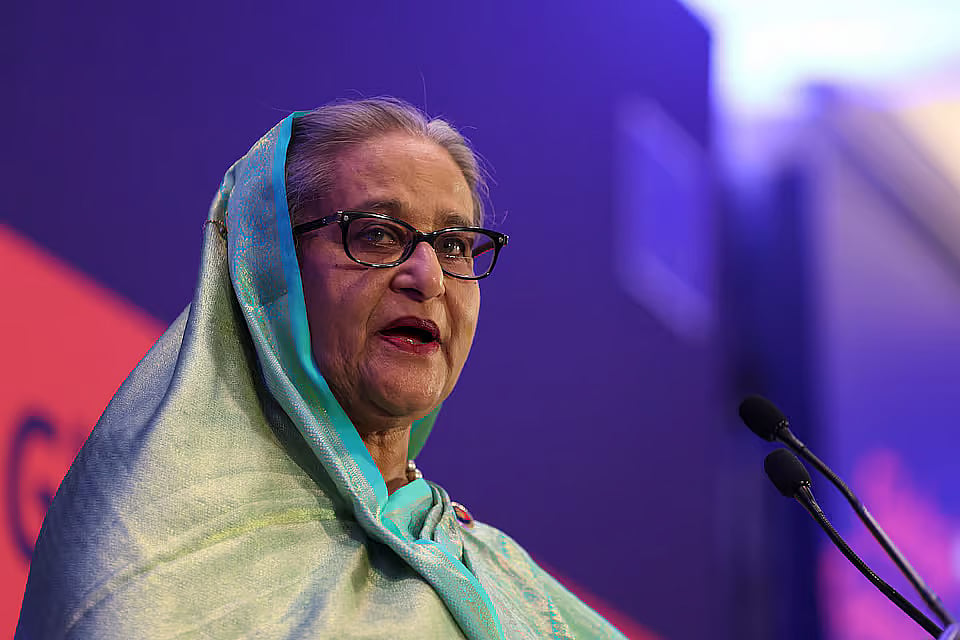
Awami League seeks attention by announcing Sheikh Hasina’s return
The Awami League, whose activities are banned, is seeking to attract attention both at home and internationally by announcing that Sheikh Hasina will return to Bangladesh in December.
To this end, the party and the banned student organisation Chhatra League are announcing various programmes online, including ‘strikes’ and ‘lockdowns’. However, even Awami League leaders have no clear idea how the announcement of Sheikh Hasina’s return to the country will be implemented.
Some Awami League leaders who are in hiding say that, under the current circumstances Sheikh Hasina’s return to Bangladesh is almost impossible without a diplomatic understanding between the governments of Bangladesh and India.
Cooperation from the international community would also be needed to create such circumstances. However, there are still no signs of any understanding between the two governments over Sheikh Hasina, they say.
Some Awami League leaders fear that if Sheikh Hasina fails to return after making the announcement, public confidence in her or the Awami League could decline. Meanwhile, the announced programmes are putting party leaders and activists in the country at risk of being arrested again.
Sheikh Hasina, the former prime minister who was ousted in the July mass uprising and is the president of the Awami League, has announced that she will return to Bangladesh from India in December.
The announcement has sparked widespread discussion about whether Hasina, who has been sentenced to death, will actually return and, if she does, what process she will follow to come back to the country.
The government’s position on the matter is clear: Sheikh Hasina is a fugitive who has been sentenced to death. If she is to return to Bangladesh, it must be under the Bangladesh-India extradition treaty. Bangladesh has also formally requested India to extradite her.
With December approaching, the Awami League, whose activities are banned, and the banned Chhatra League are announcing various programmes online. As part of these, they called a strike for 10 November.
Although the strike was not carried out, incidents of sabotage, including sporadic crude bomb explosions and vehicles being set on fire, have taken place in Dhaka and various other parts of the country on 10 November and in the days before and after.
Many leaders and activists of the Awami League and its affiliated organisations have expressed support for these activities online. Some have even claimed responsibility for them.
Law enforcement agencies are also blaming leaders and activists of the Awami League and its affiliated organisations for these acts of sabotage. Operations to arrest them have been stepped up. Law enforcement agencies have also claimed to have caught people red-handed while they were involved in crude bomb explosions in Dhaka.
Meanwhile, on 13 November, the Awami League announced a five-day programme on its Facebook page to mark the anniversary of the verdict sentencing Sheikh Hasina to death.
Yesterday, Saturday, the programme included distributing leaflets, writing on walls, conducting publicity campaigns and reaching out to people. However, no reports of such activities have emerged. Further programmes include processions, submitting memorandums and wearing black badges. A ‘lockdown’ has been announced for 19 November.
Most of the Awami League’s senior leaders are in India, particularly in Kolkata. Several sources within the party said that many leaders based in countries including the United States and various European nations had also travelled to India recently. Some of them are still there.
Sources close to these leaders said they had no clear idea of how the announcement that Sheikh Hasina would return to Bangladesh in December was to be implemented.
Discussion surrounding announcement of return
Reuters reported on 9 November that Sheikh Hasina had written to the Bangladesh High Commission in New Delhi seeking a passport and national identity card. The application was sent in an email by Matrix Chambers, a London-based law firm in the United Kingdom (UK).
However, diplomatic sources in Dhaka and New Delhi said the email sent by the law firm did not include any document or proof relating to Sheikh Hasina’s ‘authorisation’.
Meanwhile, BBC Bangla published a report last Friday on Sheikh Hasina’s announcement that she would return to Bangladesh. The report gave the impression that she did not make the announcement without India’s consent.
The BBC Bangla report also mentioned two conditions set by India. First, Sheikh Hasina travelled to India on a Bangladeshi military aircraft. If she is to be brought back, the Bangladesh Army must take responsibility for doing so. Her return could be by land or air.
Second, Bangladesh would have to guarantee that Sheikh Hasina would have the opportunity to appeal against her death sentence and that the trial over the July mass killings would be held afresh.
However, Bangladeshi diplomatic sources do not yet see any basis for such conditions being imposed.
Government stresses extradition treaty
Saturday, journalists asked Law Minister Md Asaduzzaman about the legal process concerning Sheikh Hasina’s return to Bangladesh, referring to the BBC report. In response, the law minister said, “Sheikh Hasina will come to Bangladesh through legal means. We have completed all the necessary legal procedures on our part. What they (India) will do is their own matter.”
Referring to the International Crimes Tribunal Act, the law minister said that anyone accused or convicted of crimes against humanity could not claim fundamental rights.
Asked whether the Indian government had held discussions with Bangladesh about sending Sheikh Hasina to a third country the law minister said, “They would be able to say anything about that.”
After reports emerged that Sheikh Hasina had applied for a new passport and national identity card (NID) to return to the country, State Minister for Foreign Affairs Humaiun Kobir described the matter as “utterly ridiculous” on 9 November.
He said that Bangladesh did not issue passports to terrorists. Instead, it wanted to bring them back to the country under the extradition treaty and carry out their sentences.
Humaiun Kobir also said, “She has fled, and there is no scope for staging a drama about returning to the country with a new passport. If she genuinely wants to return, there is a specific legal process for that. Bangladesh and India have an extradition treaty.”
“Let her ask the Indian government to hand her over to Bangladesh under that treaty. She can come here, surrender to the court and serve her sentence,” he added.
Appeal deadline has passed
On 17 November last year, the International Crimes Tribunal sentenced Sheikh Hasina to death in a case involving crimes against humanity committed during the July mass uprising. The full verdict in the case was published on 13 January.
The International Crimes Tribunal Act provides for a 30-day period to appeal. However, Sheikh Hasina did not file an appeal within the stipulated time.
Sources at the tribunal said that, as the appeal period had expired, she no longer had the opportunity to appeal. In addition to the death sentence, the tribunal also ordered the confiscation of Sheikh Hasina’s property in Bangladesh in favour of the state.
Six other cases against Sheikh Hasina are pending trial at the tribunal. In addition, a total of 673 cases have been filed against her, including 457 over allegations of murder in different parts of the country.
Against this backdrop, questions have also been raised within the Awami League about the purpose of the party’s programmes and activities surrounding the announcement of Sheikh Hasina’s return to Bangladesh.
A central Awami League leader in hiding, speaking to Prothom Alo on condition of anonymity, said that holding programmes in this way would not secure the demands or make Sheikh Hasina’s return to the country possible. Everything suggested that the main aim of these programmes was to attract attention at home and internationally, the leader said.
How much attention they would receive remained to be seen. However, the programmes would anger the government and increase the risks facing party leaders and activists in Bangladesh, the leader added.