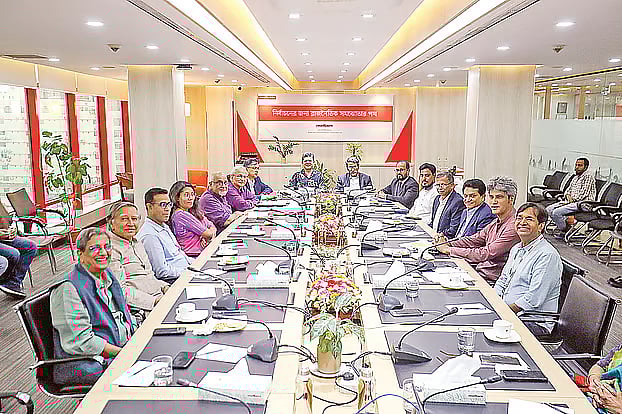
Prothom Alo roundtable
Government urged to take strong role in holding elections in February
The 13th national parliamentary election must be held in the first half of February. To ensure this, the government must take a strong role. If the election is not held by February, there are fears of not only internal instability but also risks to national security.
This concern was raised yesterday, Saturday, at a roundtable discussion titled “The Path to Political Consensus for the Election” organised by Prothom Alo at its Karwan Bazar office. Representatives of the National Consensus Commission, various political parties, and civil society took part.
Highlighting that a personality-driven authoritarian regime had taken root in the country, National Consensus Commission Vice-President Professor Ali Riaz said the upcoming election must ensure structural reforms of the state. Without agreement on these changes, the election will not bring about any fundamental transformation.
Ali Riaz outlined three possible paths: first, political parties must fulfill the preconditions for the election; second, the government must take a firm stance; third, do nothing about reforms or elections and simply wait for February to arrive. But what happens afterward, he does not wish to say, he added, warning that failure to hold elections in February would endanger both stability and national security.
A firm stance by the government is essential. Without it, the election cannot take place, he said while emphasising the importance of political consensus in implementing reforms.
Prothom Alo editor Matiur Rahman, who opened the discussion, said past experience shows reforms cannot be imposed, nor are they implemented once parties come to power. But this time, he said, there is a unique opportunity: through prolonged dialogue, 30 political parties have already reached consensus on several key reforms.
If implementation stalls, all these years of discussion, the earlier movements and sacrifices—even deaths—will be wasted, and the country could face fresh uncertainty, he warned. Calling for strong government action, he added, “We want all parties to participate in the election in February. We hope consensus on reforms can be reached. We will stand with you in this effort.”
Ali Riaz outlined three possible paths: first, political parties must fulfill the preconditions for the election; second, the government must take a firm stance; third, do nothing about reforms or elections and simply wait for February to arrive.
‘Crisis to deepen if uncertainty prevails’
Former caretaker government adviser Hossain Zillur Rahman described uncertainty as the country’s gravest crisis. He argued that dialogue on reforms had remained confined within an “elite civic circle,” fuelling mistrust. Many citizens, he said, believe politicians will later abandon their commitments. This lack of trust has deepened the problem.
Quoting data from several organisations, he said poverty was already on the rise, unemployment figures had worsened, and school dropout rates had increased. Because of uncertainty, long-term economic, social, and livelihood damages are taking shape. Ending this uncertainty is now most urgent, he said.
Referring to those who sacrificed their lives in July, Hossain Zillur stressed that their sacrifice must not be dishonoured by narrow interests or indecision. Bangladesh is facing a syndrome of ‘absent government.’ The return of state capacity is essential, he said.
Ha-Meem Group Chairman and CEO AK Azad echoed that elections have no alternative. If not held, national security would be jeopardised. He said all the proposals put forward by the National Consensus Commission were both acceptable and implementable, though the government should have acted much earlier. The more time passes, the harder implementation will become, he warned.
According to him, the interim government lacks the capacity of an elected one, which is already visible in law and order, employment, and investment. Elections are inevitable—they must be held by February. There is no alternative, he said, stressing that the government must make the decision rather than leave everything to the parties.
Referring to those who sacrificed their lives in July, Hossain Zillur stressed that their sacrifice must not be dishonoured by narrow interests or indecision. Bangladesh is facing a syndrome of ‘absent government.’ The return of state capacity is essential, he said.
‘Why must people suffer?’
Daily Star editor Mahfuz Anam questioned why citizens must suffer because political parties cannot agree among themselves. “This government had two responsibilities when it came to power: ensuring good governance and implementing reforms. Yet it has largely failed. Law and order has created a sense of instability among citizens,” he said.
Referring to murder cases as a major problem, The Daily Star editor said that at present in Bangladesh politicians, journalists, businessmen, and even a former chief justice have all been implicated in murder cases. A chief justice may be punished for delivering a wrong verdict, but he is not a murderer. Yet he is named in a murder case. Right now, around 226 journalists stand accused in such cases. One may face charges for corruption or for professional misconduct, but bringing murder charges is simply absurd.
Badiul Alam Majumdar, a member of the National Consensus Commission, said that the political parties have already reached consensus on many issues. The task now is implementation. The ball is largely in the court of the political parties. They must reach an agreement on how the reforms will be carried out. At the same time, the government must also take a clear position on this matter, he stated.
Referring to the disputed elections of 2014, 2018, and 2024, Badiul Alam said, the state institutions must be reformed. Sheikh Hasina had politicised state institutions. The caretaker government system was abolished. These actions created a situation that eventually forced Sheikh Hasina to flee. If these issues are not corrected now, if changes are not made within the existing system, institutions, and processes, then the same events that happened before will be repeated.
Badiul Alam Majumdar, a member of the National Consensus Commission, said that the political parties have already reached consensus on many issues. The task now is implementation. The ball is largely in the court of the political parties.
Prepare the Stage
On the upcoming national parliamentary election, Debapriya Bhattacharya, distinguished fellow of the Centre for Policy Dialogue (CPD), said, “Prepare the stage, do not test the patience of the audience.”
Referring to the growing dominance of pessimists about whether the election will be held in February, he noted, “The rule of politics is to do as much as is possible. Beyond that, aspirations may remain. We need this sense of realism. If the constitution is tampered with too much, many deeper constitutional issues may surface.”
Debapriya further warned that if the matter of reforms is not properly resolved, there will be consequences for four key areas of the economy: commodity prices, the risk of labour unrest, employment, and investment.
Sharing his experience from a visit to Khulna, Debapriya said, people are speaking of uncertainty about the election. At the same time, they are asking whether the election will be acceptable and credible. If the election is not properly conducted, the political crisis will not end.
Dhaka University sociology professor Samina Luthfa expressed concern that the country’s situation could become more “confrontational” ahead of the election because of the absence of a culture of compromise among political parties. She cautioned that in such a situation, citizens themselves would be the first victims.
Highlighting the poor performance of the interim government in maintaining law and order and public security, Samina said, at such a critical time, people are supposed to have confidence in the government to hold a fair and violence-free election. At this moment, that confidence is absent.
Chief Adviser’s Special Assistant Monir Haider added, the consensus we need is not just about the July National Charter. It has to be part of a much larger scenario.
On the upcoming national parliamentary election, Debapriya Bhattacharya, distinguished fellow of the Centre for Policy Dialogue (CPD), said, “Prepare the stage, do not test the patience of the audience.”
What the political parties’ leaders said
BNP Standing Committee member Salahuddin Ahmed said they want the election to be held in the first half of February, a week before Ramadan begins. There is consensus on this. Until today, no one has said they want it later. Everyone also wants reforms, he added.
Salahuddin further said, “Now, if the election is made conditional, would that be right for us? Many are saying that without reforms and justice being implemented, the election cannot be held. But election and reforms or justice are not mutually interdependent. Trials will take time, they will continue. If we set a timeline for the trials, that would be unjust. Justice must be ensured, and on that, we are all in agreement."
BNP wants constitutional proposals implemented through the next parliament, Salahuddin Ahmed said, arguing that this is the only legitimate path. He added, however, that if anyone can propose a lawful, legal, or constitutional way to implement reforms before the election, the BNP would be willing to accept it.
Salahuddin said those who favour a constituent assembly or a proportional representation (PR) system can include those proposals in their election manifestos. If the people accept them and those parties win seats in parliament, they can implement them. But why should one person’s ideal be forced upon others? he asked.
The BNP leader warned that introducing reforms that would cripple the executive through a PR system would not bring stability. If reforms are designed to hobble the executive, the public’s agenda will not be implemented. Urging unity, he cautioned that renewed divisions among the democratic forces of the July uprising could lead to a dangerous outcome — no one wants a return of fascism.
BNP Standing Committee member Salahuddin Ahmed, “Now, if the election is made conditional, would that be right for us? Many are saying that without reforms and justice being implemented, the election cannot be held. But election and reforms or justice are not mutually interdependent."
Matiur Rahman Akand, a member of Jamaat-e-Islami’s central executive council, said the national election must be held in February; there is no alternative. If not held, the situation will become worse than before, he warned. He called for a referendum to give the July Charter a constitutional basis and for elections to be held in February on that foundation. Then the country will be saved, politics will be saved, and political leaders will be safe, he said.
Akand added that attempts to seize power through backdoors must not be allowed to destroy the country. The interim government should take firm steps, and all political parties must heed public sentiment.
Akhtar Hossain, member-secretary of the National Citizens’ Party (NCP), said that holding an election in the name of constitutional continuity alone will not protect the country’s democracy.
He said, there must be an election — there is no doubt about that. The real impasse is over the July Charter and the implementation of constitutional reforms. If we do not decide now how the country will be governed after the election, the vote will not deliver the desired outcome. Changes must happen now. A new state structure must be formed. People gave their lives in the 2024 uprising for the hope of a new Bangladesh; we must pursue solutions with those expectations in mind.
Zonayed Saki, chief coordinator of Gono Songhoti Andolon, said it is good that ways out of the political crisis are being discussed at the table. He warned there is a perception that, if BNP wins, it will do nothing — the BNP must address that perception seriously.
Zonayed Saki said his party has decided to pursue fundamental constitutional reforms within the existing constitutional framework. Now, questions about implementation guarantees and mistrust have arisen. For that reason, he argued, any areas where consensus has been reached should be given legal force. If a binding legal mechanism for implementing the Charter can be created, the space for mistrust will shrink. But if mistrust is exploited to push partisan agendas, it will create major trouble.
Referring to the country’s security concerns, Lieutenant General (Retd) Mahfuzur Rahman said, “At present, Bangladesh faces a number of traditional and non-traditional security challenges, especially in our southeastern border areas.”
The sooner an elected government comes to power, the better
Commenting that an unelected government can easily become flexible under internal and external pressure, Lieutenant General (Retd) Mahfuzur Rahman, Chairman of the Osmani Centre for Peace and Security Studies, said that the sooner an elected government takes office, the better.
Referring to the country’s security concerns, Mahfuzur Rahman said, “At present, Bangladesh faces a number of traditional and non-traditional security challenges, especially in our southeastern border areas. At this stage, policy-level guidance on security is necessary. But for an interim or caretaker government, it becomes difficult to provide such policy guidance.”
Recalling the past decade and a half, the former army officer said that during this period, the armed forces had been politicised. As a result, such an army cannot function as an effective combat force. “We want to come out of that situation,” he said. “The army itself also wants to return to its fundamental responsibility—defense and security of the country.”
The roundtable was moderated by Sajjad Sharif, executive editor of Prothom Alo.