DUCSU election
Polling officials had no idea about code of conduct: Chhatra Dal
The Jatiyatabadi Chhatra Dal (JCD) backed panel has raised 11 allegations of irregularities in the Dhaka University Central Students’ Union (DUCSU) election.
The allegations include partiality of the administration, most polling officers’ zero idea about electoral code of conduct, providing voters ballot papers already marked in favour of a specific panel, ballot papers having no serial number and flaws in the vote counting method.
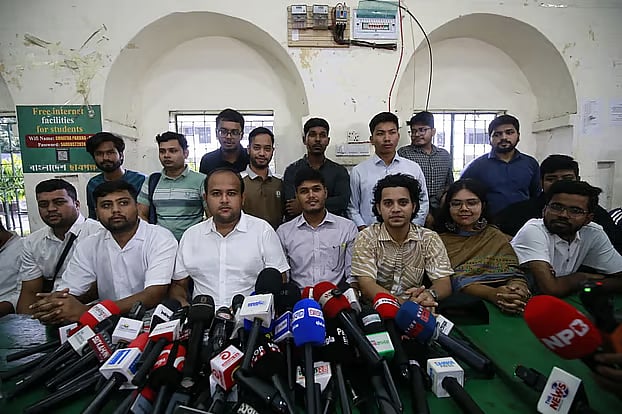
The JCD-backed panel raised the allegations at a press conference held at the Madhur Canteen of Dhaka University.
Members of the ‘Oikyabaddho Shikkharthi Jote’, a panel backed by Islami Chhatra Shibir, have won 23 of the 28 posts, including the posts of vice-president, general secretary and assistant general secretary. However, Chhatra Dal failed to secure any post.
At today’s press conference, Sheikh Tanvir Bari Hamim, the general secretary (GS) candidate from the JCD-backed panel, said that since the July-August mass uprising, a vested quarter has been trying to portray their members (JCD) negatively before the common students to gain political advantage.
After the announcement of the DUCSU election schedule, they noticed various irregularities. They lodged complaints about those irregularities following due process, but the university authorities failed to address them.
The 11 allegations
Addressing the press conference VP candidate from the JCD-backed panel, Abidul Islam Khan said
He said that as long as the administration does not clarify its position regarding the fairness of the election, there is no scope for them (JCD) to legitimise the polls from their side. At that time, he raised 11 allegations of irregularities.
1. Reports of irregularities such as supplying ballot papers already marked in favour of a particular panel and signatures being put on the voter list before voters arrived were published in the media during the election. Inconsistencies were also observed between voter turnout and the rate of casting votes at different centres. In this context, the JCD-backed panel candidates, along with most other panels and several independent candidates, applied to the Dhaka University administration for the voter attendance lists and CCTV footage of the polling centres. Although the DU administration repeatedly assured them, it has been stalling without taking any effective steps.
2. In the 2019 DUCSU and hall union elections, ballot papers did not have serial numbers. As a result, the Chhatra League was able to quietly manipulate the vote. The ballot papers used in this year’s election also had no serial numbers. Moreover, the number of printed ballot papers, the number supplied, used, and cancelled at polling centres, and the number returned after voting ended were not published anywhere. Despite repeated queries, this information was not provided to the polling agents on duty at the centres. When the candidates tried to submit complaints about these issues to the chief returning officer after the results were announced, they were advised to contact the DU administration. Later, several candidates and polling agents formally submitted complaints regarding the ballot papers. However, instead of taking necessary action through investigation, the DU administration has been delaying the matter with various excuses.
3. No information was published about which press printed the ballot papers used in the election. Allegations have already surfaced that fake ballots leaked from insecure printing presses were used to manipulate votes. On 7 September, a large number of DUCSU and hall union ballot papers were found unprotected at a printing press in Nilkhet’s Gausul Azam Market, where it was confirmed that the DU administration had no vigilance over the matter.
4. According to a notice from the Dhaka University administration, four days after the DUCSU election, on 13 September the authorities checked the vote-counting machines and software and their accuracy and reliability. However, voters and candidates were not informed about this. Only a few selected teachers and technicians were present during the verification. Various complaints and controversies regarding the vote count have already emerged, but a transparent counting process could have prevented such disputes.
5. A notice had been issued that each candidate could appoint one polling agent per centre. However, the list of polling agents was published in the middle of the night before the election. The list excluded the polling agents proposed by the candidates, and the process through which the agents were selected was not disclosed.
6. Polling agents were supposed to receive their ID cards before voting began. However, they were not provided on time, which prevented many agents from entering the polling centres despite arriving promptly. At several centres, voting commenced in a biased manner due to the absence of polling agents.
7. All candidates and panels, except for a specific panel, were informed that voting would take place at eight centres. However, on the day of voting, it was observed that polling was being conducted at a total of 18 centres, preventing any candidate or panel, except the specified one, from appointing polling agents for all 18 centres.
8. There is ambiguity over the procedure followed for appointing polling officers in the DUCSU and Hall Union elections. The chief returning officer was supposed to appoint the polling officers, but he stated that they were instead appointed by the DU administration. Most polling officers had minimal knowledge of the electoral code of conduct. As a result, they provided journalists with incorrect information, and in some cases, filed false allegations of code violations against candidates, thereby influencing the election.
9. The role of some overenthusiastic BNCC (Bangladesh National Cadet Core), Rover Scout, and Girl’s Guides members assigned to election-related security has already come under scrutiny. On election day, multiple complaints from students claimed that, with the assistance of these BNCC, Rover Scout, and Girl Guides members stationed at the campus entrances, a specific group was allowed free access to the campus. Several external Chhatra Shibir activists were reportedly caught by students and handed over to the proctor’s office.
10. During the vote-counting process, polling agents were effectively forced into an inactive role. They were not properly involved in the counting procedure. Moreover, there were errors in the counting process. In protest, all polling agents of the Chhatra Dal–supported panel, along with most other candidates’ agents, left the polling stations without signing the result sheets.
11. The use of opaque ballot boxes in the DUCSU and hall parliament elections sparked multiple complaints and controversies. In addition, most booths ran out of marker pens after 11:30 am on election day, forcing voters to mark crosses on the ballot papers with ballpoint pens. The OMR machines could not accurately read these ballot papers marked with ballpoint pens, resulting in many votes being uncounted, according to polling agents. Concerns have arisen among most candidates about whether there was a deliberate attempt to spoil votes by using ballpoint pens after a certain time. Furthermore, the ink used for marking voters’ fingers was temporary, leading students to suspect that some individuals may have voted multiple times.
Abidul Islam Khan said that they repeatedly requested the relevant authorities to address these allegations of irregularities as per the laws and provisions. However, instead of taking any action, they intentionally wasted time. As a result, they believe the DUCSU and hall parliament elections 2025 are heading toward being recorded in history as a controversially negative election.