As of Monday morning, Dhaka ranks seventh among 127 cities worldwide in terms of air pollution. According to IQAir, the city’s average Air Quality Index (AQI) at around 10 am stood at 152, which is categorised as unhealthy.
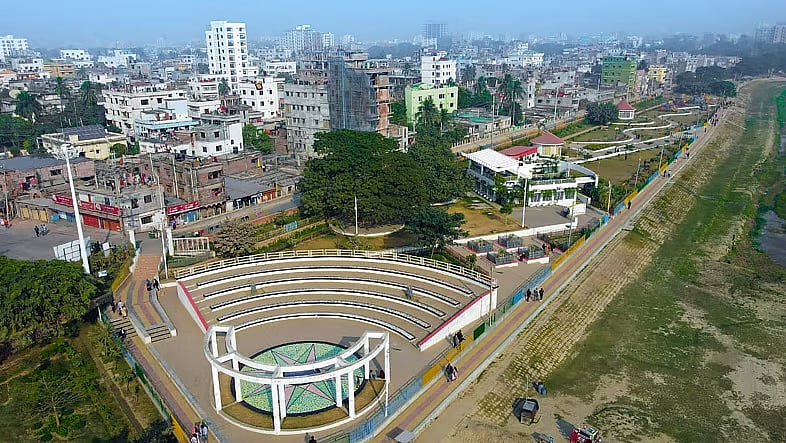
Air pollution has spread across the country. Two other divisional cities, Rajshahi and Khulna, currently have poorer air quality than Dhaka. Among the eight divisional cities, Rajshahi has recorded the highest level of pollution.
According to data from the World Health Organization (WHO), Rajshahi was recognised in 2016 as the world’s leading city in reducing harmful airborne particles.
Today, Rajshahi’s AQI stands at 167, followed by Khulna at 157.
These findings were reported by IQAir, a Switzerland based organisation that regularly monitors global air pollution. The platform’s real-time air quality index provides people with up-to-date information and warnings about how clean or polluted the air is in any given city.
Among the other divisional cities today, Monday the AQI readings are as follows: Rangpur –137, Barishal – 114, Mymensingh – 113, Sylhet – 82 and Chattogram – 73.
Rajshahi: Achievement in 2016
According to WHO data cited by The Guardian in a report published on 16 June 2016, the concentration of coarse particulate matter (PM10) in Rajshahi’s air stood at 195 micrograms per cubic metre, which had decreased by nearly two-thirds to 63.9 micrograms by 2016.
Two years earlier, the concentration of fine particulate matter (PM2.5) was 70 micrograms per cubic metre, which had halved to 37 micrograms in 2016.
The report noted that among the 10 cities worldwide where levels of airborne particulate matter had declined the most over the preceding two years (2014–2015), Rajshahi recorded the greatest reduction, a 67 per cent decrease.
Public health service
Given the current levels of air pollution in Dhaka and other cities, IQAir has issued several recommendations for residents.
These include – always wear a mask when going outdoors, keep windows closed to prevent polluted air from entering, avoid outdoor exercise as much as possible. In areas where air quality is categorised as unhealthy, wearing a mask outdoors is essential.
The impact of air pollution
Air pollution has become the greatest external threat to the life expectancy of the Bangladeshi population. It shortens the average lifespan by approximately 5.5 years, according to the 2025 Annual Update of the Air Quality Life Index (AQLI), compiled by the Energy Policy Institute at The University of Chicago (EPIC).
The report identifies Bangladesh as the most polluted country in the world.
Between 1980 and 2020, around 135 million (13.5 crore) premature deaths worldwide were linked to air pollution, according to research conducted by Nanyang Technological University (NTU) in Singapore.
Furthermore, a World Bank report titled “The Bangladesh Country Environmental Analysis (CEA)”, published in March last year, revealed that in 2019, over 272,000 premature deaths in Bangladesh were caused by four types of environmental pollution, with 55 per cent of those deaths attributed to air pollution.
The report also stated that pollution-related damages in that year resulted in economic losses equivalent to 17.6 per cent of the country’s Gross Domestic Product (GDP).