Investigation commission report
2018 elections: Ballots stuffed between 10pm and 3am
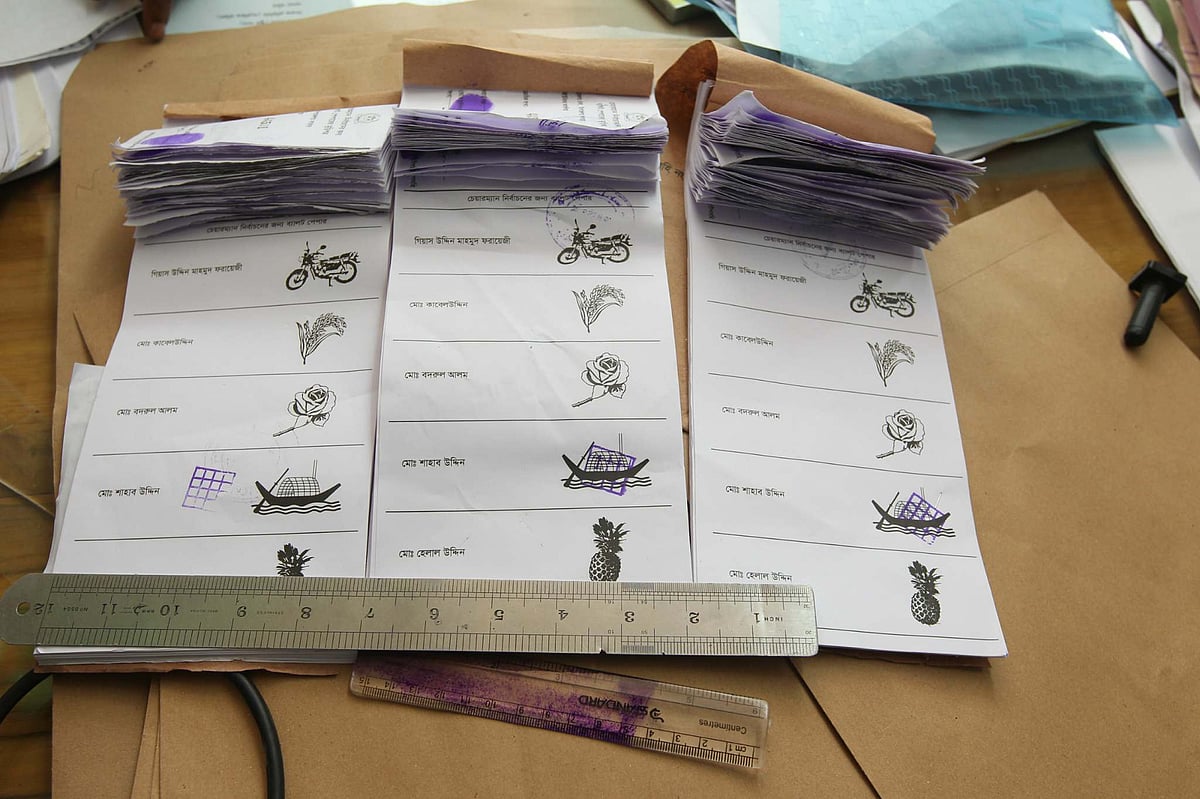
Ballots had already been stamped and packed into boxes at 80 per cent of polling centres across the country the night before the 11th parliamentary elections that took place on 30 December 2018. The stamping began at 10:00 pm and continued until 3:00 am.
To ensure an Awami League victory, the then inspector general of police (IGP) Javed Patwary, who was later appointed ambassador to Saudi Arabia, advised then-prime minister Sheikh Hasina to carry out this “midnight vote”. He has not returned to the country since the fall of the Awami League government during the July mass uprising.
The interim government-appointed National Election (2014, 2018, and 2024) Investigation Commission’s report on the three controversial elections held under the Awami League government states this.
It further says that the presiding and assistant presiding officers in charge of the polling centres admitted to the commission that they had stamped the ballots at night.
The commission’s 326-page report was released by the press wing of the chief adviser on Wednesday.
Earlier, on Monday, the commission members submitted the report to the chief adviser, professor Muhammad Yunus.
The five-member commission is headed by former High Court judge Shamim Hasnain and includes former additional secretary Shamim Al Mamun, Kazi Mahfuzul Haq, associate professor in the law department of Dhaka University, lawyer Tazrian Akram Hossain, and election expert M Abdul Alim.
A committee was formed in June to investigate irregularities in the three elections, which was later converted into a full commission.
The commission’s report states that before the 2018 election, the National Security Intelligence (NSI) set up a “special cell,” known as the “Election Cell,” to oversee, intervene in, and essentially take the driving seat in all election-related activities.
This cell played a key role in registering political parties, appointing domestic and international observers, vetting and transferring election commission officials, vetting and redeploying field administration officers, arresting and harassing opposition leaders and activists, and planning the vote on the night before the election.
The commission’s report highlights irregularities and discrepancies in the 2014, 2018, and 2024 elections, strategies employed to ensure an Awami League victory, harassment of opposition leaders and activists, and the roles of the administration, police, and intelligence agencies.
At a press conference held after submitting the report to the chief adviser on Monday, the commission said that the “innovative” plan to win the three elections through irregularities had begun right after the 2008 vote.
This plan was made at the highest level of the state, and in its implementation, parts of the administration, police, election commission, and intelligence agencies were used as state instruments.
The commission’s report also highlights the questionable turnout in the 2018 election. It states that 100 per cent of votes were recorded in 213 centres, 99 per cent or more in 122 centres, and between 90 and 99 per cent in 7,689 centres. On election day, voters were widely obstructed from entering polling centres.
The commission has also recommended an investigation into the 9th parliamentary election held in 2008.
They admitted to the “midnight voting”
Although Bangladesh Nationalist Party (BNP), Jamaat-e-Islami, and other political parties demanded a neutral caretaker government, the Awami League did not agree.
The 2018 election was held under the Awami League government. Before the election, the BNP formed the Jatiya Oikya Front under the leadership of Dr. Kamal Hossain and participated in the polls. Jamaat’s registration had been cancelled by the election commission, and 21 of its leaders contested the election under the sheaf of paddy symbol.
After the “midnight vote,” the Awami League contested 261 seats and won 258 of them. The Jatiya Party secured 22 seats. In total, the Awami League and its allied parties held 287 seats. On the other hand, the BNP won only six seats, while Kamal Hossain’s Gano Forum secured two seats.
The investigation commission spoke with 30 presiding and assistant presiding officers who were in charge of polling centres in the 2018 election.
The report states that 27 of the 30 admitted that ballots at their centres had been stamped the night before. According to the presiding officers, the stamping was carried out between 10:00 pm and 3:00 am. In the night before the voting day, reports emerged that at most polling centres, ballots had been stamped and packed into boxes under the direction of the ruling Awami League and the police using the boat symbol.
The commission’s report also highlights the questionable turnout in the 2018 election. It states that 100 per cent of votes were recorded in 213 centres, 99 per cent or more in 122 centres, and between 90 and 99 per cent in 7,689 centres. On election day, voters were widely obstructed from entering polling centres.
The commission’s analysis shows that in 587 centres across 75 constituencies, 100 per cent of valid votes went to just one candidate, with no other candidate receiving a single vote.
The report notes that on the night before the election, the election commission received allegations and reports that polling centres had been filled with ballots stamped with the boat symbol by the Awami League and the police, but took no action. The investigation commission stated that the election commission remained silent and effectively assisted the ruling Awami League.
The presiding officers, including the then chief election commissioner KM Nurul Huda and secretary Md Helaluddin Ahmed, along with all officials in charge of the election, admitted to the investigation commission that ballots had been stamped and the boxes filled in advance.
The investigation commission stated that, keeping the election commission in the dark, the government, DGFI (Directorate General of Forces Intelligence) and NSI, the administration, police, presiding officers, assistant presiding officers, and polling officers collectively carried out the “midnight vote.”
The commission’s report says that all planning for the 2018 election was carried out under the leadership of TM Zubair, former director general of NSI, through a team of 11 directors.
The then chief election commissioner (CEC) expressed regret over this to the investigation commission.
The commission’s report says a special cell was set up at NSI headquarters, headed initially by the then lieutenant colonel and later Brigadier General Nurunnobi. The cell oversaw election monitoring, verifying information from the field before reporting it to the director general. DIG Misbah Uddin’s internal wing assisted in these operations. Access to the cell’s control room was strictly limited to NSI-appointed officers. After the election, the cell deliberately burned the key documents from the control room.
The commission’s report says that all planning for the 2018 election was carried out under the leadership of TM Zubair, former director general of NSI, through a team of 11 directors.
The one sided election of 2014
The investigation commission has described the 2014 election as a “contest-free election.” In that election, candidates of the Awami League were elected unopposed in 153 out of 300 seats. Voting was later held in the remaining 147 seats.
According to the book 'Bangladesh’s Electoral System and Results' edited by Nesar Amin, in the 2014 election the Awami League contested 247 seats and won 234, while the Jatiya Party fielded 86 candidates and won 34 seats.
The investigation commission has found that the Awami League misused the legal provisions for uncontested elections to secure ‘victory’ in 151 constituencies. In the remaining constituencies, there was an effort to stage ‘participatory’ elections. As part of this process, the Jatiya Party (JaPa) was targeted. Under instructions from JaPa’s then chairman HM Ershad, most party candidates applied to withdraw their nomination papers, but the election commission did not accept those applications. The commission was unable to retrieve the applications despite repeated attempts. According to election commission officials, the applications were destroyed.
After Ershad announced an election boycott, pressure mounted on him. Security forces surrounded his residence, and he threatened suicide. On 13 December 2013, security forces arrested him and kept him confined in a military hospital.
Dummy vote in 2024
The investigation commission has described the 2024 parliamentary election as a ‘dummy election’. The report states that to make the election appear ‘participatory’, the Awami League leader herself decided which party leaders and activists would stand as candidates. Special symbols were allocated to ensure their victory. Most of the candidates with the truck and eagle symbols were Awami League independents.
The report also notes that, in the absence of genuine observers, an organisation run by fake and party-affiliated individuals was used to certify the 2024 election as ‘acceptable’.
Overall, the commission said that during the 2014, 2018 and 2024 elections, it was difficult to distinguish between the administration, police, military, intelligence agencies, government officials and Awami League workers.