Implementation of July Charter
Dissent among parties, commission to offer recommendations
Stance of different parties
Some of the parties, including BNP, want the referendum to be held on the same day as the election.
Jamaat-e-Islami, NCP and some other parties want a referendum before the polls.
The National Consensus Commission has ended discussions with political parties amid differences among political parties over the time of referendum and the method. In the face of adamant stance of political parties, in particular the National Citizen Party (NCP), Jamaat-e-Islami and Bangladesh Nationalist Party (BNP), the commission has said it would make its final recommendations to the government within a day or two by compiling all opinions from the experts and political parties.
The commission hopes the July Charter will be signed within 15-17 October.
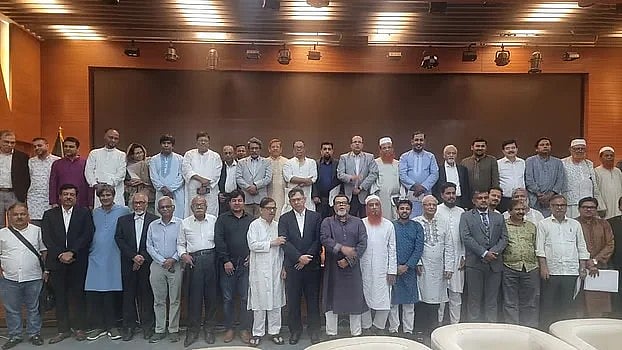
The fifth and final day of discussions with political parties on implementing the July Charter began at 3pm yesterday at the Foreign Service Academy in the capital. The discussions ended at around 11:15pm. The event was broadcast live on BTV News.
On the last day of discussion, the political parties were divided on a single issue. Some parties, including the BNP, wanted the referendum to be held on the same day as the election. However, several other parties including the Jamaat-e-Islami and NCP wanted it to be held before the polls. Besides, there are several other issues which remain unsettled, including the issues of the referendum and implementation of proposals on which parties have dissented.
The July National Charter is being prepared with 84 proposals from six reform commissions. Although a draft has been finalised, the method of its implementation is yet to be finalised. As a result, the charter has been stalled.
To determine ways to implement the charter, the Consensus Commission held both formal and informal meetings with experts. In addition, the commission began discussions with political parties on 11 September. As of yesterday, it had held talks with the parties for five days. Last Sunday, a consensus was reached on holding a referendum to seek public approval for implementing the July National Charter.
On the last day of discussions, the political parties were divided on a single issue. Some parties, including BNP, wanted the referendum to be held on the same day as the election. However, several other parties including Jamaat-e-Islami and NCP wanted it to be held before the polls. Besides, there are several other issues which remain unsettled, including the issues of the referendum and implementation of proposals on which parties have dissented.
However, there was still dissent among the political parties regarding the unsettled issues. Around 3:00 pm yesterday, the National Consensus Commission resumed its adjourned talks with political parties. At the outset, the commission’s vice-chairman, Professor Ali Riaz, urged the parties to give specific opinions on the timing and procedures of the referendum. However, during the long discussion, most parties reiterated their previous positions, and as a result, no consensus was reached in the end.
BNP’s stance
BNP vowed to hold the referendum on the same day as the election. Revolutionary Workers Party of Bangladesh, Bangladesh Jatiya Samajtantrik Dal (Bangladesh Jasad), Jatiyatabadi Samamana Jote and several other parties supported BNP on the matter.
Addressing the discussion, BNP standing committee member Salahuddin Ahmed said with the election approaching, it is impossible to organise a massive arrangement like referendum. It will cost the nation some additional money too. They feel that the proposal to hold the referendum beforehand is an attempt to delay the election.
Salehuddin Ahmed said that regarding the July Charter, it is not a constitutional order or any such decree, but rather a notification can be issued. This notification could be called an order. Based on it, a new law for the referendum can be enacted in the form of an ordinance, and the referendum would then be held. If the referendum takes place, there is no need to grant separate structural powers to the next parliament, because the people will express their intent through the vote. Once the July Charter is passed in the referendum, its implementation will be mandatory for the upcoming parliament.
Noting that the next parliament is not barred from making reforms beyond the July Charter, Salehuddin Ahmed said that the proposals in the July Charter must still be implemented, and further amendments can be introduced if necessary.
BNP vowed to hold the referendum on the same day as the election. Revolutionary Workers Party of Bangladesh, Bangladesh Jatiya Samajtantrik Dal (Bangladesh Jasad), Jatiyatabadi Samamana Jote and several other parties supported BNP on the matter.
The BNP leader added that the Charter should clearly state each party’s differing positions. Moreover, a provision should be included that requires parties to mention in their election manifestos the issues on which they hold differing views. If a party wins the national election, it will be able to implement proposals according to its stated differences.
Salahuddin Ahmed said Jamaat-e-Islami has proposed to implement the charter in the first session of the next parliament. However, he questioned, “How long will be the first session? What if it takes two years?”
The BNP leader said it would not be prudent to set a deadline for the next parliament to implement the July Charter. The parliament must have the freedom and should be given the time it needs to implement the charter. Rather, it could be mentioned like that the next parliament will implement the Charter as soon as possible.
Stance of Jamaat and NCP
The Jamaat-e-Islami wants referendum before the national election. The party’s assistant secretary-general, Hamidur Rahman Azad, said in the discussion that the referendum could be held in the first or middle week of November. He noted that holding the referendum on the same day as the national election could create complications. He added that it would not be proper to exclude the fundamental reform proposals from the Charter for the referendum, nor should any party’s opinion be imposed on the people.
Jamaat-e-Islami’s representative, lawyer Shishir Monir, said that a special constitutional order or a July Charter implementation order is necessary. This order would mention the referendum, and the July Charter would be included in its schedule. The referendum would be held based on this order.
Noting that the next parliament will have two powers, Shishir Monir said one will be the authority of a regular parliament, and the other will be constituent or structural power. This dual authority will exist in the first session of the parliament, after which it will function as a regular parliament in the second session. He added that doing so will ensure sustainable reforms. He also said that the issues on which there are differing views are quite significant; without addressing them, the reforms would collapse.
Earlier, NCP had suggested holding the referendum on the same day as the national election, but the party has now changed its stance. It has stated that the referendum must be held before the national election. To conduct the referendum, an order must be issued beforehand. Additionally, the next parliament should be granted the authority to perform a dual role.
The Jamaat-e-Islami wants referendum before the national election. The party’s assistant secretary-general, Hamidur Rahman Azad, said in the discussion that the referendum could be held in the first or middle week of November.
NCP joint convener Jabed Rasin said that following such a process would not be appropriate, as it could make the reforms vulnerable to future challenges or annulment. He emphasised that attention must be given to making the reforms sustainable.
Jabed Rasin said that, by whatever name, the July Charter Implementation Order must be issued first. The referendum will determine whether the July Charter is implemented Based on this order and the next parliament must be granted special constituent power, as the fundamental structure of the constitution is being reformed. To carry this out, the next parliament must be given this special authority. He added that the referendum must take place before the national election, because holding it on the same day as the election would diminish its significance.
BNP-Jamaat urged to hold separate talks
In the discussion, Mahmudur Rahman Manna, president of Nagorik Oikko, requested that BNP and Jamaat-e-Islami sit separately. He said, “Especially BNP and Jamaat should sit together. Talk it over and decide among yourselves. If you can agree, then we can go for the election.”
Hasnat Kaiyum, president of the Rastro Songskar Andolon, and Zonayed Saki, coordinator of the Ganosamhati Andolon, suggested that outside the National Consensus Commission’s discussion, the parties could try to reduce differences on their own.
Some other parties also proposed that if BNP can make concessions on PR (proportional representation) at the higher level, discussions could then take place on granting similar concessions to Jamaat at the lower level.
However, BNP leader Salehuddin Ahmed said that the July Charter drafting process is a “closed chapter,” and it would be better to focus on the implementation process now.
Experts’ recommendations
In his closing remarks at yesterday’s discussion, National Consensus Commission’s vice-chair Professor Ali Riaz presented the experts’ recommendations on implementing the July Charter. They are:
1. An order must be issued.
2. A referendum must be conducted based on that order.
3. The referendum should contain two separate questions: one on issues with consensus or broader agreement, and another on issues where there is dissent or a note of disagreement.
4. The Constitution Reform Council and the 13th National Parliament will be formed through the election.
5. Subject to approval in the referendum within the period specified in the order, the reforms on constitutional matters described in the July Charter will be incorporated into the constitution.
Ali Riaz said that the Commission will provide recommendations to the government within the next couple of days integrating the opinions of experts and political parties. Those who participated in the process will also be informed about it.
In his closing remarks, Ali Riaz stated, “In the struggle to preserve national unity and establish an accountable democratic state, we will have everyone’s cooperation. Wherever we are, however we are, whatever party we belong to, and whatever ideals we uphold, this unity must be maintained and continued so that we can establish a true democratic state. We will be its stakeholders, and our next generation will be able to reap its benefits.”
Earlier, the NCP had suggested holding the referendum on the same day as the national election, but the party has now changed its stance. It has stated that the referendum must be held before the national election. To conduct the referendum, an order must be issued beforehand. Additionally, the next parliament should be granted the authority to perform a dual role.
Earlier, commission members Badiul Alam Majumdar, retired justice Md Emdadul Haque, Iftekharuzzaman, Md Ayub Mia, and Monir Haider, special assistant to the chief adviser involved in the national consensus formation process, also addressed the discussion.
One year of reform initiatives
To propose reforms across various sectors of the state, the government formed six reform commissions in the first week of October last year. They are - constitution, election system, judiciary, Anti-Corruption Commission (ACC), police, and public administration reform commissions.
In February, these commissions submitted their full proposals to the government. To build consensus on the reforms, the National Consensus Commission began its work on 15 February. Although interim government’s chief adviser is the president of the Consensus Commission, vice-chair prof Ali Riaz led the discussions with the political parties.
The commission held two rounds of discussions with political parties on 166 key proposals from the six reform commissions. In the first round, from 20 March to 19 May, the commission met parties separately. In the second round, starting 2 June, the commission brought together 30 parties to discuss 20 fundamental reform proposals. The aim was to finalise and sign the July Charter within the month, but that did not happen. The second round concluded on 31 July, with at least nine of the 20 fundamental proposals facing dissent from some parties.
Based on the two rounds of discussions, the National Consensus Commission finalised a draft of the July Charter covering a total of 84 proposals, including those with dissenting opinions. However, the two rounds of talks did not yield an agreement on the implementation process for the reform proposals. Subsequently, the commission held both formal and informal discussions with the parties on this issue and also collected their written opinions regarding the implementation process.