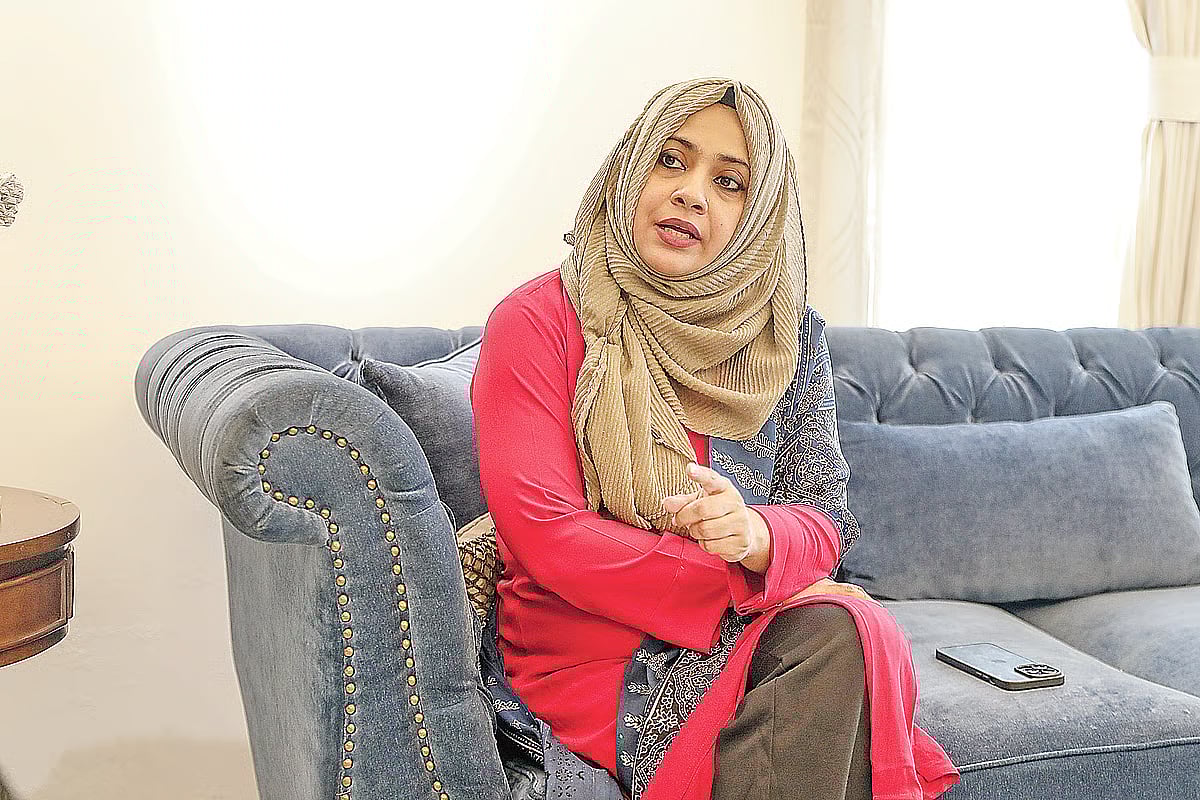
Special interview: Chowdhury Saima Ferdous
Keeping women active in politics is not an act of charity
International Women’s Day passed recently. During the July mass uprising, we saw the courageous role of women, especially on the streets. Yet their presence is far less visible in state reform or policymaking afterwards. How do you view this contrast?
Chowdhury Saima Ferdous: This has, in fact, been the historical pattern. During the Language Movement, many women leaders played pioneering roles. But how many of their names do we remember today? The same applies to the Bangladesh Liberation War. Unfortunately, as a nation, we highlight women’s suffering far more than their heroism. By labelling them as “Birangona”, we have largely confined them to narratives of victimhood and human rights violations.
Similarly, in the 1990 movement or the 2024 mass uprising—whenever women take to the streets, their presence is treated almost as decorative. Society says, “Oh, women were there too—how nice!” But it is not ready to accept them in positions of leadership. In our collective psyche, strength is still equated with a male face. Society teaches that a woman’s role is to nurture. So when a woman raises her voice on the streets or in the workplace, she is no longer seen as “normal” but labelled “aggressive” and pushed aside.
During the July movement, people stood united. But did the situation regarding women’s rights and equality change immediately afterwards?
Chowdhury Saima Ferdous: Not exactly. Rather, it is disappointing that after a mass uprising against all forms of discrimination, the same old attitudes towards women persist. Women who played leading roles in the movement are now being questioned about whether they can lead political parties. From a political perspective, that is deeply concerning.
The scale of cyberbullying women faced afterwards was itself a violation of human rights. We did not see people from all walks of life come together to defend women’s dignity. Even when a women’s commission was formed, the indecent behaviour directed at it was met with near silence from the state.
More troubling is when politically connected women themselves justify discriminatory views using religious interpretations, or accept limitations on women’s leadership. The long-term societal impact of this is often overlooked.
At the same time, digital bullying is not trivial; it is a serious social illness. Among many young people, it has been glamorised as boldness, while in reality it reflects growing disrespect. Instead of considering this as a crime, they are trying to normalise this behaviour. Political debate is part of democracy, but when it descends into personal abuse and vulgarity, it is a matter of collective shame.
You were active both on the streets and in academia from 2018 to 2024. You also faced harassment and cyberattacks during the past government. How have your personal challenges changed over this journey?
Chowdhury Saima Ferdous: It is a complex question. I never set out to enter politics; I wanted to remain in academia. But my father instilled the belief in me that failing to protest injustice creates injustice. That is why I took to the streets whenever necessary.
Personally, 2018 was far more frightening than 2024. At that time, authoritarianism was at its peak. My father was imprisoned for 284 days before an election in a completely trumped up case, despite being a freedom fighter. The level of harassment we faced was extreme. I saw the Attorney General defend false cases in court. Plainclothes DB police would wait outside court premises, and there was always a fear of enforced disappearance.
Despite women’s active role in the uprising, there seems to be reluctance or barriers to their participation in current politics. How can this change?
Chowdhury Saima Ferdous: A major barrier is the absence of clear operational policies within parties to groom and protect women. When nominations are based solely on “winnability”, women without opportunities get trapped in a vicious cycle.
Secondly, politics has become excessively expensive. Vote-buying culture that has become rampant in the past disadvantages women, as they often lack financial resources or as they don’t have just inheritance rights. Also, leadership is still perceived as muscle power and loudness.
As a result, even if smart women join politics, questions are raised about her capacity to fight on the streets and in parliament. Due to security concerns, especially in rural areas, parties often see women’s participation as a burden rather than a right. These structural flaws, high costs, and negative attitudes keep women away from the centre of politics.
The women affairs reform commission brought forth some proposals and the ‘July Charter’ proposed ensuring at least 5pc female candidates, yet major parties seem reluctant. Why?
Chowdhury Saima Ferdous: The root problem is that political parties still treat women’s participation as charity or social responsibility. They fail to see it as a necessity for their own survival and for the country’s progress.
We often invoke Rokeya Sakhawat Hossain when discussing women’s rights, but reduce figures like Khaleda Zia to narratives of “tolerance”, “patriotism” and “personal sacrifice”. Yet have we truly succeeded in establishing her prudence, her capacity for political decision-making, and her leadership as an example for both men and women alike? She has not been adequately presented as a model for the next generation of political actors. So long as female leadership continues to be dismissed as a by-product of “family circumstance” or mere contingency, and so long as there remains a reluctance to recognise women as role models in their own right, this persistent hesitancy will endure.
Working-class women, including readymade garments factory workers, played a major role in the uprising. Despite being a major portion of Bangladesh’s economic power or people power, they are often labelled “marginal”. How much importance do their economic rights receive in discussions on reforms?
Chowdhury Saima Ferdous: Before economic rights, we must address recognition. Are they fully acknowledged as citizens? Why must we label people as majority or minority?
Why should we set anyone apart on the basis of ethnic or minority identity? As citizens of this country, can they not simply be recognised as ‘Bangladeshi’? Even today, many ethnic communities—such as Bawm women—have long been struggling for the very recognition of their existence. When a person’s identity itself is called into question, and individuals are repeatedly labelled as “minority” on the basis of being Hindu or otherwise, divisions are inevitably deepened.
I would urge the current government to undertake a fundamental reform of this judicial framework. It is essential that the justice system guarantees, in practice, the principle that every individual is an equal stakeholder in this country.
If women withdraw from politics due to neglect or harassment, how concerning is that for the future? What qualitative changes should be introduced within political parties to keep women active in politics?
Chowdhury Saima Ferdous: It is not just concerning—it is a national loss. Political parties must clearly realise that they do politics for the people of this country and that over half the population of this country are women. Without their proper representation, sustainable policymaking is impossible.
If you look at the current statistics on women’s representation in parliament, it is alarming—indeed deeply concerning—for all of us. For the past 17 years, we have seen a legislature that was largely inert and dispiriting, where little more than praise-singing prevailed. While the new parliament offers a glimmer of hope, meaningful change will only come when the aspirations of more than half the population are properly represented.
Why is women’s representation essential? No matter how expert I may be, can I, as a man, ever fully think on behalf of women? Yet what we see now is men sitting and formulating policies for women. This does not lead to genuine solutions. Keeping women actively engaged in politics is not an act of benevolence or charity; it must be recognised as indispensable for the very survival of political parties and for the sound formulation of policy.
Violence against women has increased in recent years. How do you assess the government’s response?
Chowdhury Saima Ferdous: Even though election manifestos speak of women’s empowerment and safety, the gap between promise and implementation on the ground remains stark. Research shows that violence against women cannot be prevented by strict laws alone; what is required is impartial enforcement of those laws and swift justice. A culture of impunity and procedural delays only emboldens perpetrators and pushes victims further into silence. Violence is not merely a criminal offence—it is also a deep-rooted social and psychological disorder born of patriarchal displays of power and dominance.
Another major crisis is the prevailing political and social double standard. On one hand, commitments are made to uphold women’s dignity; on the other, deeply disrespectful remarks about women’s leadership are made in political rallies and public forums. When women within political parties attempt to legitimise or justify such aggressive rhetoric, it sends a dangerous signal to society at large.
In rural contexts, this can even serve as a form of social validation that contributes to violence or harassment against women. Unless this psychological and cultural dimension is addressed, neither policy declarations nor legal frameworks alone will be sufficient to eliminate a culture of violence.
Finally, what steps are most important to improve women’s lives? And, what are the toughest challenges to meet?
Chowdhury Saima Ferdous: Before the end of the current government’s tenure, ensuring women’s safety, safeguarding their dignity, and enabling their independence in decision-making are the most urgent priorities. While I appreciate the government’s initiatives in women’s education and empowerment, I believe that making education free up to the postgraduate level would have a long-term transformative impact on women’s advancement.
To prevent violence against women, strict laws alone are not sufficient; what is needed is their swift enforcement alongside a strong grassroots social movement. In countering cyberbullying, it is essential to build trust in digital security systems and in public administration so that women feel confident that the state will stand beside them in times of crisis.
Secondly, beyond questions of quotas in the civil service (BCS), what matters more is ensuring easy access to credit and genuine financial inclusion for women. However, the greatest challenge remains the prevailing social mindset that still refuses to recognise women as independent individuals. For any meaningful state reform to succeed, this psychological barrier must be dismantled, and women’s safety and autonomy must be fully ensured.
Thank you.
Chowdhury Saima Ferdous: Thank you, and thanks to Prothom Alo.