Opinion
Inequality and violence: Why Khagrachhari’s hill people have reached a boiling point
Religious and ethnic minorities in Bangladesh have seldom lived in comfort or security. Their land, property, faith, and culture have repeatedly come under attacks from the majority. The pattern persisted under the previous government, and in the aftermath of the July Uprising, the resurgence of the rightists has further deteriorated the situation.
Right-wing politics often interprets any faith, culture, or nationality outside the majority’s as a threat. That is why, with the rise of the right, the country has witnessed growing intimidation, harassment, and mob violence against dissenters, minorities, women, and the marginalised.
There have been attacks on shrines, bans on traditional fairs, baul festivals, and theatre performances, as well as threats and assaults over alleged “blasphemy”. In some cases, sadhus and fakirs were dragged through the streets and humiliated through cutting their long hair forcibly. The interim government has not yet shown any effective role in curbing such violence.
The reality is even harsher for the minorities, who are also ethnic and geographically marginalised. On top of discrimination, they often face accusations of “separatism”. The recent protests and deadly clashes, which killed three people, in Khagrachhari following the reported rape of a Marma schoolgirl must be understood in that context.
Allegations have it that an eighth grader Marma girl was gang-raped by three Bengali youths while returning home from private tuition in Singinala, Khagrachhari, on 23 September. One suspect, Shoyon Shil, 21, was arrested in this regard, but protests erupted over delays in apprehending the other two.
Under the banner of “Jumma Chhatra-Janata”, students and young people from the Chakma, Marma, Tripura, and other ethnic minority communities launched demonstrations demanding the arrest of all perpetrators and protection of women in the hills.
Their movement included class boycotts at schools and colleges, mass gatherings, and road blockades. Protesters claim that the situation turned violent only after a section of Bengali settlers and the military tried to suppress the demonstrations.
According to the Kapaeeng Foundation, between January and July 2025, there have been 24 incidents of violence against women from ethnic minority communities, 21 in the Chittagong Hill Tracts and three in the plains.
Social media then became a breeding ground for misinformation to incite violence. Those included: footage from Dinajpur’s Jibanmahal fire falsely presented as a mosque attack in Khagrachhari, a Kathmandu clash video framed as an attack on the army and BGB by the hill people, even Tripura-based inflammatory statements falsely attributed to the Jumma community, and injury of an army member in an attack on the Secretariat was presented as an attack by the hill people. (Fact-check: Rumour Scanner, DismissLab)
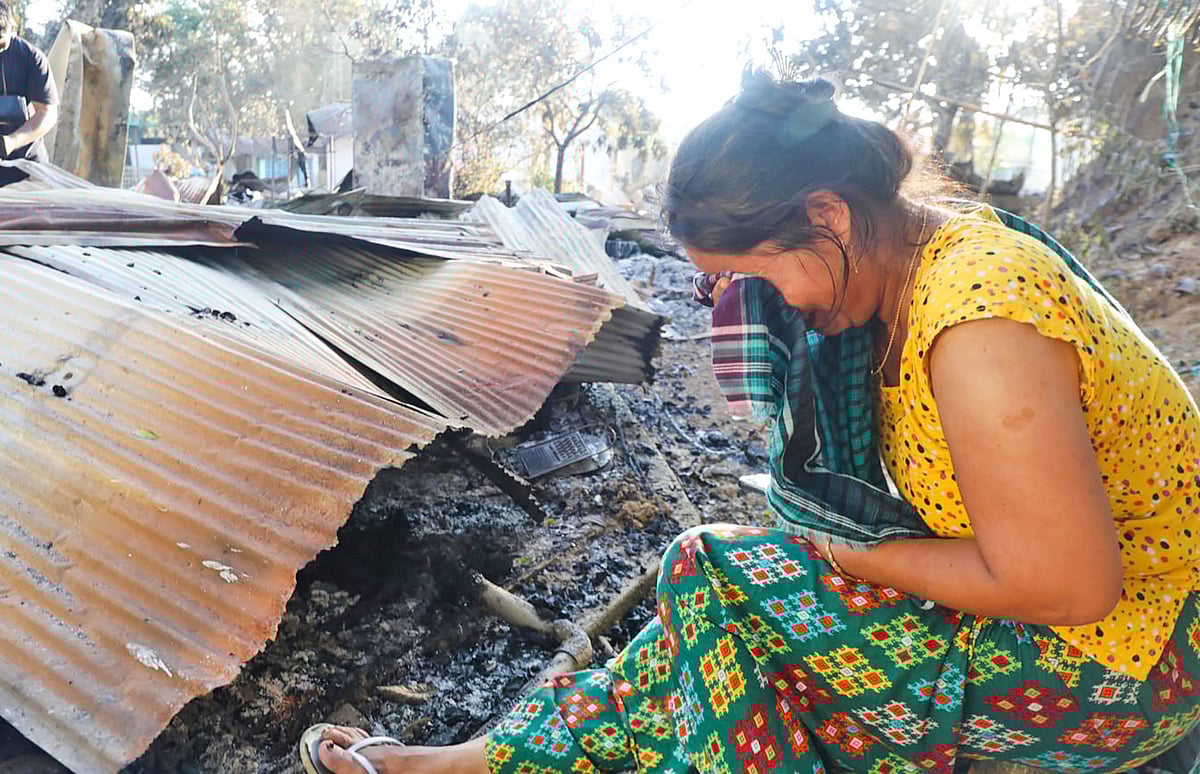
As this disinformation of attack by the hill “terrorists” on the state forces were spread, the inevitable followed. The victims of the ensuing gunfire were all from the hill communities—three young men from Guimara Upazila: Athui Marma, 21, Athrau Marma, 22, and Toiching Marma, 20. The attacks occurred in broad daylight, in the presence of law enforcement. Shops and homes—mostly belonging to hill dwellers—in Ramesu Bazaar were set ablaze. Will the perpetrators of such violence ever face justice in Bangladesh?
Such doubts persist because Lt. Gen. (retd) Jahangir Alam Chowdhury, the interim government’s adviser for home affairs, hastily blamed “Indian or fascist instigation” without any neutral investigation. This echoes the reflexes of past governments of the Awami League, which often blamed “BNP-Jamaat” or external conspiracies for communal attacks without evidence.
Besides, this was not the first incident of ethnic violence under the interim government either. A Bengali youth was beaten to death in Khagrachhari on allegations of motorcycle theft on 18 September 2024.
Amid the chaos, this incident of mob violence quickly morphed into communal clashes between Bengalis and the hill people. On the next day, 19 September, a person from an ethnic minority community was lynched.
Two hill youths lost their lives in gunfires by the law enforcement agency at district sadar at night. Later, on 20 September, a youth, Anik Kumar Chakma, was beaten to death at Rangamati town in broad daylight.
According to the Kapaeeng Foundation, between January and July 2025, there have been 24 incidents of violence against women from ethnic minority communities, 21 in the Chittagong Hill Tracts and three in the plains.
Six women were raped or gang-raped; two were killed. Across hill and plain regions combined, 34 incidents of deaths in custody, arbitrary detention, assault, or forced conversion were recorded. How many of those cases have led to convictions or justice?
Rape in the Chittagong Hill Tracts is never an isolated act—it is intertwined with systemic ethnic oppression. Survivors and activists often face intimidation, lengthy court delays, and official non-cooperation when seeking justice.
This background must be taken into account to understand the current outrage in the hills. Otherwise, it cannot be realised at all why the whole region erupted over the rape of a Marma schoolgirl. Rape in the Chittagong Hill Tracts is never an isolated act—it is intertwined with systemic ethnic oppression. Survivors and activists often face intimidation, lengthy court delays, and official non-cooperation when seeking justice.
Such experiences have eroded trust in the state, especially in the incidents of trial of sensitive cases like rape. Even in the present incident, the medical report claiming “no evidence of rape” in the Marma girl’s examination has drawn widespread disbelief.
Many have been drawing examples of Bangladesh’s record of manipulated autopsy findings—from the 2018 Bilaichhari Marma rape case to the Tonu and Abu Sayed cases in the plains.
Such suspicions in the context of Bangladesh are not unfounded. It is essential to create trust instead of putting forth conspiracy narratives to face this crisis. For this, credible reinvestigation of the incident of alleged rape based on the opinions of the hill people is necessary.
At the same time, people responsible for the looting in Khagrachhari and Guimara, arson attacks and incidents of shooting must be punished after a neutral investigation. Victim families must be compensated appropriately and rehabilitated.
The hill communities do not seek secession, rather they seek democratic rights. Like the Bengali majority in the plains, they too deserve the full protection of civil administration and citizenship. During the July Uprising, a wall slogan inspired many: “From the plains to the hills — this time, freedom for all.”
One must remember: unless the hills do not get freedom, the plains cannot be free either.
* Kallol Mostofa is a writer on energy, environment, and development economics.
* He can be reached at kallol_mustafa@yahoo.com