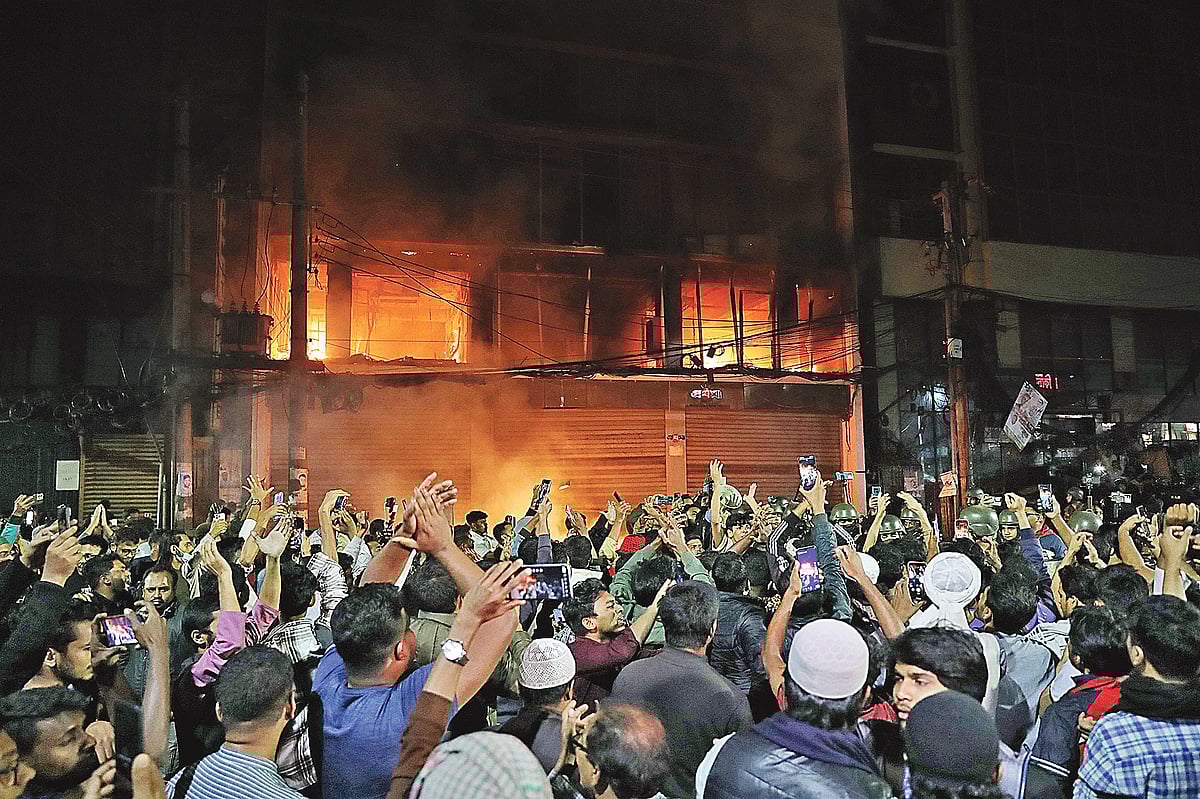
Attack on Prothom Alo, Daily Star, Chhayanaut: Masterminds not identified as yet
Four months have passed since the attack, vandalism, looting, and arson at the Prothom Alo building, yet those who planned or coordinated the incident remain unidentified.
Police say many individuals directly involved in the attack, as well as those who incited it online, have been identified. However, key questions on who devised the plan, how long preparations were underway, and whether there was financial or political backing, remain unanswered.
The investigating agency, Detective Branch (DB) of Dhaka Metropolitan Police (DMP), says it is scrutinising not only the direct attackers but also the roles of instigators and planners.
As a result, more time is needed to complete the investigation and so it has not been possible to submit the charge sheet within the two-month deadline announced by Home Affairs Adviser Salahuddin Ahmed.
On the night of 18 December last year, a coordinated group carried out attacks, looting, and arson at the Prothom Alo building in Karwan Bazar, Dhaka. On the same night, The Daily Star office near Farmgate and the Chhayanaut building in Dhanmondi were also attacked, vandalised, and set on fire.
Two months after the incident, on 28 February, newly appointed Home Affairs Adviser Salahuddin Ahmed visited the damaged Prothom Alo building. He had then said that the investigation would be completed and a charge sheet submitted within two months. That deadline expires today, 28 April.
However, the investigating agency has yet to reach the stage of submitting the charge sheet. While there has been some progress regarding direct attackers and online instigators, the investigation has not yet advanced to identifying those behind the planning, financing, or coordination.
Following the incident, police arrested 26 individuals during the tenure of the interim government. Later, on 3 April, Ataur Rahman Bikrampuri was shown arrested in the case. He had earlier been detained on 23 December last year and sent to jail under detention for posing a threat to public order.
On 9 April, through court proceedings, police showed 11 more individuals arrested in the Prothom Alo case. They had previously been arrested in a case related to the attack on The Daily Star office.
In total, 38 accused have so far been arrested in connection with the attack on the Prothom Alo building. Among them, 10 have already been released on bail; they were arrested during the interim government’s tenure.
A source related to the investigation said that, beyond those arrested, several other attackers have been identified. However, their identities could not be confirmed as they have deactivated their Facebook accounts.
The investigating agency has written to Meta authorities seeking information about some of these accounts.
A coordinated wave of disinformation, incitement on social media, fabrication of false narratives, and finally rapid organisation leading to simultaneous attacks on three key locations on the same night—Prothom Alo, The Daily Star, and Chhayanaut—all appeared to have been pre-planned.
According to available information, the investigation is focusing heavily on analysing live broadcasts, uploaded videos, and images circulated on social media on the day of the attack. However, questions about who planned the attack, how long preparations lasted, and who provided support and coordination remain unclear.
Shafiqul Islam, Additional Commissioner of DMP and head of the DB, told Prothom Alo last Sunday that many individuals directly involved in the attack have been identified by collecting footage and images related to the incident. Instigators have also been identified, and the information obtained is being verified.
He added that this is an important case and requires more time to complete the legal processes, which is why the charge sheet cannot be submitted within the deadline set by the Home Affairs Adviser.
When asked whether any masterminds have been identified so far, the DB chief said that this matter is under investigation and various angles are being examined.
Demand for bail raised in Facebook post
At 6:19 am on 24 April, a man named Altaf Hossain wrote in a Facebook post, “Among the eight people arrested at that time in the Prothom Alo case, all are now on bail. Six of them were granted bail through the ‘Baisammohin Karamukti Andolon’ (Anti-Discrimination Prison Release Movement). Since it was the Prothom Alo case, we did not disclose details earlier considering security concerns. Now seven are out, while one has been shown arrested again in the Daily Star case. Four more individuals were newly shown arrested two weeks ago; we are handling their cases. Now the name of Bikrampuri bhai has also been added.”
Police sources say that following the 2024 mass uprising, there were attempts under the banner of the ‘Baisammohin Karamukti Andolon’ to stage protests and mobilise mobs in front of various prisons, demanding the release of detainees accused of extremism, involvement with banned militant groups, or participation in attacks. The group also organised several gatherings.
Many individuals directly involved in the attack have been identified by collecting footage and images related to the incident. Instigators have also been identified, and the information obtained is being verified.Shafiqul Islam, Additional Commissioner of DMP and head of the DB
A review shows that a Facebook page named ‘Baisammohin Karamukti Andolon’ has been posting regularly since 10 August, 2024. Altaf Hossain is active on this page, along with several others. Some of them have previously been accused of involvement in extremism, while others were arrested at different times in the past.
The page has also carried a sustained disinformation campaign against Prothom Alo. On 7 November, 2024, it posted a call for a rally demanding the closure of Prothom Alo and The Daily Star under the same banner.
Two days later (9 November), another post shared photos of several individuals holding banners, claiming that speeches were delivered under the chairmanship of Shafiqul Islam by central coordinator Maulana Altaf Hossain, Maulana Ishaq Khan, and other leaders.
On 24 November, a coordinated group attempted to create disorder in front of the Prothom Alo office, including slaughtering a cow; that incident was also promoted on the same page. In another post on 25 November, reporting the release of those detained in that incident, it said: “Due to the relentless efforts, presence, and pressure from the Karamukti Andolan, along with support from journalist Ilias bhai and guidance from Ahmad Rafiq bhai, and the pressure from the ordinary people and activists, five brothers who had been arrested have been freed.”
The page also promoted provocative videos by a YouTuber based abroad.
Hadi’s death used as a ‘pretext’
Sharif Osman bin Hadi, spokesperson of the Inqilab Moncho, who had been shot, died while undergoing treatment in Singapore on the night of 18 December last year.
After news of his death spread, a vested group allegedly began systematically inciting attacks and spreading rumors against Prothom Alo on social media. One group gathered at Shahbagh and, around 11:00pm, moved to the Prothom Alo office in Karwan Bazar, chanting slogans.
According to available information, the investigation is focusing heavily on analysing live broadcasts, uploaded videos, and images circulated on social media on the day of the attack. However, questions about who planned the attack, how long preparations lasted, and who provided support and coordination remain unclear.
At 11:55pm, another organised group arrived from Shahbagh and broke the gate shutter to enter the building, carrying out vandalism, looting, and arson. A section of the attackers blocked fire service vehicles on the main road, preventing them from reaching the site.
Although members of law enforcement agencies were present at the time, they remained inactive. Firefighters were only able to begin extinguishing the blaze after about two and a half hours, by which time the fire had spread throughout the building. Important documents, furniture, computers, televisions, and other equipment were reduced to ashes.
Sources from multiple law enforcement agencies told Prothom Alo that an extremist group used Osman Hadi’s death as a pretext to orchestrate planned attacks on the offices of Prothom Alo and The Daily Star.
As part of the same plan, attacks, arson, and destruction were also carried out that night at Chhayanaut and the following day at the Udichi office.
Earlier, after Osman Hadi was shot on 12 December, the same identified group had already launched a large-scale disinformation campaign against Prothom Alo on social media.
Provocation by two YouTubers
Among those who had long been involved in sustained online campaigns and incitement against Prothom Alo, two expatriate YouTubers—Pinaki Bhattacharya and Ilias Hossain—were at the forefront. They had been provoking attacks for a long time. Investigators are reviewing their various posts and videos. Those involved in the investigation believe that such propaganda encouraged an extremist group operating within the country.
Earlier, on 24 November, 2024, allegedly under their provocation, an extremist group slaughtered a cow in front of the Prothom Alo office and created disorder and chaos over several days.
Investigators believe that from that time, a group had been preparing to target Prothom Alo. They chose the death of Osman Hadi as the opportune moment for a final attack.
In this context, alongside an extremist group, the online activities of some current and former members of Islami Chhatra Shibir are also under review. The purpose of their disinformation was to justify the attacks on Prothom Alo and The Daily Star.
After news of Osman Hadi’s death spread, YouTuber Ilias Hossain made multiple posts on social media. Following the attack on Prothom Alo, he wrote in one post, “Not a single brick of Prothom Alo should remain.”
In another post, he wrote, “Everyone come to the Prothom Alo office. Half the work is done. You finish the rest.”
After the Prothom Alo building was completely set on fire, Ilias wrote in a post addressing the attackers, “Prothom Alo done (attack complete), come to The Daily Star.”
Later that night, he posted again, “Daily Star done, well done boys.” That same night, addressing the army, he wrote on Facebook, “If the army comes in front of their office to save Prothom Alo, they should be given an appropriate response.”
Meanwhile, Ataur Rahman Bikrampuri—identified as an extremist—was detained on 23 December and placed under three months’ detention by the interim government on grounds of being a threat to public order.
Before his detention, Bikrampuri said in a Facebook live that he was not alone in instigating attacks on Prothom Alo and The Daily Star.
He said, “Didn’t we incite? Yes. Even if I did not directly call on people to vandalise Prothom Alo or The Daily Star, we hinted that the revolution must be completed. Just as NCP leaders made such posts, I also made similar suggestive posts.”
Remarks and presence of Shibir-leaning individuals
Before the attack on the Prothom Alo office, several leaders and activists affiliated with Islami Chhatra Shibir made aggressive statements targeting Prothom Alo and The Daily Star through Facebook posts and live videos.
Some of them, in addition to spreading disinformation, also called for shutting down both media outlets.
Video footage from the day of the attack shows the presence of individuals known to be affiliated with Shibir. One such individual is Ashraful Islam, literature secretary of Muhammad Shahidullah Hall student union at the University of Dhaka. A video showing his presence alongside the attackers at the scene late at night was widely circulated on social media.
After news of Osman Hadi’s death on 18 December, at a gathering at Jahangirnagar University, the general secretary of the university’s Shibir unit, Mostafizur Rahman, said, “Those who try to normalise the Awami League through the media must be seize. Tomorrow, the leftists, Shahbag activists, Chhayanaut, and Udichi must be torn apart.” (Source: Ajker Patrika, 20 December, 2025)
On the same day, at a gathering at the University of Rajshahi, Shibir president and RUCSU vice president Mostakur Rahman Zahid said, “From this program, I declare that so-called civil newspapers such as Prothom Alo and The Daily Star must be shut down.” (Source: Amader Shomoy, 20 December, 2025)
However, Jamaat-e-Islami Ameer Shafiqur Rahman condemned the attacks on the offices of Prothom Alo and The Daily Star. No information has been found about any organisational action taken against Shibir leaders accused of inciting the violence.
Inaction of law enforcement agencies
From the spreading of rumors to the act of arson, Prothom Alo contacted law enforcement agencies and important individuals in the government at every stage. However, the government did not take adequate security measures. Members of the law enforcement agencies present at the scene did not attempt to stop the attack—far from it, they did not even move toward the attackers.
Although the number of police personnel was low at the beginning, later the presence of members of security forces, including police, Border Guard Bangladesh (BGB), and the army, increased.
However, no attempt was seen to prevent or detain the attackers. About two and a half hours after the fire was set, the army assisted the entry of fire service vehicles to extinguish the fire.
Around 8:00pm, rumours spread about the death of Osman Hadi. At 8:26pm, on behalf of Prothom Alo, contact was made with the Deputy Commissioner (DC) of Tejgaon Division Police, requesting security. After 10:00pm, the government confirmed the news of Hadi’s death. Police were informed that people were gathering in Shahbagh and that incitement to attack was being spread on social media, and a request was made to ensure security.
Since the attacks on Prothom Alo, The Daily Star, and Chhayanaut took place one after another on the same night, it indicates coordination behind them.Shahdeen Malik, Supreme Court lawyer
Shortly after 11:00pm, the army, Rapid Action Battalion (RAB), and the Dhaka Metropolitan Police (DMP) Commissioner were informed one by one. All of them said that forces were being sent. But in the subsequent sequence of events, it became clear that the gap between assurances and reality was rapidly widening.
At 11:08pm, the first group of 50 to 60 people set out from Shahbagh toward Karwan Bazar. At 11:15pm, they reached Banglamotor. At that time, 12 to 13 police members were stationed in front of the Prothom Alo office.
At 11:20pm, the group of 50 to 60 people arrived in front of Pragati Bhaban in a procession. There, they had a scuffle with police. Later, they moved toward the metro rail station and took position on the main road. Shortly afterward, a section of them came in front of the Prothom Alo building and began chanting slogans. The main attacking group from Shahbagh arrived at 11:55pm.
Fire service vehicles were also blocked
At 12:22am, when the fire service was contacted, it said that its vehicles had been blocked. Without “backup” or security assistance from law enforcement agencies, it was not possible for them to move forward.
Even after multiple contacts, the same response was received. Yet at that time, vehicles of the police, Rapid Action Battalion (RAB), the army, and Border Guard Bangladesh (BGB) were present on the main road.
At 1:24am, a live report by a media outlet stated that despite the presence of numerous security force vehicles, they had not taken any action. At 1:26am, army personnel were seen moving toward the Prothom Alo building from the side of Kazi Nazrul Islam Avenue, along the road heading toward Farmgate.
At 1:31am, they took position in front of the building and began dispersing people. At 2:13am, the fire service said it had received “clearance.” At 2:30am, firefighting operations began. At 3:48am, the fire was reported to be under control.
Everything appeared pre-planned
At a protest meeting titled “Bangladesh affected by mob violence” in Dhaka on 22 December, 2025, National Citizen Party (NCP) convener Nahid Islam said that the entire attack and arson at the Prothom Alo and The Daily Star offices was planned.
He stated that the incident involving Sharif Osman Hadi could have been an “accident (bad news),” and that a conspiracy had already been prepared in advance regarding what events would unfold in Bangladesh after it.
Nahid Islam said, “After this incident, we have said that a section within the government was involved here. Consent in society for this had been created for a long time, and there was also political backing behind it. Without these three things happening together, no one would have had the courage to carry out such an act that night.”
An analysis of the sequence of events before and after the attack supports the logic of Nahid’s statement. A coordinated wave of disinformation, incitement on social media, fabrication of false narratives, and finally rapid organisation leading to simultaneous attacks on three key locations on the same night—Prothom Alo, The Daily Star, and Chhayanaut—all appeared to have been pre-planned.
Sources involved in the investigation believe that behind individuals who openly incited violence on social media, there may be multiple vested interest groups, extremist forces, as well as financial backers and propaganda facilitators. They think that coordinated efforts are needed to present sufficient evidence regarding these actors. For that, government willingness and directives from the policy level are considered essential by those involved.
On the question of planned attacks, lawyers and analysts also emphasise the need for a proper investigation.
Supreme Court lawyer Shahdeen Malik told Prothom Alo that since the attacks on Prothom Alo, The Daily Star, and Chhayanaut took place one after another on the same night, it indicates coordination behind them.
He said that there were certainly some political reasons behind the failure to conduct a proper investigation during the interim government period.
The senior lawyer believes that if the current government does not take the matter seriously and take action against those behind the incidents, they could become a future threat to the government itself. Therefore, in the government’s own interest, those responsible for the incident—those who carried it out and coordinated it—should be properly investigated and brought under the law.