July National Charter
Government to decide on date of referendum
The National Consensus Commission has submitted its recommendations to the interim government delineating how to implement the July National Charter.
The recommendations propose issuing a special order to implement the constitutional reform proposals contained in the charter, followed by a referendum.
If the proposals are approved in the referendum, the next parliament will act as a Constitution Reform Council and complete the amendments within 270 days.
However, the commission has left it to the government to decide when the referendum will be held — whether on the same day as the national election or earlier.
The order under which the charter will be implemented will be titled “July National Charter (Constitutional Reform) Implementation Order.” The order contains the full framework for implementation and will be based on the July Uprising.
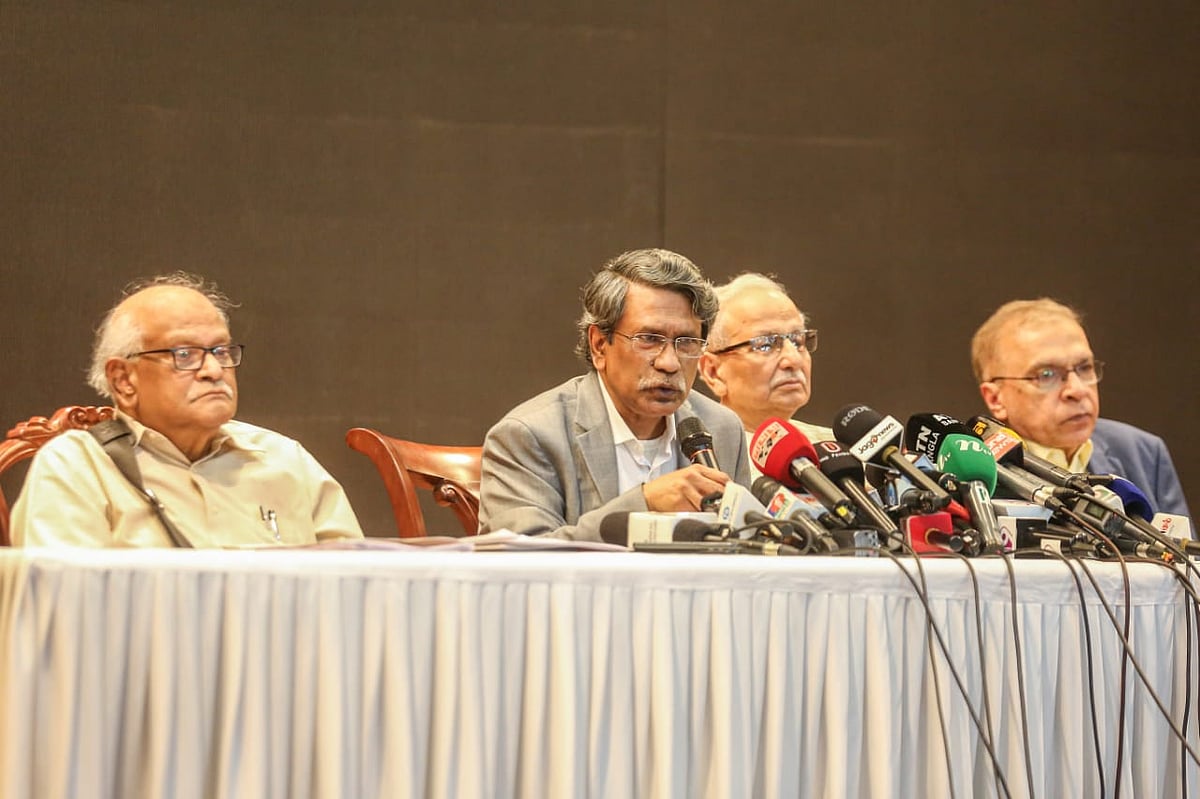
Yesterday, Tuesday afternoon, the commission submitted its recommendations to the chief adviser of the interim government, professor Muhammad Yunus. Later, at a press conference held at the Foreign Service Academy, the commission’s vice-chairman, professor Ali Riaz, presented the details.
Out of 84 reform proposals, 48 relate to the constitution. For these, the commission offered two alternative recommendations. One proposes that if the next parliament fails to implement the reforms within 270 days, the proposals will automatically be incorporated into the constitution.
In that case, the reforms will appear in the annex of the implementation order as a bill, and the referendum will cover both the order and the draft bill. The second option proposes that the referendum be held on the order itself and the constitutional reforms listed in its annex.
Under both alternatives, differing political opinions will not influence the referendum process. If the “Yes” vote wins, the constitutional reforms drafted by the commission will be implemented exactly as proposed.
Citing Turkey as an example, he said, there were 21 issues in one referendum, and it passed by a narrow margin. People voted even if they disagreed with some points. Bangladesh won’t be the first to hold a referendum with multiple issues under one question.
According to the draft order, the July National Charter (Constitutional Reform) Implementation Order and the annexed constitutional reform proposals will be presented to the people through a referendum to exercise the sovereign power of the people.
The referendum will be held by secret ballot and organised by the Election Commission. A law or ordinance will be enacted for this purpose.
Of the 84 reform proposals in the July National Charter, 48 concern the constitution.
The remaining proposals will be implemented through ordinances and executive orders, which all parties have agreed on. The main debate centres on how to implement the constitutional reform proposals, their legal basis, timing, and process.
When Will the Referendum Be Held
The BNP and several other parties have favoured holding the referendum on the same day as the next national election, using a separate ballot.
In contrast, Jamaat-e-Islami, the National Citizen Party (NCP), and a few others have preferred that the referendum be held before the election.
We have advised the government to consult the election commission, as organising a referendum falls under its jurisdiction. An ordinance will be required to facilitate this process, which will be part of the order itself. Therefore, we have not set a date.Professor Ali Riaz, National Consensus Commission vice-chairman
The National Consensus Commission did not specify a date in its recommendations. The draft order states that the referendum shall be held “at an appropriate time before the next parliamentary election to be held after the promulgation of this order, or on the same day as that election.”
In response to a question at the press conference, professor Ali Riaz said the commission has not set a specific timeframe for the referendum.
“The government may hold it at any time from the issuance of the order up to election day,” he said.
He added, “Logistically and otherwise, it’s impossible for the commission to determine whether a referendum can be held 90, 30, 45, or 46 days later. We don’t have access to necessary information, such as voter list readiness and logistical arrangements.”
Professor Riaz further said, “We have advised the government to consult the election commission, as organising a referendum falls under its jurisdiction. An ordinance will be required to facilitate this process, which will be part of the order itself. Therefore, we have not set a date.”
The referendum question
The draft implementation order specifies what question will be asked in the referendum. The referendum will primarily seek approval of the July National Charter (Constitutional Reform) Implementation Order and the constitutional reform proposals annexed to it. It will be presented as a single package and a single question.
The referendum question will read, “Do you approve of the July National Charter (Constitutional Reform) Implementation Order, 2025, and the draft constitutional amendment proposals contained in its Schedule I?”
In the alternative version, the words “draft bill” will be omitted.
When asked whether putting all 48 proposals under one question would be too complex, Professor Riaz said that referendums typically involve one or two questions, though in a few cases, countries have posed as many as five or six. “But historically, most referendums have had a single question,” he said.
He added, you should trust the people. Whenever someone says the people won’t understand, it makes him uncomfortable. It will be the government’s responsibility to explain the matter clearly and simply to every household.
When asked how a voter should respond if they agree with ten proposals but disagree with the rest, Ali Riaz replied, “The commission recommends a single-package referendum.”
Citing Turkey as an example, he said, there were 21 issues in one referendum, and it passed by a narrow margin. People voted even if they disagreed with some points. Bangladesh won’t be the first to hold a referendum with multiple issues under one question.
If the reform proposals are rejected, Riaz said, it would mean that the people have declined to approve them.
What about differing opinions
At least 36 of the 48 constitutional reform proposals include dissenting opinions from one or more political parties. The July National Charter, signed on 17 October, specifies which party disagreed with which proposal. It also notes that any political party or alliance may later act on its dissenting position if it gains the people’s mandate through elections.
However, the draft implementation order only lists the reform proposals in the annex — the dissenting opinions are omitted. The order states that the Constitution Reform Council shall complete the reforms “in accordance with the July National Charter described in Schedule I.” This means dissenting opinions will not carry weight.
When asked how dissenting opinions have been addressed, Professor Riaz said, some parties recorded notes of dissent on certain issues included in the schedule. However, the commission recommends that these matters be placed before the people for their consent. The commission gives greater importance to the people’s approval or disapproval.
Constitution reform council
According to the draft order, once the referendum approves the implementation order and the reform proposals, the next elected parliament will form a Constitution Reform Council. This council will have constituent powers to enact the amendments. Members of parliament will serve concurrently as regular MPs and as members of the reform council. The council will remain active for 270 days from the start of its first session.
The draft order states that the Constitution Reform Council shall complete the reforms “in exercise of the sovereign authority of the people” within 270 days of its first session, as outlined in the July National Charter annexed to the order. Once completed, the council’s activities will end.
When asked whether the council could modify any proposal in the charter — for example, the one that bars a prime minister from simultaneously serving as party chief —Ali Riaz explained, the council must act within the commitments of the July National Charter. The constituent power is given because fundamental reforms are being made, which an ordinary parliament cannot enact. But constituent power does not mean unrestricted authority.
Upper house
The draft order also states that within 45 days of completing constitutional reform, an upper house of parliament will be formed through proportional representation (PR) based on national vote shares.
The term of the upper house will end simultaneously with that of the lower house (National Parliament). For this election, the list of upper house candidates will not need to be published beforehand.
Implementation by ordinance and executive order
At the press conference, Professor Ali Riaz said that proposals not related to the constitution could be implemented through ordinances or executive orders. The commission recommends that such issues be implemented immediately, he said, adding that the recommendations clearly specify which items can be executed through ordinances and which through executive orders.
In response to a question, he expressed hope that political parties would take the implementation recommendations positively.
Regarding the NCP and several parties that have yet to sign the charter, Ali Riaz said, the commission hopes they will review, consider, and sign it, as the NCP and others played significant roles in drafting the July National Charter.
Present at the press conference were commission members Badiul Alam Majumdar, retired Justice Md Emdadul Haque, Ifthekharuzzaman, Md Ayub Mia, and Safar Raj Hossain; Chief Adviser’s Press Secretary Shafiqul Alam; and Special Assistant to the Chief Adviser Monir Haidar, who was involved in the consensus-building process.
The July National Charter was formulated through discussions among political parties and six reform commissions, incorporating 84 reform proposals. The discussions concluded on 31 July.
Although determining the implementation mechanism was not initially within the commission’s mandate, it began consultations with parties and experts after several — including Jamaat and the NCP — demanded clarity on how the charter would be executed. Those discussions concluded on 9 October, resulting in agreement on a referendum-based implementation process.
However, differences remained over the referendum’s legal basis, timing, and procedure. Combining these views, the National Consensus Commission formally submitted its implementation recommendations yesterday.