During the Awami League government’s 15 years in power, which ended following the student-led mass uprising, Bangladesh’s banking sector became one of the country’s biggest victims of large-scale corruption and money laundering.
During that period, the S Alam Group allegedly used political influence and the backing of state intelligence agencies to take control of seven banks and one financial institution.
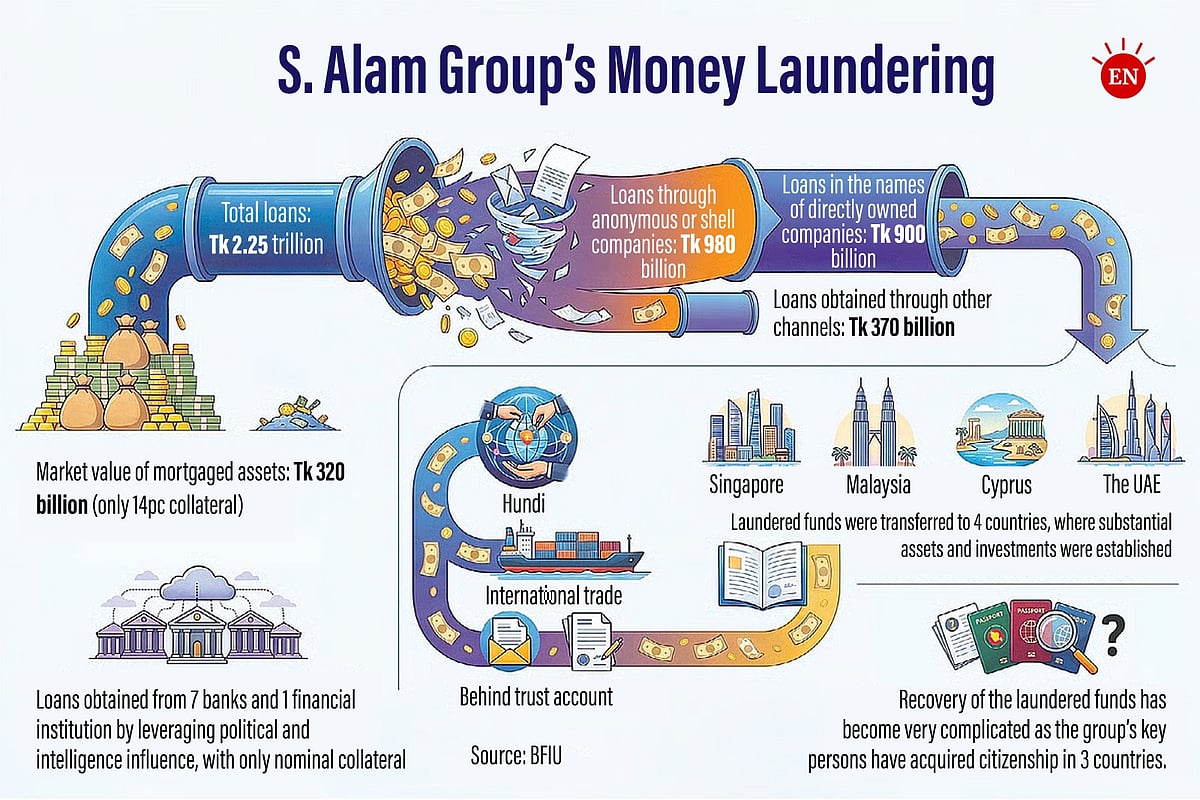
The conglomerate then reportedly embezzled and laundered nearly Tk 2.25 trillion abroad by securing loans in the names of real and fictitious companies with only nominal collateral, disregarding banking regulations.
These findings have been disclosed in the 2024–25 Annual Report of the Bangladesh Financial Intelligence Unit (BFIU). In the report, the case is presented as a case study under the pseudonym “S Group.”
However, discussions with BFIU officials confirmed that the case study refers to the S. Alam Group.
According to the BFIU report, the group’s looting of banks through fraudulent loans and the laundering of money to four countries through hundi networks and international trade represent one of the most unprecedented and systematic failures in the history of Bangladesh’s banking sector.
The report says the perpetrators used several methods, including the misuse of bank funds, embezzlement through bond transactions, abuse of public office, and manipulation of institutional controls.
The report further states that under the Awami League government, Bangladesh witnessed one of the world’s largest banking scandals. At the heart of the financial scandal were fraudulent loans, violations of banking regulations, abuse of political power, and systematic manipulation of the country’s banking framework.
Leveraging political patronage while circumventing regulatory oversight, the “S Group” allegedly built a vast network of banking fraud, financial irregularities, and money laundering.
Taking control of financial institutions
According to the report, members of the S. Alam family systematically took control of seven banks and one financial institution. They subsequently appointed family members and trusted associates to the boards of these institutions, giving the group complete dominance over internal decision-making.
The report also states that the group gained control of one of the country’s largest private commercial banks by using the influence of a state intelligence agency and high-level political connections.
Once in control of the boards, the group allegedly altered internal rules and procedures to suit its interests and approved loans for itself and its associates without effective oversight.
Looting through shell companies
The BFIU case study says that after establishing complete control over the banks, the S Alam Group began siphoning off funds through fraudulent loans.
In addition to legitimate businesses, the group allegedly created a large number of fictitious or shell companies and disbursed substantial loans in their names without conducting proper due diligence.
According to the report, the group obtained loans totaling Tk 2.25 billion from the banks under its control. Of this amount, Tk 900 billion was borrowed in the names of 43 companies, Tk 980 billion was obtained through anonymous or shell companies, and the remaining Tk 370 billion was secured through other means.
The BFIU states that these enormous loans were approved against only nominal or inadequate collateral. Loans totaling Tk 2.25 trillion were backed by mortgaged assets with a market value of only Tk 320 billion.
Money laundered through hundi and trade
The BFIU says the funds extracted from the banking system were transferred abroad through highly sophisticated money laundering schemes.
According to the report, the S Alam Group primarily used trust accounts, international trade transactions, and informal hundi networks to move the money overseas.
The report states that the group used the laundered funds to acquire substantial assets in Singapore, Malaysia, Cyprus, and the United Arab Emirates (UAE). It also maintained strong links with offshore jurisdictions known for weak financial oversight.
In addition, the report notes that the group’s key persons have obtained citizenship in three different countries, making the legal recovery of the laundered assets significantly more complicated. Their overseas businesses allegedly served as secure destinations for illicit funds under the cover of international trade, hundi operations, and expatriate remittance services.
To seek the group’s response to the allegations contained in the BFIU report, Prothom Alo emailed the S Alam Group on Saturday requesting its comments. However, as of Tuesday, the company had not responded to the email.